
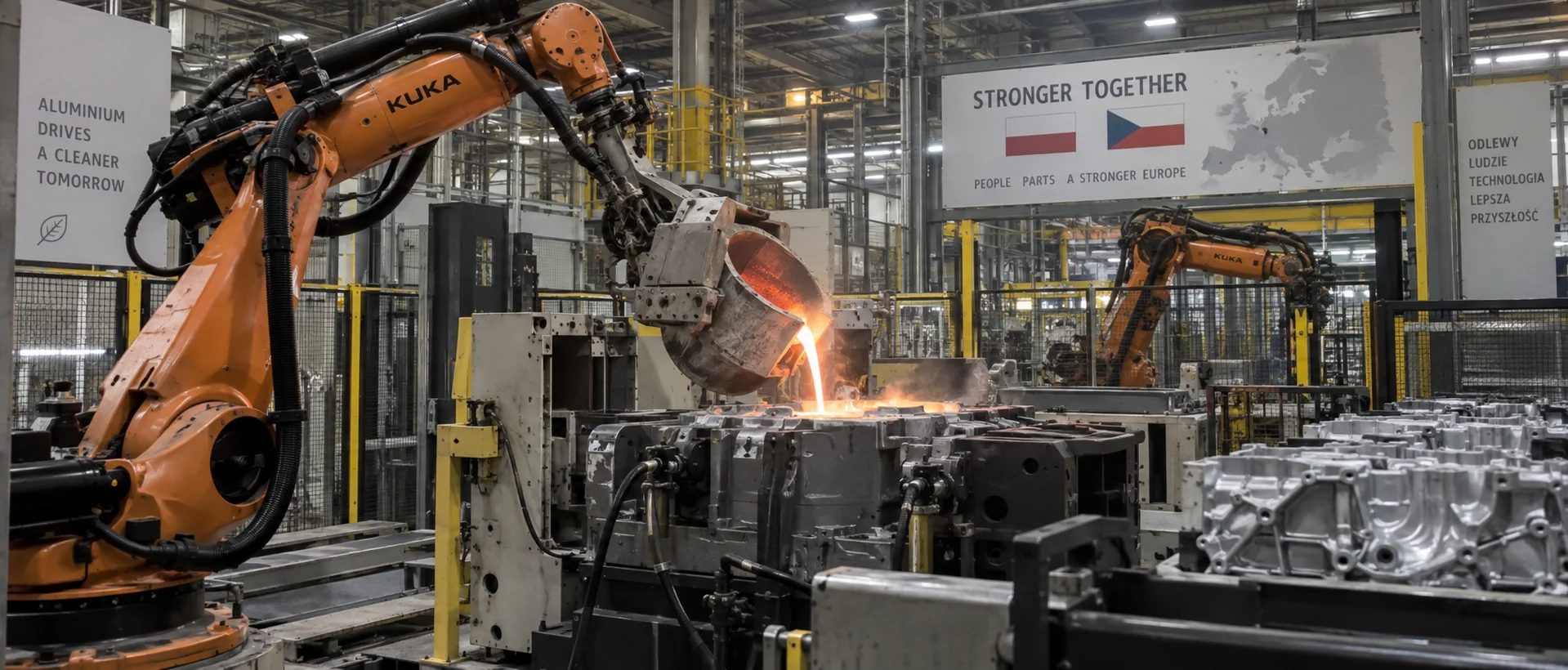
Over the past decade and more, the spatial map of European manufacturing has been quietly redrawn. The instinctive first reaction is “Germany’s factories moved east.” But what has actually happened is both more complex and more interesting: it is closer to a new regional division of labour. Germany, France and Italy continue to hold on to R&D, engineering, core manufacturing and customer-facing functions, while Poland, Czechia, Hungary and Slovakia — drawing on geography, an existing industrial base, labour and access to the EU’s single market — absorb a growing share of the manufacturing, component and supply-chain layers.
Within that process, Poland and Czechia are the two most representative cases. Both are tightly interlocked with the German and Western European industrial system, and each has grown a complete automotive and industrial manufacturing base of its own. For the die-casting industry, that means a rising share of aluminium die casting, machining, surface treatment, tooling and component projects can find their corresponding industrial foundations somewhere inside this Central and Eastern European network.
So understanding Poland and Czechia is never about finding two more “cheaper locations.” It is about answering a more fundamental question: what kind of supply-chain network is European manufacturing actually turning into?
Why these two countries: three cards beyond cost
Poland and Czechia became nodes on far more than the single word “cheap.”
The first card is geography. Both countries sit directly east of Germany and Western Europe’s main industrial markets, which keeps logistics distances short. For automotive components, industrial equipment and anything sensitive to lead time, a supplier sitting closer to its customer can shave real cost off transport cycles and cross-border coordination.
The second is institutions. Both are full members of the EU’s internal market. For a European company, building capacity in Poland or Czechia does not mean stepping into a wholly separate trading regime — it means carrying out cross-border production and procurement inside the EU. Tariffs, standards and customs friction are institutionally stripped out.
The third card, and the most easily underestimated, is the industrial base that already exists. ACEA data shows Poland and Czechia hold roughly 209,000 and 172,000 direct automotive manufacturing jobs respectively, both near the top among EU member states; direct automotive manufacturing employment in Czechia accounts for 13.4% of the country’s entire manufacturing workforce, again among the highest in the EU. In other words, what Poland and Czechia absorb today is no longer just “production capacity” — it is an integrated set of manufacturing processes already embedded in Europe’s automotive and industrial supply chains.
Poland: weaving scale into a network
What most separates Poland from the rest of Central and Eastern Europe is its size and coverage.
It has a sizeable domestic economy and has grown multiple manufacturing clusters at once — automotive components, machinery, electronics, batteries, industrial equipment — of which automotive is the most representative. The Polish Investment and Trade Agency (PAIH) describes Poland as the world’s seventh-largest exporter of automotive parts, with Polish companies already supplying components and related technology to global markets.
For die casting, that foundation has direct meaning. Automotive structural parts, motor housings, transmission and drivetrain components, brackets, pump bodies and all manner of aluminium functional parts feed into demand for high-pressure die casting, low-pressure casting, machining and post-processing capability — and this demand is not prospective, it is already hanging on the existing chain.
Poland is also still absorbing new industrial investment. PAIH figures show that in 2025 it supported the completion of 64 investment projects with a total declared investment of more than €4 billion, of which 42 were production projects declaring over €3.6 billion. Not all of that investment touches die casting directly, but it says one thing plainly: Poland’s manufacturing base is still expanding and still upgrading.
For a die-casting company, the question to ask is not “is Poland a low-cost country?” It is that Poland has already assembled a meaningful mass of downstream manufacturing customers and supporting suppliers, enough to run a complete chain from casting through machining and assembly to the final customer.
Czechia: the workshop embedded deep inside Germany’s industrial system
If Poland’s defining trait is scale and coverage, Czechia’s other label is a deeper industrial tradition and a highly concentrated automotive, machinery and engineering base.
Czechia has long been part of the German and Central European manufacturing network. Automotive, machinery, electrical equipment and industrial components all occupy a heavy position in its industrial landscape. This industrial linkage shows up most clearly in automotive component trade — data from Germany Trade & Invest (GTAI) shows that in 2025 Czechia imported roughly €17.93 billion worth of automotive parts, of which about €5.85 billion came from Germany, roughly a third.
That single set of numbers points to one conclusion: rather than reading Czechia as an independent manufacturing market, it makes more sense to see it as a production node inside the German and Central European industrial system.
For die casting, that industrial structure carries value in its own way. Aluminium die-cast parts rarely exist as standalone products; they are always tied to tooling, machining, heat treatment, surface treatment, assembly and the engineering system of the end customer, together forming a single supply chain. A considerable number of Czech companies have long-term manufacturing experience across exactly those stages, which is why Czech competitiveness shows up more in industrial coordination and specialised manufacturing capability than in production cost alone.
That said, Czech manufacturing is under pressure. GTAI notes that weak demand from European automotive plants has already hit some Czech suppliers, with some companies even beginning to close production sites; at the same time, automation and new-energy-vehicle related investment continues to advance. This is a reminder that Central and Eastern European manufacturing is not growing in a single direction — it is rebalancing against the backdrop of the EV transition, shifting European automotive demand and rising costs.
Two kinds of division inside one network
From the perspective of the European supply chain, Poland and Czechia are not simply competitors.
| Dimension | Poland | Czechia | What drives it |
|---|---|---|---|
| Manufacturing scale | Larger domestic market, broad coverage | Deep industrial base, higher concentration | One trades on breadth, the other on density |
| Automotive | Larger component manufacturing and export volume | Automotive occupies a higher share of manufacturing | One runs on volume, the other on dependence |
| German supply chain | Close ties to German and Western European markets | Exceptionally close ties to the German industrial system | One is market-adjacent, the other is system-embedded |
| Die-casting demand | Automotive, machinery, electronics, industrial equipment | Automotive, machinery, engineering | One demand is broader, the other more specialised |
| Supply-chain character | Emphasises scale, coverage and investment absorption | Emphasises industrial base, specialisation and regional coordination | One is expanding, the other is deepening |
That is why I have never been convinced by the tidy binary of “Poland for scale production, Czechia for specialised production.” Whether a specific project is competitive still comes down to equipment capability, alloy systems, tooling capability, machining level, quality systems, delivery capability and distance to the end customer — and those variables matter far more than “which country."
"Eastward shift” is a misreading: what Europe is doing is regional division
“The eastward shift of European manufacturing” has become a common phrase in recent years. But reading it only as “German factories moving to Poland and Czechia” misses what is actually changing in the European supply chain.
The more accurate description is that European industry is growing into a more transnational regional division. Germany remains one of Europe’s most important automotive and industrial manufacturing centres, while Poland, Czechia and the other Central and Eastern European countries absorb more of the production, component and supply-chain layers. ACEA data shows that Central and Eastern Europe now accounts for about a third of the EU’s vehicle production and provides around two million jobs across the automotive value chain.
What this means is that European manufacturing is moving from a relatively concentrated production model toward a more dispersed, more cross-border and more collaborative network. For die casting this is especially true: a single aluminium automotive component project might complete product development and customer certification in Germany, carry out casting and machining in Czechia or Poland, finish assembly in another European country, and finally supply vehicle makers and Tier-1 suppliers in Germany, France or Spain. The boundary of a supply chain is no longer the same thing as the boundary of a country.
The next round of die-casting competition is not about tonnage, but about systems
New-energy vehicles are rewriting the product structure of Europe’s die-casting industry. Electric drive systems, battery systems, thermal management systems and body structural parts still carry hard demand for aluminium castings; high-pressure die casting, large structural parts, integrated forming and automated production are changing how traditional die-casting companies compete.
But that does not mean every European die caster will charge headlong into large-scale integrated casting. For the large mass of small and medium-sized enterprises, the more realistic competition still centres on a handful of things: casting stability and process control, tooling and product engineering capability, machining and post-processing capability, flexible small-batch and high-variety production, quality traceability and customer responsiveness, and the ability to coordinate with vehicle makers and Tier-1 suppliers.
So the opportunity in Poland and Czechia does not rest on the single boom of “large-scale integrated casting.” It rests far more on the sustained, ongoing demand for aluminium castings across the whole component-manufacturing system.
What this means for Chinese suppliers
For Chinese die casters, the rise of Poland and Czechia deserves attention — but there is no need to rush to read it as “Chinese manufacturing is being replaced by European manufacturing.”
The two operate under very different competitive conditions. Chinese companies carry strong industrial foundations in die-casting equipment scale, tooling, supply-chain completeness, automation application and experience with new-energy-vehicle products. The one real moat held by Central and Eastern European suppliers is that they sit closer to European customers and integrate more easily into Europe’s local production system.
So the competition of the future is unlikely to be a zero-sum “European manufacturing vs. Chinese manufacturing.” It will be a recombination around cost, technology, delivery, customer responsiveness and supply-chain coordination. For Chinese die-casting companies, competition in the European market is also shifting from “can you produce it” toward “can you keep serving European customers” — on-site customer support, technical communication, quality-issue handling, commercial coordination and cross-border supply-chain management all carry growing weight.
What you can see from Poland and Czechia is a trend that keeps getting clearer: European manufacturing is becoming more regionalized, and the European supply chain is becoming more transnational. The value of these two countries has never been just that labour costs are relatively competitive — it is that they have become an inseparable part of the German and Western European manufacturing system.
For the die-casting industry, the thing to watch is no longer just which country’s capacity is growing fastest. It is which countries are forming new customer clusters, which regions are forming new supply-chain nodes, and how those nodes coordinate with one another — that is the real vantage point for understanding where European die casting goes next.
For Chinese manufacturing companies, what truly needs to be built is not just the ability to “find a production base in Europe,” but the ability to read the European supply chain, to enter the European customer system, and to keep delivering stable supply and local responsiveness across a cross-border chain.
The change in European manufacturing, in the end, is not a simple migration from west to east. It is growing into a more dispersed, more specialised and more transnational industrial network — and Poland and Czechia happen to be the two clearest windows through which to watch that change unfold.
Data sources: ACEA automotive manufacturing employment and production data, Polish Investment and Trade Agency (PAIH) investment and export data, Germany Trade & Invest (GTAI) Czech automotive component trade data. Some figures are industry-scale estimates.