
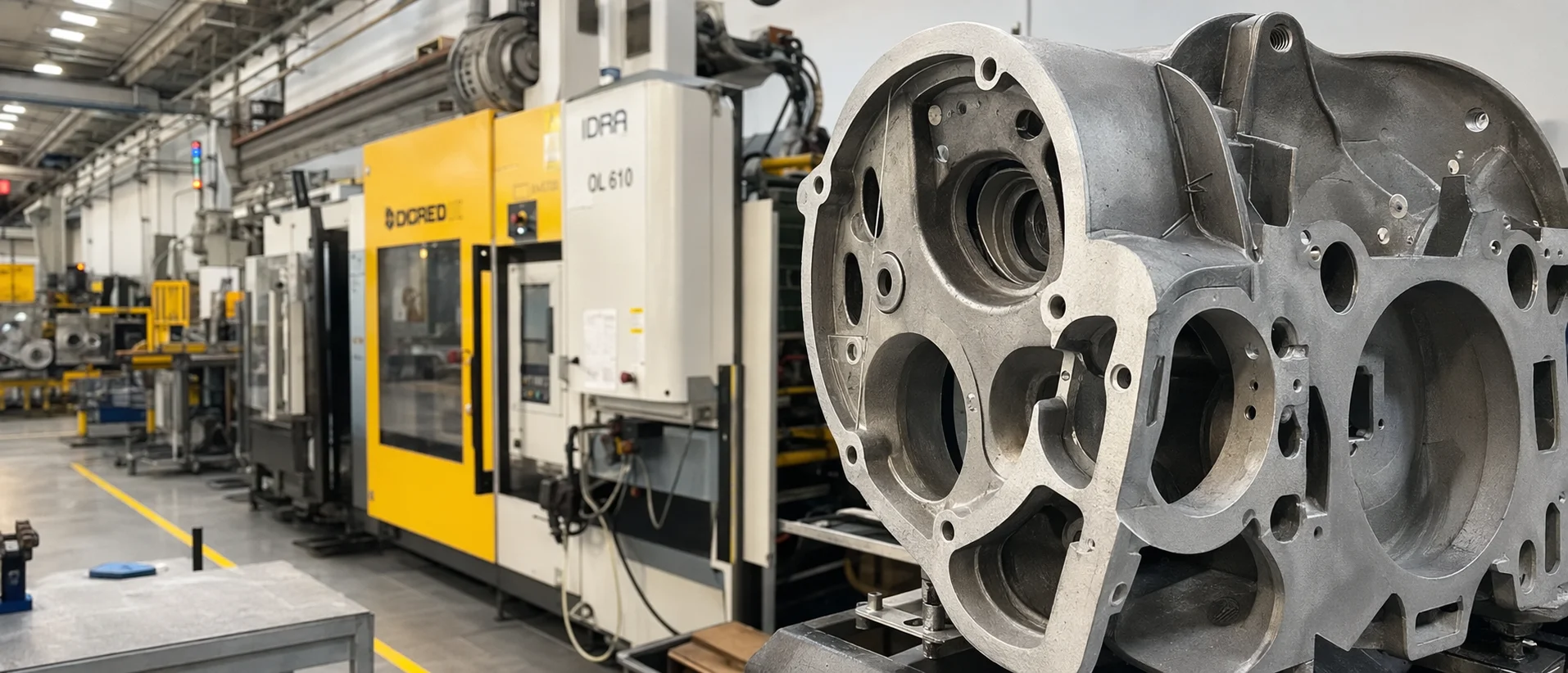
At every EUROGUSS trade fair, the Italian pavilion is the second-largest national presence after the host country, Germany. But sit down with an Italian foundry owner and you quickly realise their mindset has little in common with their German counterparts. The Germans are talking about gigacasting tonnage races, industrial electricity prices, and carbon border taxes. The Italian is more likely to tell you about the year his grandfather opened the shop, the surface-finishing protocol for a Ferrari chassis component, or why a Brescia foundryman spends an entire career mastering a single process.
That difference is not a quirk. It is the key to understanding Italian die casting.
Italy’s foundry sector does not compete on the same axis as Germany’s. Trying to read it through a German lens — more tonnage, more automation, more consolidation — will lead you to entirely the wrong conclusions about where its strengths lie and why they are so hard to replicate. (For a structural analysis of the German aluminium die-casting industry, see “Germany’s Aluminum Die-Casting Industry: Megacasting Growth and the KMU Transformation Challenge”.)
1. Brescia: A City That Has Been Shaping Metal for Five Centuries
Italian die casting is overwhelmingly concentrated in the north, specifically in the province of Brescia in Lombardy. This is not an accident of industrial geography. Brescia has been a centre of metalworking since Roman times — first as an armoury for the legions, then as Renaissance Europe’s most prestigious producer of firearms and armour, and later, after the Industrial Revolution, as the mechanical heartland of northern Italy. In 2015, a joint study by the Edison Foundation and Confindustria ranked Brescia as the province with the highest industrial value-added in Europe. Not somewhere in Baden-Württemberg. Not somewhere in Bavaria. Brescia.
Today, within a radius of roughly 1.3 million people, several hundred foundries and metal-processing firms operate in Brescia and its surroundings. Most are small by international standards — fifty to three hundred employees is typical — but their specialisation runs extraordinarily deep. Family ownership is the default mode, and many shops are now in their third or fourth generation.
Brescia does not just make cast parts. It makes the machines that make cast parts. Over sixty percent of the world’s large die-casting equipment traces its roots to two companies: Italpresse and Idra. Both were born in Brescia. Italpresse was later acquired by Denmark’s Norican Group; Idra was bought by China’s LK Group. But their R&D centres and core manufacturing capabilities remain firmly embedded in Brescia’s industrial soil. This is the most distinctive feature of the Italian die-casting ecosystem: it produces both the components and the production equipment. Process knowledge and machine-building capability feed each other in a closed loop that no other European cluster can match.
2. Production Is Shrinking — but the Story Is More Interesting Than That
On paper, the Italian foundry industry’s recent trajectory looks unflattering. Total casting output fell from roughly 2.3 million tonnes in 2019 to around 2.0 million tonnes in 2024. The second quarter of 2025 saw another 5.9% year-on-year decline. Fabio Zanardi, president of Assofond, the Italian foundry association, has repeatedly expressed concern about the sector’s outlook in public statements.
But treating total tonnage as the headline statistic misses what makes Italian die casting worth paying attention to.
Italy’s product mix is structurally different from Germany’s. The German aluminium die-casting sector runs on high-volume automotive series production — engine blocks, transmission housings, oil-pump bodies. Large parts, large batches, relentless price pressure. Italy certainly produces automotive components, but its core customers are not Volkswagen and Opel. They are Ferrari, Lamborghini, Maserati, Alfa Romeo, and Ducati.
This matters because it changes the entire quality framework a foundry operates under. A Ferrari engine mount must pass all mechanical property tests — and it must look beautiful doing it. Visible flow lines are unacceptable. Draft angles must be finished to a near-polished standard. This is not vanity. It is the business model of Italian automotive manufacturing: these companies do not sell transportation appliances, they sell objects of desire. And the foundries that supply that ecosystem have developed an entirely different set of quality instincts and production rhythms as a result.
The byproduct of this logic is revealing: Italian die casters typically earn far higher margins per part than their German peers, but their total volumes and revenues are considerably smaller. In a global industry narrative obsessed with scale, Italy’s path is less visible. Its moat, however, may be considerably deeper.
3. Energy and Geography: Less Painful Than Germany, but Far From Easy
During the 2022 energy crisis, Italian foundries faced less severe pressure than their German counterparts, but nobody would describe the situation as comfortable. Italy’s dependence on Russian pipeline gas was lower than Germany’s — Algerian gas arriving through the TransMed pipeline, combined with spot-market LNG purchases via several regasification terminals, gave the country a more diversified energy mix. But that diversification was a safety cushion, not a free pass. Italian industrial electricity prices still doubled or tripled during the 2022–2023 peak.
The more persistent headache for Italian foundries is Turkey. Around 2024, Turkey — powered by lower energy costs, a weaker currency, and more flexible labour arrangements — overtook Italy to become Europe’s second-largest casting producer. Turkish foundries have not only captured market share in the mid-to-lower-tier segments that Italian shops once dominated, but have also established direct price competition in Eastern European and German markets.
Italy’s response is not a price war. It cannot afford one. The strategy is to keep climbing: more complex parts, tighter tolerances, harder-to-substitute components — staying above Turkey’s effective range.
4. Gigacasting: Italy Is in the Game, Just Quietly
European gigacasting headlines have long been dominated by German names — Handtmann, BMW Landshut, VW Kassel. Italy’s profile in this conversation has been conspicuously low. But that does not mean Italy is absent.
In November 2025, FOMA (Fonderia Manganese), based in Lombardy, commissioned Italy’s first 4,600-tonne large die-casting cell — built by Italpresse, Italian-designed, Italian-installed. This is not a pilot experiment. It is a production-ready line that has already begun producing sample parts. FOMA’s move places Italy squarely in the front row of Europe’s gigacasting second tier.
Equally significant is the footprint Chinese equipment manufacturers are building in Italy. Haitian — one of China’s largest injection-moulding and die-casting machine builders — has established an assembly line in Brescia. This signals two things at once: that the Italian market is itself a buyer of Chinese equipment, and that Italy is becoming the bridgehead for Chinese die-casting machinery manufacturers entering Europe. Brescia’s foundry craftsmen will be calibrating machines shoulder-to-shoulder with Chinese engineers on their home turf.
5. What This Means for Chinese Suppliers
For Chinese die casters and equipment manufacturers looking to enter the European market, Italy is neither the easiest path nor the least interesting one.
The hard part first. Italian customers’ expectations around surface quality, cosmetic consistency, and the flexibility to deliver small batches of high-variety parts routinely exceed what German customers demand. In Germany, you can succeed by meeting the specification. In Italy, you may need to exceed it — because the customer’s aesthetic standard is not captured in a drawing; it lives in a designer’s eye.
The opportunities are equally real. First, the equipment market: Italy is both a global manufacturing hub and a global consumption hub for die-casting machinery. The supply chains of Italpresse and Idra themselves contain substantial volumes of casting and machining demand. A Chinese supplier that establishes a foothold in the Brescia cluster gains access to the global high-end die-casting equipment supply chain — a credential that opens doors far beyond Italy.
Second, Italian family-owned foundries are undergoing a generational transition. Many third- and fourth-generation heirs have limited interest in — or capability for — running a foundry. This creates a window for external partnerships and acquisitions that did not exist a decade ago.
Third, Haitian has already built in Brescia. The path is demonstrably viable. The question is not whether it can be done, but who will do it and how.
Italian die casting is not “Europe’s low-cost option.” That role belongs to Turkey. Italy’s role is something harder to price and harder to displace: the guardian of European precision casting and a century-long aesthetic tradition. In a global supply chain that grows more homogeneous by the year, that kind of irreplaceability may be the most durable competitive barrier of all.
Data sources: Assofond industry briefings, WFO Global Foundry Census, NürnbergMesse EUROGUSS historical data, GIESSEREI magazine, Foundry Planet industry reporting, CAEF European Foundry Association. Some figures are industry-scale estimates.