
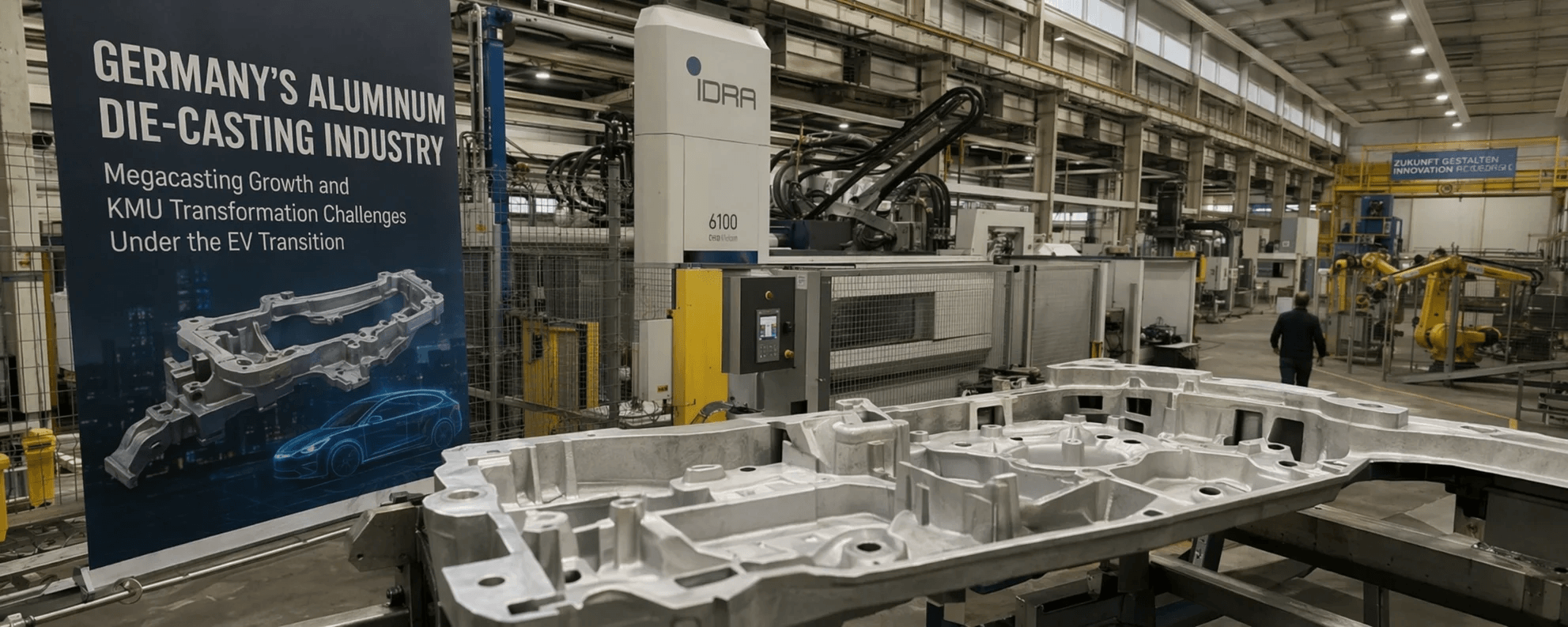
Germany is Europe’s largest economy and its traditional manufacturing powerhouse. By volume, the country consumes more aluminum die-cast components than any other European market — roughly 27% of the continent’s total. That number, taken on its own, is respectable but not earth-shattering. But layer on top of it two variables — volatile energy prices and the structural overhaul of the automotive powertrain — and what you get is not a cyclical dip. What Germany’s domestic die-casting sector is living through right now is a fundamental reordering of the competitive landscape, and it is unfolding faster than most industry observers expected.
In the internal combustion era, the profit model for German die casting was straightforward: high-volume, multi-variant powertrain parts — engine blocks, transmission housings, oil-pump bodies — formed the bedrock of capacity utilization across the industry. That bedrock supported an entire ecosystem of small and medium-sized family-owned firms — KMUs (Kleine und mittlere Unternehmen) in the German lexicon. These were, and in many cases still are, operations of a hundred to three hundred people, running a handful of presses in the 1,000-to-3,000-ton range, reliably feeding Tier-1 suppliers and OEMs in their regional orbit.
The electric vehicle has blown up that model. Not overnight, but faster than a lot of people had penciled into their three-year plans.
1. Who Is Buying Germany’s Aluminum Die-Cast Parts? — A Breakdown of the Demand Side
In 2025–2026, Germany’s aluminum die-casting market for automotive and industrial applications sits at roughly $2–2.3 billion. The buyer structure is not especially convoluted. Five segments account for virtually all of it.
Automotive & transportation (~65–70%). The undisputed heavyweight. Passenger cars alone represent about 76% of this slice. Traditional ICE powertrain components — engine blocks, transmission cases, and the like — are gradually declining in absolute volume but still command roughly 39% of the market. That number is worth sitting with for a moment, because it captures the industry’s current predicament in a single statistic: the new demand hasn’t grown up yet, while the old demand is already shrinking. The sector is navigating a transition corridor where legacy volumes are decaying faster than BEV-related volumes are ramping.
Industrial machinery & automation equipment (~10–15%). The second-largest buyer bloc. The spend here goes into robot-arm joints, servo-motor housings, gear-reducer casings, and similar precision components where thermal dissipation and dimensional accuracy are non-negotiable. This demand stream is relatively steady and largely decoupled from the automotive cycle — a small mercy for suppliers diversified into it.
Power & new energy (~10–13%). The high-potential growth vector. Driven by Europe’s net-zero policy momentum, procurement of solar-inverter housings, wind-turbine control boxes, and EV charging-station core castings is climbing. The growth rates are eye-catching — but the absolute tonnage is still nowhere near enough to offset the structural bloodletting happening in automotive.
Construction & infrastructure (~8–9%). Mainly high-end door and window hardware, curtain-wall connectors, and architectural fittings. European circular-economy legislation has made castings with high recycled-aluminum content particularly attractive in this segment. The German construction market is renovation-heavy rather than new-build-driven, so demand is stable but modest in scale.
Aerospace & high-end electronics. Tiny by tonnage, lucrative by margin. This corner of the market sits in the hands of a handful of specially certified shops and contributes little to the broader capacity-utilization story — but everything to the narrative around where value-add lives.
Grasping this demand structure is essential to understanding the polarization we will get to shortly, because the structural displacement happening within the automotive segment is the engine driving the entire shakeout.
2. Core Indicators, 2024–2026: Tonnage Is Shrinking, but the Value-Density Is Rising
Data from the BDG (German Foundry Association) and industry-validated estimates paint a picture that feels counterintuitive at first glance: domestic output is stabilizing — or even contracting — in tonnage terms, yet the value per kilogram leaving German plants is climbing.
| Indicator | 2024 (Revised) | 2025 | 2026 (Estimate) |
|---|---|---|---|
| Domestic revenue | ~$2.9–3.2B | ~$2.5–2.9B | ~$2.6–3.0B |
| Annual output (aluminum die-cast parts) | ~400 Kt | ~370–380 Kt | Stabilizing at low levels (~370 Kt) |
| Capacity utilization (traditional lines) | ~75–80% (overall) | ~75% (overall), ~50% for smaller presses | Divergence widening (traditional weak, high-end tight) |
| Megacasting trajectory | Early-stage deployment | Accelerating rollout | Explosive growth (~33% CAGR) |
There is a statistical trap hiding in this table, and it pays to call it out explicitly. The headline “tonnage is falling but revenue is holding” reflects something more consequential than a simple price increase: the product mix is shifting, decisively, from low-unit-price small parts to high-unit-price large structural components. A single 60-kilogram megacast rear underbody carries a much higher factory-gate price per kilogram than a bin full of 2-to-3-kilogram traditional brackets and housings. Shrinking tonnage does not automatically equal a proportional erosion of industry value-add.
But — and this is the part that separates the winners from the casualties — that statement is only true if your plant is equipped to take the large-part work. For the vast majority of KMUs, that condition does not hold.
3. Two-Speed Industry: Polarization Is Not a Metaphor — It Is the Operating Reality
Germany’s domestic die-casting capacity is undergoing a violent structural adjustment, and the shape of it is a tale of two industries moving in opposite directions. This is not a mild story about “the gap widening between strong and weak.” This is a hard sort: winner-takes-most, the rest get pushed to the exit.
The Tier-1 Heavyweights: Building a Moat on New-Energy Megacasting
Heavy HPDC (high-pressure die casting) in the 4,000-to-9,000-ton range, along with vacuum die-casting capacity, is experiencing explosive growth on German soil. Handtmann, one of the country’s die-casting giants, has already commissioned a full-scale megacasting production line — the kind of installation that, as recently as three or four years ago, sat squarely in the “experimental project” category inside most industry roadmaps.
Driven by the demanding requirements of battery-tray housings and body-in-white structural components — high strength, near-zero porosity — vacuum die-casting capacity in Germany is expanding counter-cyclically at a compound annual growth rate exceeding 5.4%. In a market where overall production tonnage is contracting, this is one of the very few sub-segments swimming against the current.
The headline names — Martinrea Honsel, KSM Castings Group, Handtmann — are not surviving the cost squeeze through luck. They are leaning on three structural advantages that smaller competitors simply cannot replicate.
First, deeply embedded aluminum-price and energy-cost pass-through mechanisms negotiated with OEMs like Volkswagen and BMW. When ingot prices spike or industrial electricity rates surge, a portion of that pain flows downstream to the customer rather than lodging entirely on the foundry’s P&L.
Second, a global manufacturing footprint. Profits generated in North American or Chinese plants can cross-subsidize domestic technical R&D and capital expenditure in Germany.
Third, a genuine technology moat. High-volume, high-yield megacasting is not a problem you solve by writing a check for a bigger machine. The soft capabilities — runner and gate design, thermal-balance control, defect-prediction modeling — are built over timelines measured in decades, not quarters. The mold doesn’t just have to fill; it has to fill the same way, every cycle, across hundreds of thousands of shots. That institutional knowledge is not portable and not easily bought.
The KMUs: Caught in a Low-Utilization, High-Cost Vise
If the heavyweights are expanding against the wind, the KMU segment is the other side of the coin — and it is brutal.
Order-book collapse meets cost-structure blowout. The small-to-medium traditional ICE parts that formed the livelihood of these firms — throttle-body housings, oil-pump bodies, small brackets and mounts — are being methodically erased from vehicle architectures by electrification. At the same time, die casting is an energy-intensive process by its nature, and small and mid-sized plants have virtually zero bargaining power when facing Germany’s elevated industrial electricity prices. Layer on top of that consecutive base-wage increases negotiated by IG Metall, the powerful metalworkers’ union, and fixed processing-cost structures have ballooned by more than 30%.
Three blows, landing simultaneously: fewer orders, higher electricity bills, rising labor costs.
Utilization crashes through the viability floor. Across the 1,000-to-3,000-ton press segment, capacity utilization has collapsed to around 50% in large swaths of the industry. For a die-casting shop in this tonnage class, 50% utilization is not “tight but manageable.” It is cash-flow negative. Fixed costs — energy base charges, labor contracts, equipment depreciation — do not scale down proportionally when you run fewer shifts. The arithmetic gets ugly fast.
Restructuring and consolidation accelerating. The past 18 to 24 months have brought a wave of insolvencies and forced restructurings. A particularly emblematic case is Behringer, a subsidiary of the well-known precision die-caster Druckguss Westfalen. Hit by the cost crisis, the company was forced into insolvency protection and ultimately underwent an asset sale and carve-out. In an industry upcycle, a firm with decades of operating history and a reputation for precision does not go down easily. At this point in the cycle, history offers no shield.
KMUs starved of orders and cash flow cannot fund the investment needed to automate or pivot toward vacuum die-casting. And the longer they go without making that pivot, the less qualified they become to win high-value-add work. It is a self-reinforcing downward spiral, and once you are in it, climbing out requires capital that most of these firms no longer have.
4. The Overseas Supplier Window: A Sourcing Vacuum — with Strings Attached
The closures and capacity withdrawals among German KMU die-casters have produced a knock-on effect that is beginning to ripple through supply chains: Tier-1 buyers and industrial OEMs in Germany are finding it increasingly difficult to source small-to-medium cast parts domestically at a combination of price and reliability that works. A sourcing vacuum is opening, and it is real.
For overseas suppliers eyeing the German market, the window is genuine — but it is not an open door. It is a door with a bouncer, a dress code, and a very long guest list to get onto.
The core opportunity is real. German buyers are actively scouting globally for die-casting partners that can deliver cost-competitive pricing and supply-chain stability. Asian and Eastern European suppliers are the most direct beneficiaries of this trend — the former on cost structure, the latter on geographic and logistical proximity. Germany’s domestic industrial power prices show no sign of returning to pre-2021 levels in any reasonable timeframe, which structurally erodes the cost-competitiveness of “Made in Germany” in standard and medium-complexity cast parts. That is not a cyclical headwind that will reverse; it is a permanent fixture of the competitive landscape going forward.
But the bar is not low. A German Tier-1 supplier qualification process normally runs 12 to 18 months, and IATF 16949 certification is merely the price of admission. The real time sink is the gauntlet of simultaneous-engineering capability validation, series-production consistency audits, and on-site process audits under VDA 6.3. A Chinese die-casting plant that shows up with “competitive pricing and decent quality” will not get through these gates. What is needed is a complete quality architecture — from APQP through PPAP, from PFMEA through MSA — that can run end-to-end and withstand scrutiny at every checkpoint.
For Chinese die-casters that have already cleared Tier-1 qualification and have series-production delivery experience, the current German market window opens along two dimensions.
The first: step in and absorb the small-to-medium part orders that German KMUs are abandoning, competing on value-for-money and delivery reliability.
The second: plug into Europe’s gigacasting capacity gap by embedding into the synchronous-development ecosystem for large structural components. This path takes longer to pay off but builds stickier, harder-to-displace customer relationships.
Meanwhile, trade-policy risk is accumulating. The BDG has made multiple representations to Berlin and Brussels voicing concern about “import pressure from Asian suppliers.” If, in the coming years, the EU expands the Carbon Border Adjustment Mechanism (CBAM) to cover aluminum castings, or opens an anti-dumping investigation, the “pure export” model — ship from a low-cost jurisdiction directly to a European customer — will be the first to feel the impact. In this shakeout, the suppliers that ultimately win will not necessarily be the cheapest. They will be the ones that manage to thread the needle across three lines simultaneously: quality-system rigor, delivery stability, and trade-compliance readiness.
Data in this article is drawn from the German Foundry Association (BDG), the German Federal Statistical Office (Destatis), the industry publication GIESSEREI, and publicly available estimates from relevant market-research institutions. Figures for 2024–2026 represent industry estimates; final official data may see marginal adjustments.