
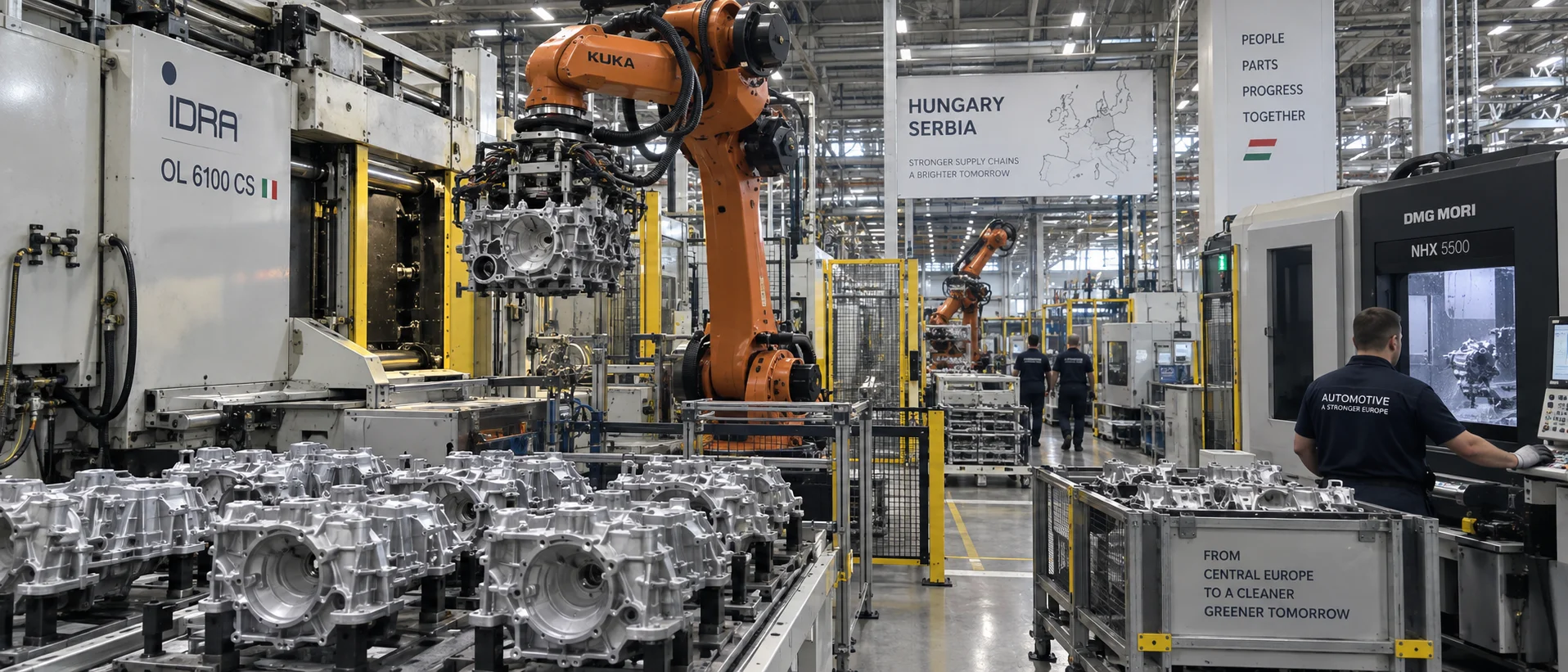
Hungary and Serbia are turning into two Central and Eastern European nodes of Europe’s automotive supply chain that are increasingly worth watching. But the two countries do not start from the same foundation. Hungary has already grown a mature OEM and Tier-1 supply system, deeply embedded in the German and EU automotive chain. Serbia, by contrast, has relied mainly on international investment to build up its automotive parts manufacturing capability step by step.
For the die-casting industry, what is actually worth watching is not how many new manufacturing projects these two countries have added, but what kind of aluminium parts, casting, die-casting and machining demand those projects are generating — and how much of that demand is shifting from imports toward localisation.
The answer to that question is worth far more than an investment list.
Hungary: welding new energy onto a mature old chain
Hungary’s automotive industry did not appear overnight.
Audi, Mercedes-Benz, Suzuki and BMW already have production operations there, and international Tier-1 suppliers such as Bosch, ZF, Magna and BorgWarner have set up production or R&D activities in the country. Industry figures from the Hungarian Investment Promotion Agency (HIPA) for 2026 show that Hungary hosts more than 700 automotive-related companies, of which around 70 are Tier-1 suppliers; in 2024 the country produced roughly 437,000 vehicles and about 2 million engines. The automotive industry has long been a major pillar of local manufacturing.
On top of that foundation, new energy is layering fresh supply-chain demand. In recent years, investment in electric vehicles, batteries, e-drive systems, automotive electronics and related components has kept flowing into Hungary, so that the existing automotive chain is beginning to sprout new product categories and new supplier requirements. Data from MERICS and the Rhodium Group show that China’s direct investment into Europe (EU plus UK) reached €16.8 billion in 2025, of which Hungary attracted around €3.9 billion, once again ranking first in Europe; over the same period, Chinese investment in Europe’s automotive sector came to roughly €7.6 billion, 93% of it concentrated in the new-energy-vehicle supply chain.
None of this means Hungary’s traditional automotive industry is being replaced by new energy. The more accurate description is that the existing supply chain is adding new products and new supplier demand.
For die casting, the specific categories worth tracking include e-drive housings, electronic-control housings, thermal-management components, structural parts and the various aluminium functional parts. As these products enter the local production system, demand for aluminium castings, die casting, machining and downstream assembly capability is pulled up along with them.
Serbia: the casting foundation is there, but die casting still needs time
Compared with Hungary, Serbia’s automotive base and structure are a different matter.
Figures from the Development Agency of Serbia (RAS) show that the country’s automotive industry has already formed a manufacturing system centred on automotive components, covering tyres, wiring harnesses, wiper systems, metal parts and engine-related products; international companies such as Bosch, Continental, ZF, Brose and Magna are also already carrying out production or related business there.
Casting has also started to enter the local automotive supply chain directly. RAS figures show that Chinese companies such as Meita and Minth have built large automotive parts casting plants in Serbia, making casting and machining capability part of the local vehicle-manufacturing system.
Here it is essential to separate two concepts: casting and die casting. Publicly available data can prove that Serbia has an automotive casting industry, but you cannot use that data alone to conclude that the country has already formed a large-scale high-pressure die-casting industry. The more accurate judgement is that Serbia already has a foundation in automotive casting and related processing, while its die-casting market and die-casting supply chain still need to be watched further.
At the same time, ZF has set up e-drive production and R&D in Pancevo, Bosch produces wiper systems in Pecinci, and other international suppliers are also steadily expanding their local operations. These investments are pushing Serbia’s automotive parts industry toward a more complete manufacturing system.
One more point cannot be overlooked: Serbia is currently an EU candidate country, not yet a member state. That means its manufacturing and cross-border supply-chain conditions for the European market are not identical to those of an EU member such as Hungary — the difference in institutional channels shows up in concrete matters of tariffs, standards and customs clearance.
More car plants does not mean more die-casting orders
For Hungary and Serbia, the automotive industry is one of the most important sources of demand for die casting and aluminium castings. But a growing automotive industry does not mean die-casting demand grows in lockstep.
From the actual supply chain, what you really need to trace is this chain:
OEM → Tier-1 → casting / die casting → post-processing / machining → surface treatment or inspection → assembly
Different products use different materials and processes. The same aluminium component might go through high-pressure die casting, low-pressure casting or gravity casting depending on what it is. So you cannot judge a region’s die-casting opportunity by linearly extrapolating from vehicle output or the number of car plants.
What is worth studying more closely is the specific products and the supply-chain structure: aluminium powertrain housings, motor and electronic-control housings, thermal-management components, aluminium structural parts, brackets and functional aluminium parts, parts that still need further machining after casting or die casting, and the tooling, inspection and assembly capability that supports them.
In other words, for a die-casting company there are really four things to work out: which products are being produced locally, which products are growing, which processes have already been localised, and which supply-chain links still have gaps.
The next opportunity is not Giga Casting, but those housings
New-energy vehicles are rewriting the product structure of aluminium components. Batteries, motors, electronic control, thermal management and lightweight structural parts all tend to increase the use of aluminium components, and these products in turn draw in several supply-chain links — die casting, machining, inspection, surface treatment and assembly.
That is exactly why the Central and Eastern European die-casting opportunity cannot simply be read as “the next Giga Casting.”
Giga Casting mainly solves the integrated manufacturing of large structural parts, whereas the demand worth watching in Central and Eastern Europe right now is far broader: it includes the aluminium powertrain components inside the traditional automotive supply chain, as well as the e-drive, electronic-control, thermal-management and structural-part demand brought by new energy. Rather than fixing your eyes only on large integrated die-casting projects, it is more useful to watch at the same time the aluminium components and machining demand inside the existing OEM and Tier-1 supply chains.
For a supplier, what really matters is not whether a region has thrown up a single large die-casting project, but whether it has formed a sustained, stable and reasonably scaled product demand.
Two nodes, two stages
| Dimension | Hungary | Serbia | What drives it |
|---|---|---|---|
| EU status | EU member state | EU candidate country | One is inside the door, the other still outside |
| Automotive base | Mature OEM and Tier-1 system | International parts investment keeps rising | One is formed, the other is forming |
| OEM footprint | Audi, Mercedes-Benz, BMW, Suzuki and others | Centred on parts manufacturing | One builds whole vehicles, the other specialises in parts |
| Tier-1 system | International Tier-1 suppliers fairly concentrated | International Tier-1s keep entering and expanding | One is clustering, the other is streaming in |
| Casting / die-casting demand | From mature automotive and new-energy chains | From parts expansion and existing casting industry | One is upgrading, the other is catching up |
| New-energy direction | Battery, EV, e-drive and automotive electronics investment is clear | E-drive and new-energy parts keep increasing | One is full-spectrum, the other is starting out |
| Supply-chain character | Deeply integrated into German and EU automotive chains | Manufacturing capability for the European market keeps developing | One is already embedded, the other is still connecting |
The two countries share one thing: both are absorbing the regionalised layout of Europe’s automotive supply chain. But the stages they are in are not quite the same. Hungary already has a fairly complete automotive industrial base, and its new-energy investment is a further extension of an existing supply chain; Serbia, by contrast, shows itself more through the continuous entry of international automotive parts companies, the expansion of manufacturing capability, and the gradual development of casting, machining and other links.
That means both countries deserve attention from die-casting companies, but with different emphasis: in Hungary it makes more sense to look for opportunities in the specific product demand inside a mature OEM and Tier-1 system; in Serbia you need to keep watching new automotive projects, casting projects and how the related supply chain takes shape step by step.
For Chinese die casters: the opportunity is not only Chinese investment
The footprint Chinese companies are building in Europe is part of this round of supply-chain change, but it is not the whole of it.
Looking at the development of Europe’s automotive industry, two supply-chain models are likely to coexist for a long time: one is European local production plus local procurement; the other is European factories plus cross-border supply from a Chinese supply chain. For Chinese die-casting companies, the second model still has real meaning — especially for those Chinese suppliers who already have European customer experience, understand European quality and commercial requirements, and can cooperate with European customers on on-site communication and technical support. Chinese manufacturing capability can still be part of the European supply chain.
At the same time, as European localised production keeps growing, some products may also gradually shift toward local procurement in Europe. So which supply model a specific product ultimately takes still depends on its characteristics, customer certification, logistics costs, delivery requirements and the maturity of the local supply chain.
In other words, the Chinese supply chain and the European local supply chain are not necessarily simple substitutes for each other — in different products and different projects, the two may coexist for a long time.
Looking at Hungary and Serbia from the die-casting industry’s point of view, rather than counting how many factories or how many die-casting machines are there, it is more useful to chase a few more specific questions: where the OEMs are, where the Tier-1s are, which aluminium components are growing, which products have already achieved local procurement, and which products still depend on Germany, China or other supply markets. These questions tell a die-casting company far more about the real market opportunity than simply tallying a country’s vehicle output or investment amount.
Hungary’s character is that a mature automotive supply chain and new-energy investment are forming new product demand; Serbia’s character is that the automotive parts industry keeps expanding while casting and machining links keep maturing. So what Central and Eastern Europe is really worth watching is probably not “the next Giga Casting base,” but the product demand, manufacturing capability and supply-chain gaps that keep surfacing as Europe’s automotive supply chain regionalises.
Where the factories are is only the first step. The real opportunity lies in where the supply chain needs new connections.
Data sources: Hungarian Investment Promotion Agency (HIPA) industry figures, MERICS and Rhodium Group China-Europe investment data, and Development Agency of Serbia (RAS) industry figures. Some figures are industry-scale estimates.