
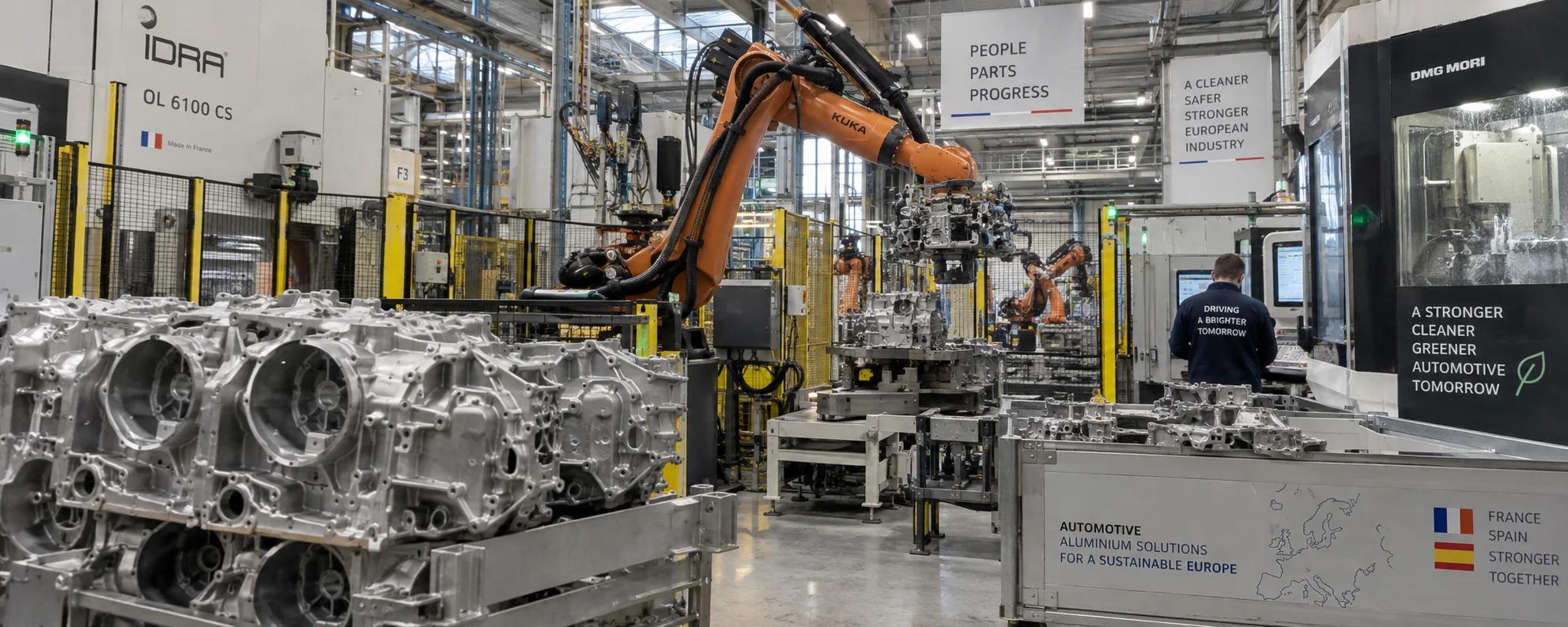
If Poland, Czechia and Hungary represent the direction in which European manufacturing is adding and expanding capacity, then France and Spain represent a different kind of change: how traditional western European manufacturing bases find their place again in the middle of new-energy vehicles, shifting costs and supply-chain regionalization.
France and Spain are both major European car-producing countries. Each has a mature vehicle-manufacturing system, an automotive components industry and a deep industrial foundation, and both have long participated in the German and wider European automotive supply chain. ACEA data shows that in 2025 Germany remained the EU’s largest car producer, with Spain, Czechia, France and Slovakia following behind — in other words, neither of these two countries has left the European car-manufacturing system.
What is actually changing is something else: traditional manufacturing strengths are recombining with new product structures, new energy conditions and new supply-chain models. That recombination, not any simple story of decline, is the key to understanding where the die-casting industries of these two countries go next.
France: welding a battery supply chain into an old industrial system
France’s automotive industry runs deep. From vehicle assembly and components through to engineering R&D and industrial equipment, France has long maintained a remarkably complete automotive industrial system. Beyond Renault and Stellantis sit a dense network of component makers, engineering houses and industrial service firms.
But new-energy vehicles are changing part of the traditional supply chain. The engines, gearboxes and fuel systems of a conventional internal-combustion car carry a great deal of machined work and castings; an electric vehicle’s powertrain is instead concentrated in the battery, the e-drive system and thermal management. That shift means a portion of traditional suppliers have to rework their own product mix.
France has not sat back and waited for this change to arrive — it has been actively building its new-energy supply chain. On batteries, Business France data shows the country has planned several large battery plants, with six gigafactories now laid out and a target capacity of 100–120 GWh. Through the staged reporting of battery and critical-raw-material projects under the “France 2030” programme, 40 battery-related projects have received support, backed by roughly €2.3 billion in public investment subsidies that have drawn in about €8.2 billion in total social investment.
Northern France in particular is worth watching closely. ACC is already building its battery plant at Douvrin, and Verkor is constructing its first gigafactory at Dunkirk. At the same time, Orano and XTC New Energy Materials, among others, are building battery-materials projects nearby.
So the change in France’s automotive industry is not the tidy story of “traditional cars down, new-energy vehicles up.” Two things are happening at once: the traditional supply chain is adjusting, while a new battery, e-drive and related component chain is forming. For a die-casting company that means watching two demand streams at the same time — aluminium components inside the traditional automotive supply chain, and the new demand coming from e-drives, thermal management, automotive electronics and structural parts. Rather than guessing whether one kind of die-cast product will fully replace the traditional ones, it is more useful to look at which specific models, components and supply-chain links are actually changing.
Spain: electrifying a mass vehicle-manufacturing base
Spain’s industrial structure is a different matter from France’s. Spain has long been one of Europe’s most important vehicle-production bases, with a large number of international automakers running plants there and a fairly complete components supply chain built up around them.
In 2025 Spain produced roughly 2.274 million vehicles, down 4.3% year on year, while electrified-vehicle output reached 225,000 units, up 11.2%. About 85.8% of the year’s production was exported, and 92.6% of those exports went to other European markets. That says Spain’s automotive industry is right now carrying two things at once: pressure on traditional output, and a production system adjusting toward electrification.
But investment has not stopped. ANFAC data shows Spain’s automotive industry investment reached about €3.2 billion in 2025, a record high, with one of its key directions being the retrofit of plants toward electrified models and industrial upgrading.
So the key question for Spain’s automotive industry is not simply whether it can hold on to vehicle output. It is whether the country can keep attracting new-energy-vehicle investment, and whether its existing components suppliers can complete their own product and manufacturing adjustments. For the die-casting industry, what is worth watching is not raw car output but four specific things: which models are actually being produced locally, which powertrains are growing, which aluminium components are starting to be localised, and which traditional component suppliers are moving into new product areas. Those four things decide how much of the automotive industry’s change ultimately converts into real die-casting demand.
Two industrial foundations, two transition paths
Although both countries are western European automotive manufacturing bases, their foundations and their transition paths are not identical.
| Dimension | France | Spain | What drives it |
|---|---|---|---|
| Automotive base | A fairly complete vehicle, components and engineering R&D system | Larger-scale vehicle production and parts manufacturing | One leans on system, the other on scale |
| Industrial character | Strong domestic auto groups and industrial-technology system | Concentrated international-automaker plants and export supply chains | One relies on itself, the other on multinationals |
| New-energy transition | Continuous build-out of battery, e-drive and related chains | Electrification retrofit of vehicle plants and new-energy supply chains | One builds a new chain, the other rebuilds an old plant |
| Die-casting focus | E-drives, thermal management, automotive electronics and traditional aluminium parts | Automotive parts and new-energy-related aluminium components | One watches additions, the other watches conversions |
| Main challenge | Traditional supply-chain adjustment, cost and industrial competition | Product upgrading, supply-chain transformation and investment competition | One reshapes structure, the other chases investment |
France’s more distinctive strength is the recombination of a traditional automotive industrial system with a battery and new-energy chain; Spain’s is the parallel running of large-scale vehicle manufacturing with electrification retrofit and components-chain upgrading. Both are adjusting — just with different emphasis.
Western Europe is not declining: it is re-dividing labour
In the past, France, Spain, Germany and Italy together formed the core of Europe’s automotive industry. As manufacturing in Poland, Czechia and Hungary has kept developing, Europe’s car-production network has become more dispersed and more transnational.
But that does not mean a simple “western Europe moving east.” The more accurate description is this: Europe’s automotive manufacturing system is forming a more regionalized, multi-centred supply-chain network. A single car programme’s R&D, parts manufacturing, vehicle assembly, machining, final assembly and end customer may be spread across several countries. Germany still holds strong vehicle, engineering and high-end manufacturing capability; France continues to play on its vehicle, engineering R&D and industrial system; Spain keeps its strong production and export capacity; and Poland, Czechia, Hungary and the other Central and Eastern European countries keep growing their role in production, components and regional supply chains.
That is why European automotive competition is increasingly hard to explain with labour cost alone. What companies actually have to weigh at the same time is cost, technology, logistics, customer proximity and supply-chain completeness — and that is precisely why France and Spain still hold industrial value.
Die-casting opportunities hide in the change of product structure
Die casting is a good window onto how the automotive supply chain is changing, but you cannot judge the French or Spanish die-casting market with the single ruler of “did car output go up or down.”
What actually matters is how the product structure changed. A conventional car’s engine, gearbox, chassis and body parts contain a great deal of aluminium casting; new-energy vehicles add new aluminium applications in motors, electronic control, thermal management, battery systems and lightweight structural parts. The two are not a simple one-up, one-down — traditional powertrains still exist, hybrids and plug-in hybrids still hold an important share of the market, and new energy keeps generating new component demand at the same time.
Here it helps to separate two different measures. Spain’s 9.9% is the share of electrified vehicles in Spain’s full-year production — a production basis, for Spain. The figures below are the EU’s new-registration structure — a registration basis, for the EU. ACEA data shows that in 2025 EU new registrations broke down as 17.4% battery-electric, 34.5% hybrid and 9.4% plug-in hybrid. These are not the same ruler, and they cannot be compared directly.
For die-casting companies, the more useful thing to track is specific products, materials, processes and supply-chain positions: motor housings, electronic-control housings, battery-related aluminium components, thermal-management parts, aluminium structural parts, aluminium components inside traditional powertrains, high-precision functional parts, and parts that combine casting with machining. And different products do not necessarily share one process — the same aluminium part might go through high-pressure die casting, low-pressure casting or gravity casting depending on what it is. So a change in the automotive industry cannot be read directly as a proportional change in high-pressure die-casting demand.
Large-scale integrated die casting is certainly worth watching, but it is only one direction in how new-energy vehicle manufacturing is changing. For mature bases like France and Spain, the more valuable things to keep observing are whether traditional aluminium components undergo product upgrading, whether e-drive and thermal-management components grow, and where the casting, machining and assembly of these products is actually located. In other words, the die-casting opportunity does not come only from “large structural parts” — it also comes from the large, sustained mass of small-to-medium, high-precision and functional aluminium components.
The shared challenges of a mature manufacturing base
Both countries still hold a strong automotive industrial base, but several shared questions press on them. The first is product-structure adjustment: part of the traditional internal-combustion supply chain has to find new product directions while adapting to the different technical demands of new energy. The second is cost and manufacturing efficiency: energy, labour, automation levels and productivity all affect the competitiveness of casting and machining. The third is supply-chain regionalization: customers increasingly value supplier proximity, logistics stability, on-site response and supply-chain security.
So what France and Spain have to solve is not just “how to cut costs.” It is how to keep their competitiveness alive across technology, customers, manufacturing capability and supply chain at the same time.
For Chinese die casters: the doors of a mature market are different
France and Spain still hold a large number of mature automotive customers and component suppliers, and both markets remain worth attention. But entering them is not the same logic as entering a newly added Central and Eastern European manufacturing node — France and Spain already have mature local supply chains and customer systems, so the core question for Chinese companies is often not “is there demand” but “can you become a stable, reliable, long-term supplier.”
Beyond price, customers typically look at several things: stable product quality, sustained delivery capability, efficient technical communication, problem handling and on-site response, an understanding of European customer requirements, and long-term supply capability. At the same time, the restructuring of France’s and Spain’s supply chains means some Chinese manufacturers can still reduce customers’ management burden around cross-border procurement through European local service, technical support and supply-chain coordination. So Chinese companies entering these two markets are better off assessing them from the angle of a long-term supply-chain partnership rather than simply going after orders.
The change in France and Spain points to one thing: European manufacturing is not a simple story of “western Europe declining while Central and Eastern Europe rises.” It is forming a more regionalized, more multi-centred manufacturing and supply-chain network. France and Spain represent the upgrading and transformation of mature manufacturing bases; Germany continues to hold the core of industry, engineering and automotive; and Poland, Czechia, Hungary and the rest keep absorbing new production and supply-chain links.
For the die-casting industry, Europe’s future market will very likely hold two kinds of opportunity at once: one from the product upgrading, supply-chain adjustment and new-energy transition of mature industrial bases like France, Spain and Germany, and another from the new product and supply-chain demand created by Central and Eastern European expansion. So when judging whether a European country deserves attention, you cannot look only at vehicle output, labour cost or investment amounts. You also have to look at which customers are there, which products are changing, which industries are investing, which supply chains are relocating, and where a die-casting company can actually fit into the chain.
France and Spain have not left European manufacturing. What they are going through is a re-adjustment from their traditional automotive manufacturing advantages toward new-energy vehicles and a new supply-chain system — and that adjustment will continue to shape the regional layout of Europe’s automotive and die-casting industries for years to come.
Data sources: ACEA vehicle production and new-registration data, Business France battery-industry data, and ANFAC Spanish automotive-industry data. Some figures are industry-scale estimates.