
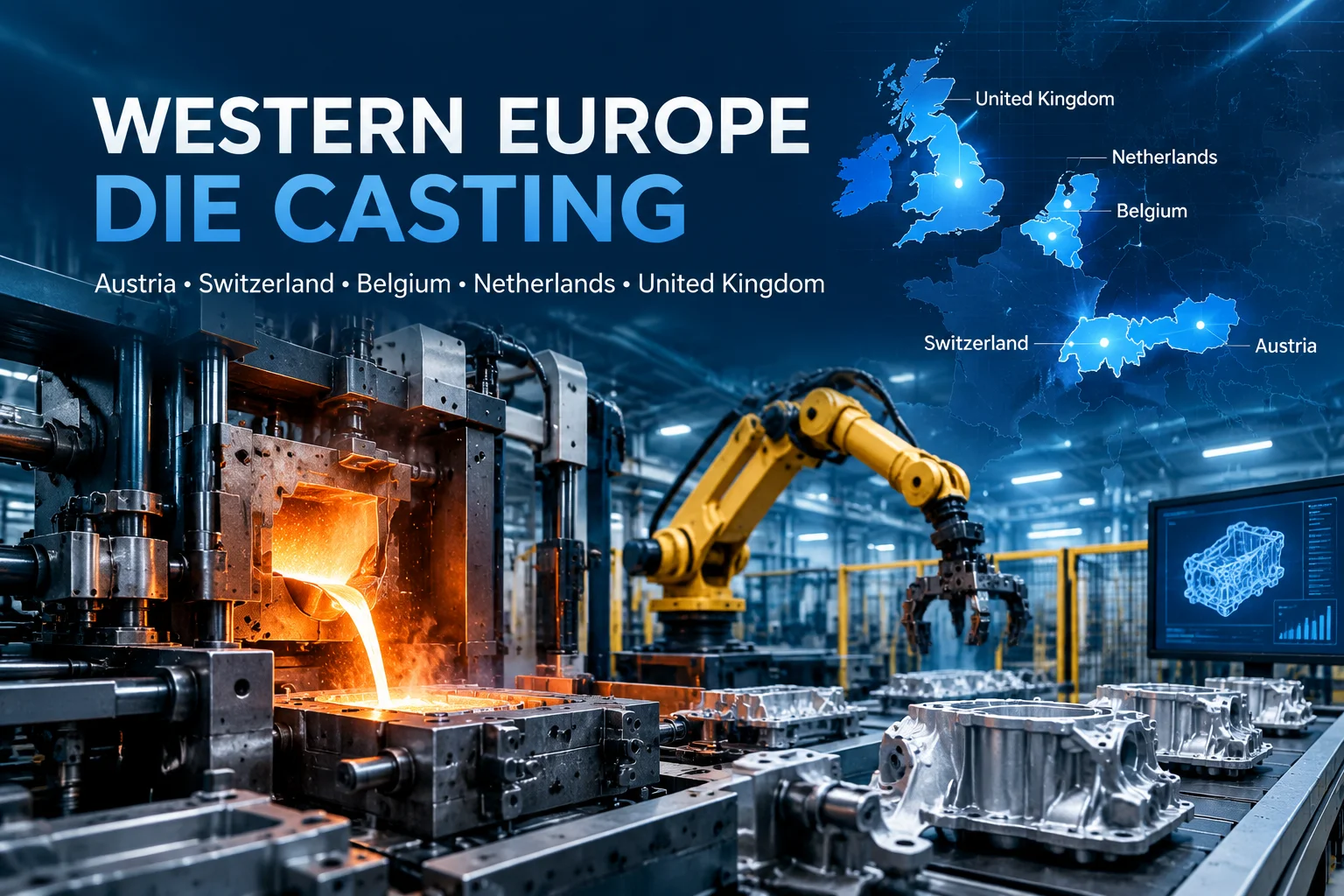
People like to talk about Western Europe as a single die-casting market. It never was one. Austria sits on automotive components, powertrain systems and complete-vehicle contract manufacturing. Switzerland’s automotive suppliers are built to serve several industrial sectors at once. Belgium’s vehicle footprint has already changed shape, and the Netherlands — once its large-scale contract manufacturing ended — turned its manufacturing toward high technology and regional supply chains. The UK still holds its base in automotive, aerospace, defence and energy, but car output and part of its light-alloy order book are now under pressure.
Before you start counting cars
Final demand for die castings may come from a local OEM, or from a Tier-1, a machinery builder or an electronics manufacturer — while the production itself may happen in a neighbouring country, or be split across the plants of one multinational group in several countries. “A big automotive industry” therefore does not mean “big local die-casting demand,” and “non-ferrous casting output” does not mean “high-pressure die-casting output.”
The European Foundry Association (EFF), in its 2024 statistics, lists non-ferrous casting and light-alloy casting separately. Two figures show the size of the gap. Austria produced about 139,600 tonnes of non-ferrous castings in 2024, of which light and ultra-light castings made up about 130,200 tonnes. The UK produced about 74,900 tonnes of non-ferrous castings, of which light and ultra-light castings accounted for about 64,900 tonnes.
Those numbers say something about the depth of a country’s casting base, but they cannot be read straight across as die-casting tonnage — the coverage of the statistical categories, the population of companies surveyed and the exact process mix all have to be cross-checked against each country’s own industry data before you can use them.
Five countries, five different foundations
| Country | Automotive & OEM base | Tier-1 & supplier base | Casting data | Non-automotive demand signals | Core character |
|---|---|---|---|---|---|
| Austria | Automotive components, powertrain systems and complete-vehicle contract manufacturing | Magna Steyr, BMW Motoren, AVL, Magna Powertrain, ZKW and others | Total castings ~270,000 t; non-ferrous castings ~140,000 t | Motorcycles, commercial vehicles, agricultural machinery, industrial equipment | Contract manufacturing and powertrain both present — the most complete supply chain |
| Switzerland | Limited domestic vehicle production; automotive suppliers serve international markets | A large number of suppliers, most serving several industrial sectors at once | 2024 casting deliveries ~34,700 t, down 13.6% year on year; light-metal and non-ferrous casting down ~14% | Rail vehicles, machinery, precision industry | Export-oriented; one supplier serves multiple industries |
| Belgium | Volvo Ghent and other existing vehicle manufacturing | Automotive and industrial supply chain still tied into the European cross-border network | Limited EFF-comparable national non-ferrous casting data | Industrial equipment, energy, transport equipment | Vehicle base contracted; Ghent the one remaining anchor |
| Netherlands | Large-scale contract vehicle manufacturing ended; automotive supply chain and other manufacturing remain | DAF and other commercial-vehicle and regional supply-chain players | EFF 2024 provides no comparable national Dutch casting data | Semiconductor manufacturing equipment, energy systems | Contract manufacturing exited; manufacturing shifted to high tech |
| United Kingdom | Several OEMs, commercial-vehicle and component manufacturing sites | Nissan, Toyota, JLR, BMW/MINI, Stellantis systems | Non-ferrous castings ~74,900 t; light and ultra-light castings ~64,900 t | Aerospace, defence, energy, heavy vehicles | Automotive under pressure; aerospace and defence filling in |
The automotive-manufacturing information in the table is used mainly to judge where demand originates; the casting data follows the EFF 2024 report definitions.
Austria: vehicles, powertrains and components all in one hand
Austria has the most complete automotive chain of the five — complete-vehicle contract manufacturing, powertrain systems and component manufacturing, all in one country. Local industry data puts Austria’s automotive production value in 2024 at around €42.5 billion, employment at about 192,000 people, and the export share at roughly 87%.
From Graz to Steyr, this is real capacity, not a paper footprint. Magna Steyr in Graz takes on vehicle engineering and manufacturing for international OEMs; BMW’s plant in Steyr builds powertrain systems; and AVL, Magna Powertrain and ZKW are spread across powertrain development, R&D and lighting. Austria also has manufacturing activity in motorcycles, commercial vehicles and agricultural machinery.
From a die-casting point of view, though, none of this is straightforward. Powertrains, e-drives, structural parts and transmission components may well hide aluminium castings and die castings, but which specific part is procured locally in Austria, through which casting process, and ordered by the OEM or by a Tier-1 — that has to be traced project by project and plant by plant along the actual vehicle programmes and factory supply chains.
One detail in the EFF report is revealing. Austrian foundries entered 2024 facing a shortage of orders, fluctuating capacity utilisation and pressure from energy costs. National casting output came to roughly 270,000 tonnes, essentially flat year on year — yet the output value of non-ferrous castings fell by around 20.8%. Output barely moved while the money shrank. The change in total cast tonnage and the real operating condition of a company are not the same thing.
Switzerland: no volume cars, but a cross-industry supplier base
Switzerland’s foundation is the opposite of Austria’s. There is no large passenger-car OEM cluster on Swiss soil; the country’s automotive suppliers mostly serve international markets, and most of them serve machinery, electronics and precision manufacturing at the same time.
Swissmem’s data lays the structure out plainly: the Swiss automotive supply chain counts around 578 companies, turns over about CHF 13 billion and employs some 32,000 people — and only about 20% of those companies do automotive exclusively. The rest work across several industrial sectors at once.
That means you cannot judge Swiss die-casting demand by watching local vehicle output; you have to look at automotive customers and industrial customers together. The EFF report shows Swiss foundry deliveries falling 13.6% in 2024 to about 34,700 tonnes, with light-metal and non-ferrous casting down around 14%. Automotive orders are being dragged along by European EV demand, cost pressure and order-book stability, while rail-vehicle orders were, in the reporting period, comparatively steady.
Swiss casting also has a strongly export-facing character: a 2023 industry report put roughly 80% of output as destined for export. A market with limited local vehicle production that sells eight tenths of what it makes abroad is shaped far more by international customers and cross-border supply chains than by its own car plants.
Belgium: after the contraction, Ghent is the one anchor left
Belgium was once a significant European vehicle-assembly country, but over the past two years its vehicle footprint has shrunk fast.
ACEA data shows Belgian passenger-car production at just 197,624 units in 2024, down 31.2% year on year. The weight that pushed that curve down was the formal closure of Audi Brussels in February 2025 — once that plant shut, the local manufacturing landscape could never go back to what it was.
But Belgium has not left the field. Volvo Cars’ Ghent plant is still running and remains the country’s existing vehicle-manufacturing anchor. So any analysis of Belgium’s automotive-related demand today has to track the existing plants, the specific vehicle programmes and the surrounding Tier-1 network — not extrapolate from the vehicle volumes of the past.
A plant closure takes away direct supply and part of the local component demand, but it is too simple to say “the whole supply chain’s orders are gone.” Some Tier-1 or component capacity may still be serving other European plants. The things worth pinning down are these: is the plant still producing, have the vehicle programmes changed, has component sourcing moved, and do the procurement decisions still sit in Belgium?
The Netherlands: the contract-manufacturing era is over, manufacturing moves up the value chain
The Netherlands is the story of a contract-manufacturing era coming to an end. VDL Nedcar’s large-scale contract vehicle manufacturing at Born formally ended in 2024, and the site has since been seeking to turn itself into a multi-industry manufacturing base. The Netherlands still holds an automotive supply chain and commercial-vehicle manufacturing — DAF among them — but no one can use yesterday’s contract volumes to project today’s demand.
What actually gives the Netherlands international weight is its semiconductor-manufacturing-equipment industry, alongside its role in regional logistics, warehousing and distribution — all of which shapes cross-border delivery routes and how supply chains are served.
As for die casting itself, the Netherlands has no comparable output figure in the EFF’s 2024 national statistics. That is, in its own way, telling: the Dutch die-casting industry really is small, and the scant presence of Dutch exhibitors at Europe’s major die-casting and foundry trade fairs is a side confirmation of the same point.
The United Kingdom: automotive under pressure, aerospace and defence filling in
The UK has the most diverse industrial mix of the five. Nissan, Toyota, JLR, BMW/MINI and Stellantis all maintain vehicle or component operations in the country, and engine and component production has never stopped.
But the SMMT figures are what they are: UK car production in 2024 was 779,584 units, down 13.9% year on year, with commercial-vehicle production at 125,649 units. More troubling is what the EFF’s 2024 survey of UK foundries flagged: most light-alloy casters saw business slightly better than 2023, but many order books still sit below pre-pandemic levels; EV project enquiries, design work and trial production do not always convert into volume orders; passenger-car OEM orders are fluctuating; and some programmes have seen the cycle from enquiry to series production stretch out.
The UK holds another card: aerospace, defence, energy and heavy vehicles. UK government figures put the aerospace industry’s 2024 turnover at about £34 billion with direct employment of around 100,000 people, and ADS’s statistics for aerospace, defence, security and space confirm the sector’s weight. On the casting side, UK non-ferrous casting output in 2024 was about 74,900 tonnes, down 16.8% year on year, with light and ultra-light castings at about 64,900 tonnes, down 18.6% — but the association also notes that aerospace orders are recovering and demand from defence, oil & gas and industrial gas turbines is rising.
Between the fall and the rise, the real direction of UK die-casting demand sits inside the industry structure. On top of that, cross-border delivery, origin, certification and customs clearance between the UK and continental Europe form a separate layer of variables that have to be accounted for on their own in any supply-chain analysis.
Beyond automotive, more leads than conclusions
Automotive is still the most important entry point for reading die-casting demand. But rail, machinery, semiconductor equipment, aerospace, defence, energy and industrial equipment all have manufacturing activity somewhere in these five countries — the UK in aerospace and defence, Switzerland in rail and precision machinery, the Netherlands in semiconductor equipment, Austria in industrial equipment.
The catch is that none of these sectors’ turnover, investment, employment or machine output can be read directly as evidence of die-cast procurement. A big industry is not proof that it placed an order with a local die caster. So this article lists them only as directions for further investigation, not as entries in a size comparison of the five countries’ die-casting demand.
Put the five side by side and only a few things hold up
Set the five countries in the same frame and only a handful of things actually hold.
The first is that the automotive manufacturing structures are nothing like each other. Austria has complete-vehicle contract manufacturing, powertrains and components all at once; Switzerland leans on a supplier base whose companies span several industries; Belgium’s vehicle footprint has changed shape, but Volvo Ghent is still running; the Netherlands has seen its large-scale contract manufacturing end and has to be read through a different automotive supply chain; the UK keeps several OEM, commercial-vehicle and component sites. Five players, each playing a different hand — a single vehicle-output indicator simply cannot cover demand structures that different.
The second is that the casting data is only partly comparable. Austria and the UK have relatively complete non-ferrous and light-alloy casting statistics; Switzerland has delivery volumes and a material split; Belgium has limited comparable data; and the Netherlands has no corresponding national figure in the EFF report at all. The premise for any single uniform comparison table simply does not hold.
The third is that the Tier-1 and supplier base is the genuinely useful entry point for reading die-casting demand. Austria: Magna Steyr, BMW Motoren, Magna Powertrain, AVL, ZKW. Switzerland: that cross-industry supplier system. Belgium: the existing OEM and its surrounding Tier-1s. The Netherlands: DAF and the regional supply chain. The UK: Nissan, Toyota, JLR, BMW/MINI, Stellantis and the component system around them.
The non-automotive sectors remain, for now, directions for investigation rather than settled findings — the UK’s aerospace and defence, Switzerland’s rail and machinery, the Netherlands’ semiconductor equipment, Austria’s industrial equipment all deserve further study, but they are still some distance from a comparable measure of die-casting demand.
Read the five countries from end to end and the opening line lands: Western Europe was never one die-casting market moving in step. Austria’s opportunity hides in its powertrains, Switzerland’s in a single plant serving many industries, Belgium’s in the one anchor that is Ghent, the Netherlands’ in the high-tech manufacturing left after contract work departed, and the UK’s in the aerospace and defence that sit beyond the car. Five paths, pointing at five completely different demand structures.
So anyone who picks up a car-production ranking or a casting-output table and tries to read these five markets’ die-casting opportunities from it will most likely misread them. The useful work is to follow the OEM and Tier-1 footprints and chase the specific parts, processes and procurement decisions — always remembering the two sentences that opened this piece: casting is not die casting, and automotive scale is not die-cast procurement scale.
Data sources: EFF “The European Foundry Industry 2024”, ACEA 2024 full-year economic and market report, SMMT, Advantage Austria, Swissmem, VDL Groep, the Dutch government, the UK government and ADS. Some figures are industry-scale estimates.