
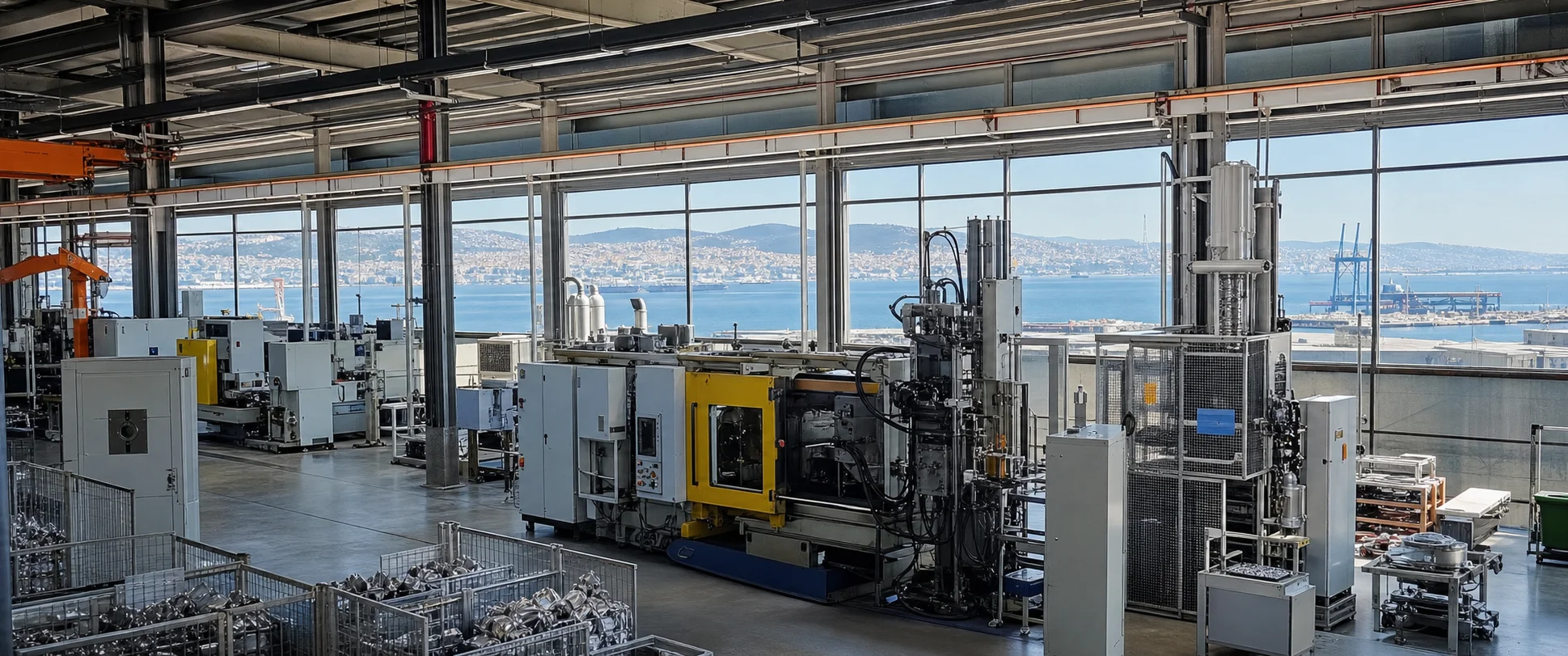
If you were to draw the European die-casting industry as a gravity map, a decade ago its centre of mass would have sat almost uncontroversially over southern Germany and northern Italy — the densest foundry clusters, the most mature automotive supply chains, the deepest accumulated process knowledge. Draw that map again today and something has visibly shifted: the centre is drifting eastward, and the point where it has moved furthest is not Poland, not Czechia. It is Turkey.
Alongside Germany and Italy, Turkey is now one of Europe’s three largest light-metal casting producers. That is no longer a forecast; it is a fact that has already surfaced in the capacity data. But understanding Turkey means refusing to stop at the word “cheap.” What actually deserves attention is that the country is becoming a new manufacturing node in Europe’s supply-chain restructuring — not a simple destination for relocated capacity, but a composite industrial platform that is accumulating equipment investment, talent density and institutional advantage all at once.
1. Cost is not the whole story — breaking down Turkey’s competitive structure
Turkey’s competitiveness is usually compressed into a single sentence: “because it’s cheap.” The reality is more textured.
Start with energy. Turkey’s dependence on Russian pipeline gas is far lower than Germany’s. The TANAP pipeline from Azerbaijan, several LNG import terminals — including the Saros Bay FSRU that came online in 2023 — and cross-border pipelines with Iran and Iraq together make up a notably diversified import mix. During the 2022–2023 energy crisis, Turkish industrial electricity prices rose too, but the relative increase was well below that of the EU’s core economies. For aluminium die casting, where electricity accounts for roughly 15–20% of production cost, that gap is not a rounding error.
Then there are labour and the currency. Turkish manufacturing labour costs run at roughly one-fifth to one-quarter of Germany’s, but there is an easily overlooked variable: skills. Turkey has Europe’s third-largest manufacturing labour pool, behind only Germany and Italy. And because the country has been supplying European automotive OEMs for decades, a large share of its line workers and engineers are already fluent in European production rhythms, quality-documentation systems and customer-communication norms. This is not a market you have to train from zero.
The exchange rate is a double-edged sword. The lira has depreciated more than 60% against the euro since 2020, handing Turkish exporters an enormous price buffer — while simultaneously pushing up the cost of imported raw materials, and a meaningful share of the primary aluminium used in Turkish die casting is imported. The point is that Turkish “cheapness” is not constant. When the lira collapses, the export-price advantage widens, but the cost of imported inputs eats into the margin at the same time. The smart Turkish foundries are not gambling on the exchange rate; they are hedging it.
Geography is an advantage of its own. From Istanbul to Stuttgart, the heart of the German automotive industry, is roughly 2,500 kilometres overland — three to four days by truck. Set that against the six-to-eight-week sea-freight-plus-clearance cycle from China to Europe, and the difference in response speed is the difference between life and death in a JIT supply chain. Add the customs union between Turkey and the EU — meaning Turkish-made industrial goods enter the EU duty-free — and Turkey enjoys, on both logistics and trade-institution grounds, something close to the treatment of half an EU member state.
2. Who is buying, who is making — the shape of demand and supply
Turkey’s die-casting growth is not an isolated supply-side story. Its demand side is strengthening structurally at the same time.
Automotive is the absolute engine, accounting for more than 60% of Turkish die-casting demand. Turkey is itself a significant car manufacturer — around 1.35 million vehicles produced in 2024, making it Europe’s fifth-largest vehicle producer. Ford Otosan, the Ford–Koç joint venture, runs Ford’s largest commercial-vehicle production base in Europe from Kocaeli. Oyak Renault’s Bursa plant is one of the Renault Group’s largest overseas facilities. And Tofaş, a joint venture with Stellantis, supplies the Fiat brand’s core products for Eastern and Southern Europe from Bursa. Die-cast parts are already embedded throughout these supply chains, and the share captured by Turkish foundries within them is climbing fast.
BYD is the most striking new variable. In July 2024, BYD signed an investment agreement worth around $1 billion with the Turkish government to build a full-vehicle plant with annual capacity of 150,000 units. The logic is transparent: use Turkey’s customs-union relationship with the EU to route around the EU’s anti-subsidy tariffs on Chinese-made EVs. But for the die-casting industry, BYD’s arrival in Turkey means more than one more assembly plant. It means an entire Chinese automotive supply chain starting to follow its OEM. Die-cast parts are bulky and expensive to transport, which gives them a natural pull toward localised production. Once BYD’s Turkish plant reaches volume, a cluster of die-casting suppliers is very likely to follow it into the surrounding region.
The supply side carries signals of its own. Kutluk Döküm, one of Turkey’s largest die-casting enterprises, acquired the established German foundry Teutoguss GmbH — a Turkish company reverse-acquiring a German foundry, something unthinkable a decade ago. This is not just a capital story; it means Turkish foundries have crossed a threshold in technology absorption, customer networks and management capability. At the same time, Turkey’s largest die-casting machine is nearing completion — no official tonnage has been disclosed, but the industry is watching closely to see whether this marks the country’s first step into gigacasting.
3. The Marmara corridor: the industrial spine of Turkish die casting
Turkey’s die-casting industry is heavily concentrated along the industrial corridor hugging the Marmara coast — stretching east from Istanbul through Kocaeli and Sakarya, and south to Bursa. This strip accounts for more than 60% of the country’s die-casting-related enterprises.
Kocaeli (İzmit) is the corridor’s core engine. One of Turkey’s most important industrial cities, it concentrates a dense mass of automotive-component, metalworking and chemicals firms. Its foundries tend to be larger — three hundred to eight hundred employees is common — and their specialisation already approaches Southern European levels. Bursa, by contrast, sits close to the OEMs — Oyak Renault and Tofaş are both here — and has formed a cluster oriented around automotive die castings. The European side of Istanbul, including the İkitelli industrial zone, leans toward small and medium-scale casting and precision machining, serving a broader industrial base.
Further into the Anatolian interior, Konya and Izmir are two other nodes worth noting. Konya’s traditional strength is agricultural-machinery and industrial-equipment casting, and it has begun moving into aluminium die casting in recent years. Izmir benefits from its Aegean port and is distinctly export-oriented, with customers concentrated in the Balkans and Southern Europe.
The Turkish foundry association TÜDÖKSAD plays an active coordinating role. ALUEXPO, the Istanbul aluminium-industry fair held every two years, has become a fixed date on Europe’s non-ferrous casting calendar — the 2025 edition drew more than 300 exhibitors. That in itself is a signal: Turkey’s casting industry has completed the upgrade from “regional supplier” to “international player.”
4. What this means for Chinese suppliers
For Chinese die casters and equipment makers, Turkey is at once a competitor and a channel.
The competitive pressure is real. In the mid-to-low-end aluminium segment — structural brackets, motor housings, pump covers — Turkish foundries hold logistics speed, tariff advantages and communication ease inside the EU that Chinese suppliers cannot match in the short term. Ask a German Tier-1 to choose between “Chinese import plus six weeks of sea freight plus CBAM carbon cost” and “Turkish procurement plus four days by truck plus zero tariff,” and the scales tip clearly toward the latter.
But the cooperation side may offer even more room. First, the equipment market. Turkish foundries are upgrading capacity at scale — new die-casting cells, automation equipment, inspection systems — and that is exactly the window Chinese die-casting-equipment makers are looking for. Haitian has already set up in Italy, and LK’s dealer network covers Turkey, but no Chinese die-casting-equipment brand has yet established a dominant foothold in the Turkish market.
Second, supply-chain nesting. As BYD and other Chinese automakers — Chery is also evaluating a Turkish plant — enter Turkey, Chinese die-casting suppliers that follow the “supplier-follows-OEM” strategy can build a manufacturing base inside the EU customs union, serving Chinese OEMs and European OEMs from the same location. This scenario has already played out in Southeast Asia, in Thailand; the Turkish version simply adds the customs-union variable.
Third, Turkey could become one piece of a CBAM strategy. Chinese aluminium die castings exported directly to the EU face steadily rising carbon costs. But a smelting–casting–machining footprint in Turkey — using low-carbon aluminium ingots sourced from China or locally — can enter the EU under a “Made in Turkey” identity and optimise part of that carbon-cost structure. Turkey is advancing its own carbon-border mechanism on an ETS pilot basis, so the window will not stay open forever, but the 2026–2028 period is a realistic one in which to position.
5. Where the ceiling sits
Turkey’s die-casting growth story has a ceiling, and pretending otherwise will not make it disappear.
Macro volatility is the most obvious uncertainty. Turkish annual inflation exceeded 80% between 2022 and 2024, and settled around 40% in 2025 — still a number that is unfriendly to long-term investment decisions. The lira’s continued depreciation, for all its export benefits, also distorts corporate balance sheets: an exporter earning in euros and spending in dollars benefits, but a foundry selling mostly into the domestic market does not.
The quality ceiling is another reality. Turkish foundries are improving their process capability quickly, but in high-end precision castings — EV battery housings with demanding airtightness requirements, precision structural parts held to tolerances of ±0.05 mm or tighter — they still trail the top German and Italian plants. This is not a capability gap so much as an experience gap. German plants have been making these parts for thirty years; Turkish plants, for five. Time is a sedimenting variable that cannot be compressed.
On the political front, the EU–Turkey customs union has been under discussion for “modernisation” since it was signed in 1995, but negotiations move slowly. Extending it to services and agriculture, and adding public-procurement provisions, has repeatedly stalled over the Cyprus question and Turkey’s domestic politics. A material regression in the customs union is not the base case — the probability today is low, but it cannot be ruled out — and if it happened, the institutional dividend of Turkish manufacturing into the EU would shrink sharply.
Finally, southeastern Turkey remains an active seismic zone. The 2023 Kahramanmaraş earthquake struck mainly textile and agricultural regions rather than the die-casting core, but it exposed a structural weakness in Turkey’s industrial geography: the high geographic concentration of its clusters is at once a strength and a risk.
The story of Turkey’s die-casting industry is not about a “cheaper Europe.” It is about a new manufacturing node embedding itself into a redrawn European supply-chain map. It brings cost advantage, an institutional channel and rapidly upgrading capacity — and it also brings macro volatility, a quality ceiling and political friction. For the Chinese die-casting industry, the question is not whether Turkey is “good” or “bad.” It is that Turkey has already drawn an irreversible arrow onto the supply-chain map.
Data sources: TÜDÖKSAD industry briefings, WFO Global Foundry Census, NürnbergMesse EUROGUSS historical data, GIESSEREI magazine, Foundry Planet industry reporting, CAEF European Foundry Association, and public vehicle-production and investment figures. Some figures are industry-scale estimates.