
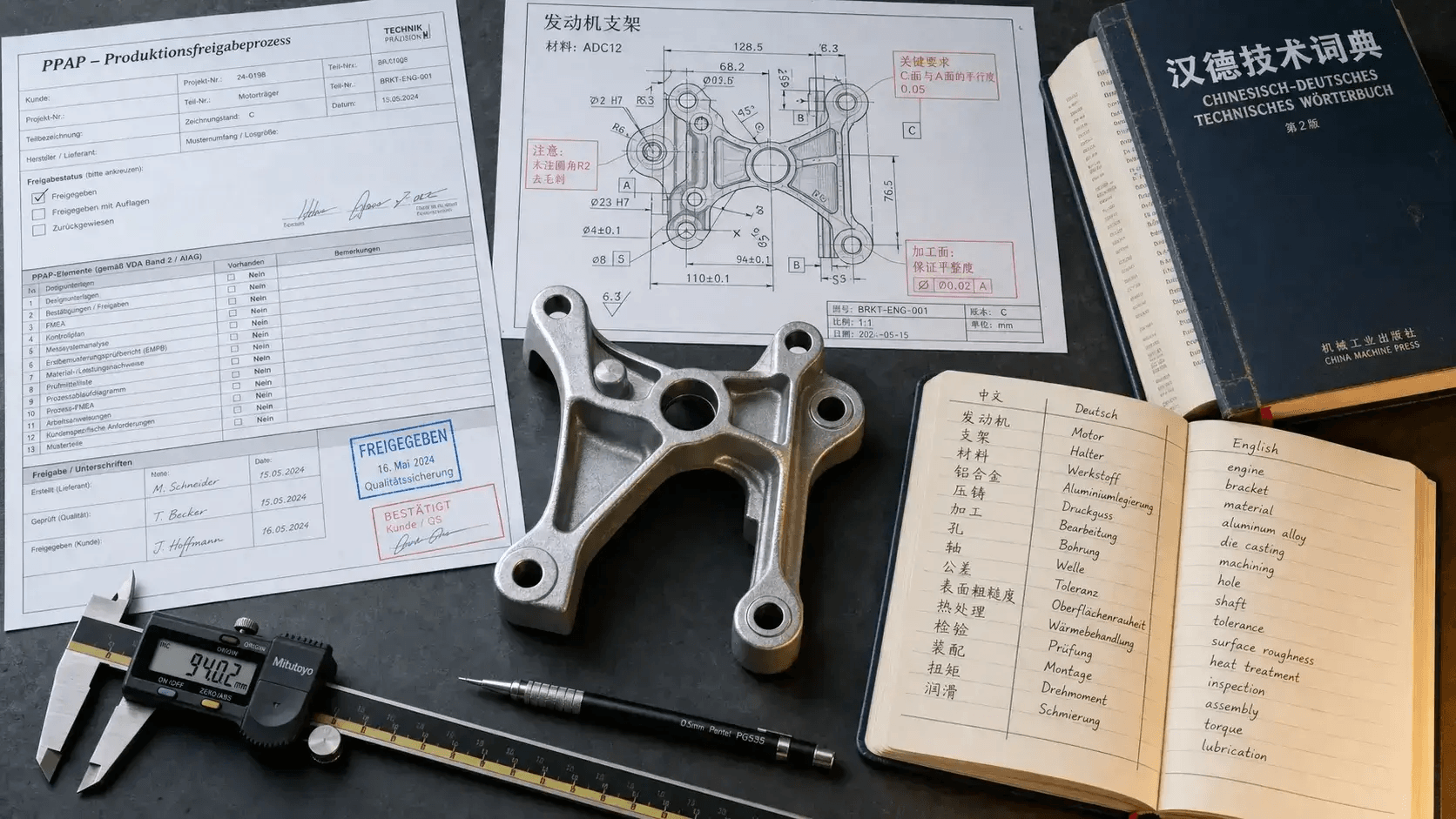
Most friction between a German quality team and a Chinese die-casting supplier is not technical. It is vocabulary. The German term Lunker refers to a specific shrinkage cavity; in Chinese standards that maps to 缩孔 — yet a line operator may report it as 砂眼. Translate that literally and a German engineer thinks Sandeinschluss (sand inclusion): a different defect with a different root cause. Agree the terms first, and a three-day email chain becomes a ten-minute call.
What follows is a working reference, not a dictionary: the term as it is actually used on a Chinese shop floor, the term a German quality engineer writes in an 8D report, and notes on where translation breaks down.
Process and equipment
| Chinese | German | English | Notes |
|---|---|---|---|
| 压铸 | Druckguss | Die casting | Umbrella term |
| 高压压铸 / 压铸 | Hochdruckguss / HPDC | High-pressure die casting | In China, 压铸 alone usually means HPDC |
| 低压压铸 | Niederdruckguss / LPDC | Low-pressure die casting | Uncommon in export work |
| 重力铸造 | Schwerkraftguss / Kokillenguss | Gravity die casting | German uses two terms interchangeably |
| 压铸机 | Druckgießmaschine | Die-casting machine | Toggle and two-platen are common variants |
| 型腔 | Formhohlraum / Kavität | Cavity | Mold cavity |
| 浇道 / 浇口 | Anguss / Angusssystem | Gate / Gating system | 浇口 = the gate itself |
| 排气槽 | Entlüftungskanal | Vent / Overflow | German distinguishes vent from overflow |
| 顶针 / 顶杆 | Auswerferstift | Ejector pin | Witness marks on the part: 顶针印 |
| 分型面 | Trennebene / Trennfuge | Parting line | Visible flash line on the part |
Materials
| Chinese | German | English | Notes |
|---|---|---|---|
| 铝合金 | Aluminiumlegierung | Aluminium alloy | Dominant die-cast material |
| 锌合金 | Zinklegierung | Zinc alloy | 锌 ≠ 铝 — easy to confuse when scanning quickly |
| 镁合金 | Magnesiumlegierung | Magnesium alloy | Driven by EV demand |
| ADC12 | ADC12 | ADC12 | Common Chinese spec, JIS-derived |
| A380 | A380 | A380 | US/EU counterpart to ADC12, slight compositional differences |
Defects
Mistranslation costs most here. The same physical defect can have two or three names in a Chinese plant, depending on region and who is speaking. The “factory-floor name” column captures what people actually say — not the standard term.
| Chinese (standard) | Common factory-floor name | German | English | Appearance |
|---|---|---|---|---|
| 缩孔 | 缩松 / 砂眼 | Lunker | Shrinkage cavity | Internal void from solidification |
| 气孔 | 气泡 | Gaspore / Porosität | Gas porosity | Round voids from trapped gas |
| 冷隔 | 冷纹 | Kaltlauf / Kaltfließnaht | Cold shut | Surface seam where two metal flows did not fuse |
| 流痕 | 水纹 | Fließmarkierung | Flow mark | Cosmetic surface trace, usually no structural impact |
| 拉伤 | 粘模 | Klebespuren / Druckstellen | Drag mark / sticking | Demoulding before full solidification |
| 飞边 / 披锋 | 毛边 | Grat | Flash | Excess metal at the parting line |
| 缺料 | 欠铸 | Unvollständige Füllung | Short shot | Cavity not fully filled |
| 夹渣 | 夹杂 | Einschluss / Fremdeinschluss | Inclusion | Foreign material trapped in the casting |
| 起泡 | 鼓泡 | Blase | Blister | Subsurface gas visible only after heat treatment |
| 龟裂 | 裂纹 | Riss | Crack | 龟裂 implies a network pattern |
| 尺寸偏差 | 超差 | Maßabweichung | Dimensional deviation | Often blamed on shrinkage allowance |
| 翘曲 / 变形 | 走样 | Verzug | Warpage | Distortion after ejection |
Quality system terms
| Chinese | German | English | Notes |
|---|---|---|---|
| 来料检验 / IQC | Wareneingangsprüfung | Incoming inspection | At the customer’s receiving dock |
| 首件 / FAI | Erstmusterprüfung / EMPB | First article inspection | Required before mass production |
| 全检 | 100 %-Prüfung | 100 % inspection | Typical outcome of CS1/CS2 |
| 抽检 | Stichprobenprüfung | Sample inspection | AQL-based |
| 8D 报告 | 8D-Report | 8D report | Standard format for customer complaints |
| 受控发运 | Kontrollierter Versand | Controlled shipping (CS1/CS2) | Customer-imposed parallel inspection |
| 客诉 / 抱怨 | Reklamation / Beanstandung | Customer complaint | Reklamation is formal; Beanstandung is informal |
| 不良品 / NG | Ausschuss / NG | Reject / NG | ”NG” is widely used in Chinese plants |
| 返工 | Nacharbeit | Rework | Rework on sorted-out parts |
| 报废 | Verschrottung / Schrott | Scrap | Cannot be recovered |
Four translation traps
缩孔 vs 砂眼. Operators often call any small surface void 砂眼. A German engineer reading “sand-eye” assumes Sandeinschluss. In most cases it is a Lunker.
气孔 vs 气泡. Both Chinese terms are used for gas porosity. 气泡 also covers the surface Blase (blister) that appears only after heat treatment — in German, two different defects with different root-cause paths.
Grat, flash, 飞边, 毛边. English-speaking plants say “flash”; Chinese drawings use 飞边, shop talk uses 毛边. Four labels, one defect: Grat.
Lunker has no exact Chinese equivalent. 缩孔 is closest, but Lunker can also describe larger pulled-back voids that Chinese specs call 缩松. Align the term boundary at first article — otherwise every batch becomes a vocabulary dispute.
A high-leverage habit
When you open a new program with a German Tier-1, send a one-page table tailored to that component family — the 20–30 terms most likely to appear. About an hour to prepare. In our experience, that single document often cuts complaint resolution time by 30–40%.