
“The trading company we’ve worked with for years filed for bankruptcy today.”
The call came from a leading manufacturer in a specialized European industry. For years they had bought tooling and die-cast components from China through a local trading company. Sourcing, quoting, inspection, logistics — the middleman handled all of it, and the customer’s only real job was to confirm delivery dates against the drawings. Now, overnight, the trader was gone. The customer was left holding a stack of orders and more than thirty die-cast projects, some already in series production and some about to launch, with no idea who was actually manufacturing any of them.
More urgent than “find a new supplier” was the simple, unforgiving fact that production could not stop. Several of the customer’s assembly lines were waiting on those castings. One missing part can idle an entire line, and a stopped line is billed by the hour.
By the time NaiSiTong was brought in, the customer wasn’t asking a single question but a whole chain of them. Which Chinese manufacturers actually produce these projects? Where do the tools sit right now, and in what condition? Which suppliers can still deliver? Which projects have to move? And how do you splice a severed supply chain back together without ever interrupting supply?
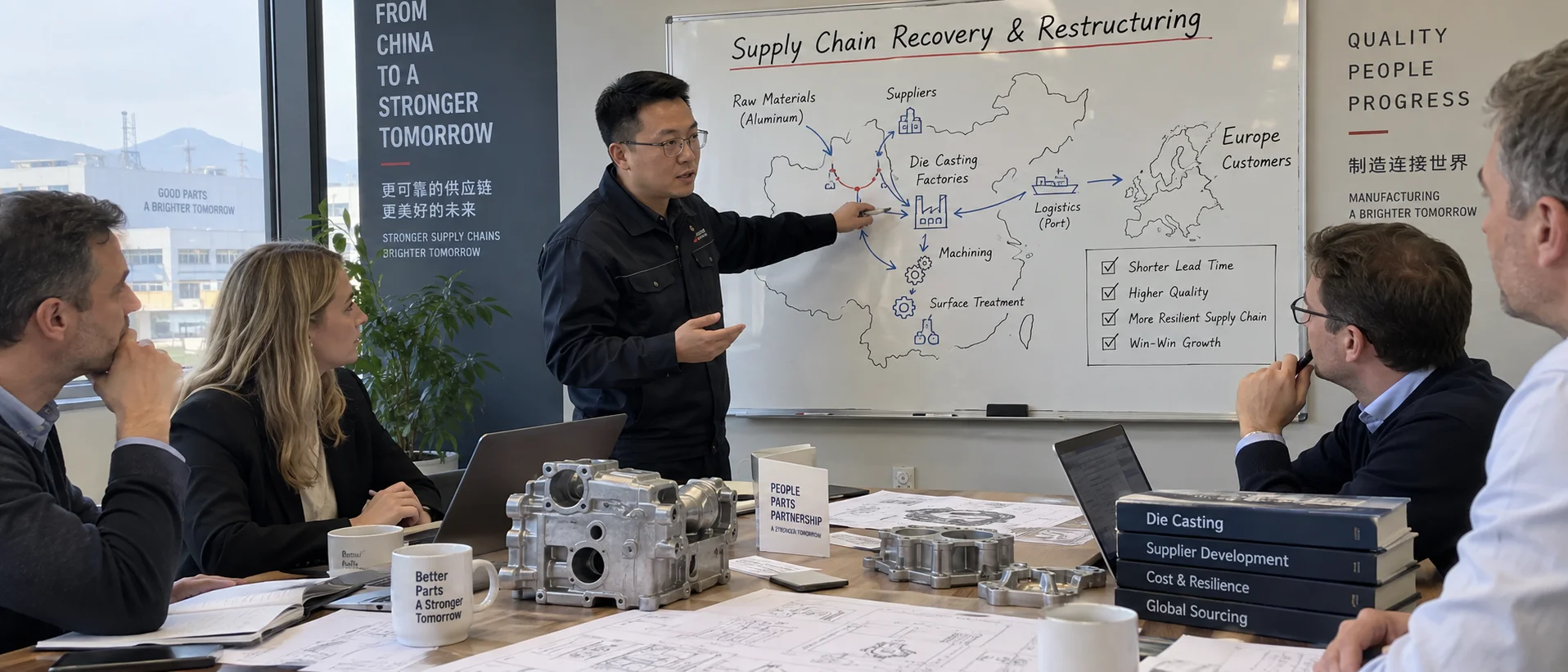
That is the case this article reconstructs — a complete restructuring, from supply-chain disruption to a supply chain the customer can actually control.
Why customers go blind to their own supply chain
It would be easy to blame the customer for poor management. But sourcing Chinese die-cast parts through a trading company is common practice across Europe, and for sound reasons — it is genuinely convenient. A competent trader finds the factory, negotiates the price, chases the delivery dates, and handles customs and logistics. The customer pays one total figure and hands everything else to the middleman.
The price of that convenience is blindness.
A trader has every incentive to keep supply-chain information to itself. The supplier list, where the tools physically sit, the real progress of each project, the true capacity of each factory — this is precisely what makes the trader valuable. Hand it over transparently and the trader becomes a link that can be bypassed. So, over time, the customer receives little more than quotes and shipping documents: the price is clear, but who is making what, how, and how far along, remains opaque.
When nothing goes wrong
None of this is a sign that the customer was careless. The blindness is structural — it is built into the trading model itself. Even a diligent purchasing team that asks all the right questions tends to get filtered answers, because the trader has to walk a line between being useful and being replaceable. The customer who is happiest with their trader is often the one who has never actually tested whether the relationship would survive the trader’s disappearance., the arrangement runs smoothly. The moment the middle link breaks, the customer discovers in an instant that they hold no direct line to any factory and no direct way to take over a project. Tools may be scattered across the shop floors of several plants, some projects may not even have finished their trial runs — and all of that information vanishes together with the trader’s bankruptcy.
Phase one: tracing through the trading company to four real factories
The first thing NaiSiTong did was not to rush out looking for new suppliers. It was to answer the question the customer was most anxious about: who is actually making these thirty-plus castings?
There is no shortcut to this. Working from the customer’s incomplete orders, drawings and email trails, we traced backward project by project — which factory shipped this lot, where the tool sits now, how far into series production each part has reached, and whether any inventory or spare capacity remains. Some of it could be pieced together from the surviving records; more of it had to be verified on the ground, inside the Chinese factories themselves.
In the end we mapped
Verifying on the ground means walking into a plant, reading the production records, looking at the tool on the press or in storage, and asking the factory directly what it can still commit to. It is slow, physical work — but it is the only way to turn a pile of paperwork into a picture you can act on. all thirty-plus projects onto four real Chinese manufacturers, and for each one we confirmed three things: the production status of the project, the condition of the tooling, and whether that factory could keep supplying going forward.
That list of four factories became the foundation of the entire restructuring. For the first time, the customer could see what their supply chain actually looked like — which links were solid and which were hanging in the air.
Phase two: tooling transfer and emergency scheduling
Once the picture was clear, the real trouble surfaced.
Of the four manufacturers, one had to move entirely. The reason doesn’t need spelling out — perhaps it was bound most tightly to the old trader, or perhaps its own finances could no longer support continued supply. Either way, leaving the tools there meant a risk nobody could control.
Tooling transfer sounds like moving a mold, but it turned out to be the most labor-intensive part of the whole case. A die-cast tool is not a standard part; a single tool can weigh over a tonne, and every step — dismantling, transport, reinstallation, re-trialling — can shift a part’s dimensions and its process stability. During the transfer, NaiSiTong carried both the technical and the commercial coordination. Could the new factory absorb this tool’s process? Did the first article off the new tool need a full dimensional inspection? Did the original commercial terms still hold? Each of these had to be settled one at a time, so the transfer stayed continuous and supply never stopped.
Meanwhile, we did not let go of the other three manufacturers that could still deliver. Which factory takes the urgent orders, and in what sequence, decides which of the customer’s lines restarts first. We worked with the customer to align with all three — re-prioritising by urgency and pulling the most critical parts first.
Phase three: rebuilding a direct, controllable China supply chain
Restoring supply only stops the bleeding. The real value comes after.
This bankruptcy forced the customer to see something clearly: putting every egg into one trader’s basket means handing your lifeline to a link you cannot control at all. So, as supply gradually returned, NaiSiTong went a step further and helped the customer build new, direct supplier relationships — no longer through a single intermediary, but with the customer able to talk to the Chinese manufacturers directly and see project progress and tool status for themselves.
What the customer ended up with was not simply “this crisis was solved.” It was a supply chain that is more transparent and more resilient than the one they had before: they know how many factories they can call directly, where every tool sits, how far along every project is, and where to shift if one supplier runs into trouble.
Four actions worth reusing
The difference between the old arrangement and the new one is not subtle. Before, the customer held quotes and shipping documents; now they hold names, addresses, tool locations, and a direct line to every factory that makes their parts. When the next surprise comes — a price spike, a capacity crunch, a quality issue — it lands on a chain they can actually see and steer, rather than one they can only read about after the fact.
Looking back at the case, what NaiSiTong got right comes down to four repeatable moves.
First, see clearly before you act. The most expensive mistake in a supply-chain crisis is rushing to find new suppliers before the picture is clear — that only moves the risk from one blind spot to another. Mapping the real supply chain first is the precondition for everything that follows.
Second, treat tooling as the core asset. In a die-casting supply chain, the tool is the true lifeline. Where a tool sits, what condition it is in, and whether it can move decide whether supply holds or breaks. Restructuring a supply chain is, at bottom, restructuring the ownership and movement of tools.
Third, protect production first and think long-term second. Urgent-order priority has to follow the customer’s actual line requirements, not an even spread of effort. Get the most critical line running first.
Fourth, make “direct” the default. A trader is not forbidden — but it must never become the single, opaque link. Every crisis is a chance to push the supply chain one step further toward direct, transparent and controllable.
The fragility of a supply chain is usually not one factory going wrong; it is the customer being unable to see the chain at all. When you can see every link, every tool and every project, a disruption stops being an uncontrollable disaster and becomes something you can resolve step by step.
If you are in Europe, going through a similar disruption or re-examining how much control you actually have over your China supply chain, get in touch with NaiSiTong. We stand between European customers and Chinese factories — and we make the chain visible, connected, and managed.