
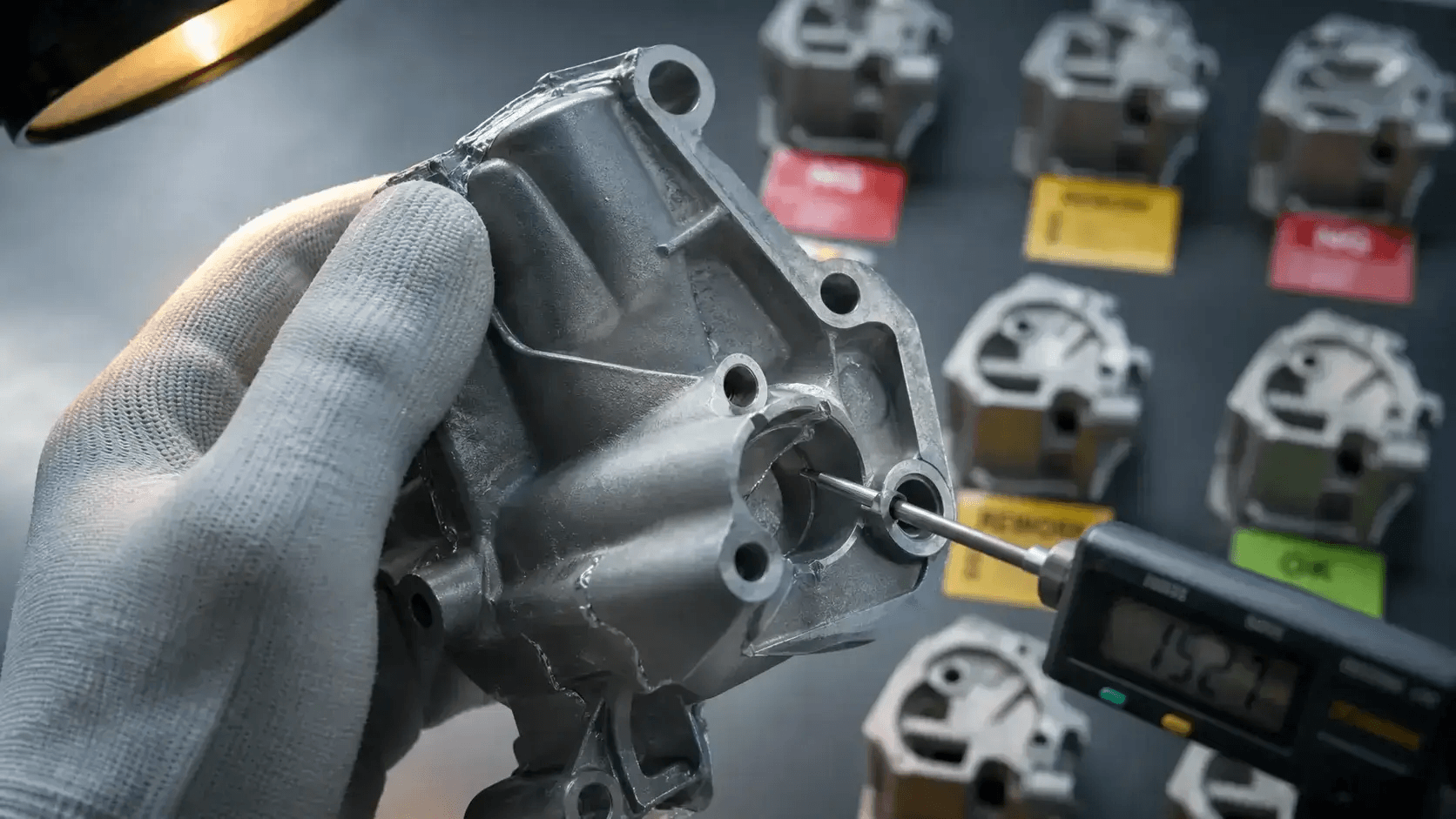
When a defective die-cast part lands on incoming inspection, the first reaction is operational: how many are bad, how do we sort, who pays. That all needs answering. The question that determines whether next month’s shipment fails too is why.
Defects are rarely random. Each category points to a specific weakness in the supplier’s process. Read them as signals, not just symptoms, and you can decide whether to tighten control, invest in support, or reconsider the relationship.
Below are the five defect families we see most often on aluminium die-cast parts shipped from China to Europe — and what each one reveals about the plant behind it.
1. Cold shut (Kaltlauf)
A cold shut is a visible seam on the part surface where two streams of molten metal met but did not fuse. It looks like a crack, but it is a surface line — often on curved features or where metal had to travel a long way from the gate to a remote corner of the cavity.
What it usually indicates:
- Melt temperature too low, or melt held too long before injection — loose furnace control or transfer timing.
- Poor gating design — metal cools before it reaches the far end of the cavity. This is a tooling problem, not a parameter tweak; it will not correct itself.
- Cycle time compressed to meet a delivery target — parts ejected before the cavity is fully filled and pressurised.
One cold shut in a 50-piece sample is noise. The same cold shut, same location, across multiple shipments is a tooling redesign conversation.
2. Gas porosity (Gaspore) and shrinkage cavity (Lunker)
Two physically different defects, often reported under one label in Chinese 8D reports.
Gas porosity is round, sub-surface, and often distributed — caused by trapped air or volatiles in the melt. Shrinkage cavity is irregular, usually in the thickest section — the surface solidifies while the core is still contracting.
Why the distinction matters:
- Gas porosity is usually fixable through venting changes, die lubrication adjustment, and melt degassing — process-level work, weeks not months.
- Shrinkage cavity usually means poor thickness control or cooling channels in the wrong place — tooling modification required, with cost, lead time, and a discussion about who pays.
What it usually indicates:
- Reporting “porosity” without separating the two suggests no process engineer is involved in defect classification — a warning sign on complex parts.
- If 8D root cause always lands on “operator error” or “material lot”, root-cause analysis is not actually happening.
3. Flash (Grat)
Excess metal squeezed out at the parting line — a thin fin around the part. Some flash is always present; whether it is a defect depends on size, location, and assembly impact.
What it usually indicates:
- Worn parting surfaces without maintenance. Flash is one of the cheapest defects to fix — and one of the most diagnostic when ignored. A supplier shipping heavy flash is deferring maintenance; when maintenance slips, other process areas usually drift too.
- Alternatively, insufficient clamping force for the part’s projected area — wrong machine, structural mismatch.
Flash alone rarely makes a part unusable. A flash-heavy shipment is often an early warning of more serious defects in the next batch.
4. Inclusion (Einschluss)
Foreign material embedded in the casting — typically oxide skins from the melt surface, refractory fragments from the furnace lining, or die release agent that did not fully volatilise.
What it usually indicates:
- Weak melt management — inadequate dross removal, no filtration between holding furnace and shot sleeve.
- Excess die lubrication — a classic sign of non-standard spray practice.
- Refractory inclusions specifically mean the furnace lining is degrading and has not been replaced — a multi-thousand-euro maintenance item that has been deferred.
Inclusions are almost never one-offs. They continue until the upstream process is corrected. Containment sorting buys time; it does not fix the source.
5. Dimensional variation (Maßabweichung)
Parts that pass visual inspection but fail at assembly because a critical dimension is out of tolerance — often bore diameter, mounting hole position, or overall length.
What it usually indicates:
- Wrong shrinkage allowance, or a die designed for a slightly different alloy than the one being run — fixable by die rework, but expensive.
- SPC as audit decoration, not daily practice — control charts on the wall, but no response to drift. Defects arrive in bursts: a hundred bad parts, then a hundred good, because nobody acts on the trend.
- First-article data cherry-picked — submitted samples measured under ideal conditions; production spread is much wider.
This family is especially costly because it rarely shows up at incoming inspection — the part looks fine. It surfaces on the assembly line, often after bad parts are already in production stock.
Read combinations, not just single defects
One defect is a data point. The same defect in two consecutive shipments is a problem. A serious supplier conversation should be triggered by combinations:
- Cold shut + flash → tooling maintenance neglected across the plant
- Porosity + inclusion → upstream melt management is failing — not a one-batch issue, but weeks of drift
- Dimensional variation with no other defects → process control exists on paper only — the most dangerous kind, because it hides
When 8D reports blame different root causes for the same defect category — operator one time, material lot the next, ambient temperature after that — you are not looking at random process variation. You are looking at a process not measured at the points that matter. Defects will keep coming; only the explanation changes.
At that stage, the most valuable contribution from a quality partner on the ground is a straight answer after a plant walk: can this defect be fixed within a quarter — or is the supplier itself the problem?