
The automotive die-casting industry spent the better part of a century optimising around a single architectural constant: the internal-combustion powertrain. Engine blocks, cylinder heads, transmission cases — these parts defined what a die caster needed to know. The requirements were demanding but familiar: mechanical strength, dimensional stability, and cost efficiency over production runs measured in the millions. Then the powertrain went electric, and the ground shifted under the entire supply chain.
An electric vehicle’s “three-electric” system — battery, motor, electronic control — places physical demands on cast aluminium and magnesium housings that have no precedent in conventional automotive manufacturing. A motor housing is not just a structural shell; it is a high-voltage electrical enclosure. An inverter cover sits millimetres above a densely populated PCB carrying hundreds of amps. A battery tray spans nearly the full vehicle wheelbase and must remain helium-tight for a decade of thermal cycling.
These are not incremental adjustments to existing practice. They are entirely new technical disciplines, and the OEMs — Mercedes-Benz, BMW, Audi, Volkswagen, and the Chinese newcomers reshaping the global market — are codifying them into supplier requirements that will separate the industry’s survivors from its casualties. Drawing on the frameworks established by VDA 19.1 and the ZVEI guide on technical cleanliness in electrical engineering, this article examines the five technical frontiers where electrification is redrawing the map for automotive die casters.
1. Surface Cleanliness: From “Degrease It” to Particle Counting at the Microscopic Level
In a conventional engine block, residual aluminium swarf from machining might cause a blocked oil gallery or a scored bearing — serious, but probabilistic, and often caught in testing. In an EV inverter housing, the risk calculus changes entirely.
The PCBs inside these enclosures operate at voltages of 400V, 800V, and increasingly higher. Pin spacing on densely routed boards can be 200μm or less. A single conductive particle — an aluminium chip from a tapped hole, a flake of flash dislodged by vibration — can bridge two adjacent pins and initiate a high-voltage short circuit. The result is not a warranty claim. It is a vehicle fire.
The VDA 19.1 / ZVEI framework. The methodology that German OEMs now apply to die-cast electrical enclosures originates in standards developed for automotive electronics manufacturing. VDA 19.1 and the ZVEI guideline Technical Cleanliness in Electrical Engineering define a systematic approach to classifying and quantifying particulate contamination on component surfaces. The framework itself does not prescribe hard numerical limits. What it provides is a common language and measurement protocol through which OEM and supplier negotiate acceptance criteria for each part number — not a pass/fail threshold handed down by fiat, but a set of mutually agreed boundaries derived from the specific electrical geometry of the enclosure.
In practice, across the mainstream EV programmes currently sourcing from Asian and European die casters, a consistent range has emerged: metallic reflective particles — aluminium chips, copper fragments from tool wear, steel debris from fasteners — must be controlled below a maximum length of 100μm to 150μm. This is not a standard requirement. It is a negotiation benchmark that has become de facto expected through repeated application. Some programmes specify tighter limits for cavity regions adjacent to high-voltage busbars. Others allow 200μm in zones where the PCB maintains greater clearance. The supplier who enters these conversations without an in-house cleanliness laboratory and a documented particle extraction and analysis procedure, following VDA 19.1’s prescribed methodology of membrane filtration, drying, and microscopic particle counting, is negotiating blind — and will discover the gap only when the first production batch fails incoming inspection at the OEM.
What this means on the shop floor. Meeting sub-150μm cleanliness requires more than a final wash. It demands cleanliness as a process variable, not a post-process check. Machining centres need enclosed chip extraction systems with validated filtration. Deburring stations require proof that they are not themselves generating new particles through abrasive wear or inadequate chip clearance. Parts handling between operations — conveyor surfaces, bin materials, operator gloves — becomes a contamination source that must be characterised and controlled. The wash line is no longer a generic parts washer; it is a validated cleaning process with defined fluid filtration grades, rinse pressure, drying temperature, and periodic cleanliness verification through extraction and microscopic analysis.
Suppliers that have built this capability into their process architecture report that the investment pays back in reduced sorting and rework at the OEM’s incoming inspection. Those that attempt to meet the requirement through inspection alone — washing and re-washing rejected batches — find themselves in an unsustainable cycle that consumes margin, delays shipments, and erodes the customer relationship. The question for a supplier evaluating a new EV programme is not whether to invest in cleanliness capability, but whether the investment can be structured to serve multiple customers simultaneously — amortising the laboratory, the cleaning line, and the trained personnel across a portfolio rather than a single contract.
2. Flash, Peeling and Cold Shuts: Surface Defects That Became Electrical Hazards
In a traditional engine casting, a 0.5mm burr along a parting line is an aesthetic annoyance. An inspector notes it, the part proceeds through assembly, and nobody worries about it until someone cuts a finger during handling. In an EV powertrain housing, that same burr is a latent short-circuit waiting to happen — and the OEMs now treat it accordingly.
For programmes supplying Mercedes-Benz, BMW, Audi, and Volkswagen, surface defect criteria have hardened into explicit rejection thresholds enforced at incoming inspection. The following table captures the current practical reality for mainstream new-energy vehicle projects.
| Defect | Typical EV programme requirement | Failure mode in service |
|---|---|---|
| Flash (burr) | ≤0.2mm, edges must be smooth and radiused | Detaches under vibration or high-pressure wash; conductive debris lands on PCB or migrates into motor windings |
| Surface peeling / lamination | Zero tolerance on finished functional surfaces | Delaminated skin fractures under thermal cycling, creating large conductive aluminium flakes capable of piercing winding insulation |
| Cold shut | Unacceptable on load-bearing faces and flow-path regions | Unfused boundary acts as crack initiation site under high-frequency motor vibration and tensile hoop stress; leads to structural failure or coolant ingress |
The 0.2mm flash limit has become a widely cited benchmark in new-energy vehicle projects, but it reflects project-level convention rather than a universal threshold. There is no single “BBAW unified standard” — each OEM operates its own specification system: BMW’s GS standards, Volkswagen’s VW norms, and Mercedes-Benz’s DBL documents define independent criteria and acceptance grades. The supplier’s obligation is to work to the specific technical specification issued for the programme, not to an industry shorthand. Treating any one number as universally applicable is a fast route to a rejected shipment.
Why these defects matter differently now. The key shift is not that the standards are novel — flash and cold-shut controls existed in combustion-era casting, too. The shift is in consequence. A burr that falls into a crankcase might cause a blocked oil passage and a gradual bearing failure that manifests at the next service interval, with ample warning. The same burr falling onto a 400V inverter PCB can cause immediate, catastrophic failure — and the root cause may resist detection in a post-incident teardown, because the particle itself may have vaporised in the arc. This is the logic behind OEM quality teams now classifying surface defects on EV powertrain housings as electrical safety risks rather than mechanical quality issues.
Operational implications. Flash removal can no longer be a manual fettling operation performed by an operator with a file at the end of the line. It must be a controlled, verified process step — automated deburring, validated edge-breaking, and documented inspection at statistically defined intervals. Die maintenance intervals tighten, because worn parting surfaces and degraded ejector-pin clearances are the primary sources of escalating flash. Surface peeling demands scrutiny of die temperature control, spray practices, and alloy cleanliness upstream of the shot. Cold-shut prevention requires gating design review, melt-temperature discipline, and cycle-time control — none of which can be imposed by a quality inspector at the end of the line. For suppliers accustomed to treating surface finish as a cosmetic afterthought, this dimension of the electrification transition may be the most operationally disruptive.
3. Gigacasting: When the Press Passes 16,000 Tonnes and the Metallurgy Has to Keep Up
No single technology captures the electrification era’s ambition — and its contradictions — quite like gigacasting. The concept is seductively simple: replace dozens of stamped steel pressings, welded brackets, and mechanical fasteners with a single aluminium casting, produced in one shot on one machine. The execution is anything but.
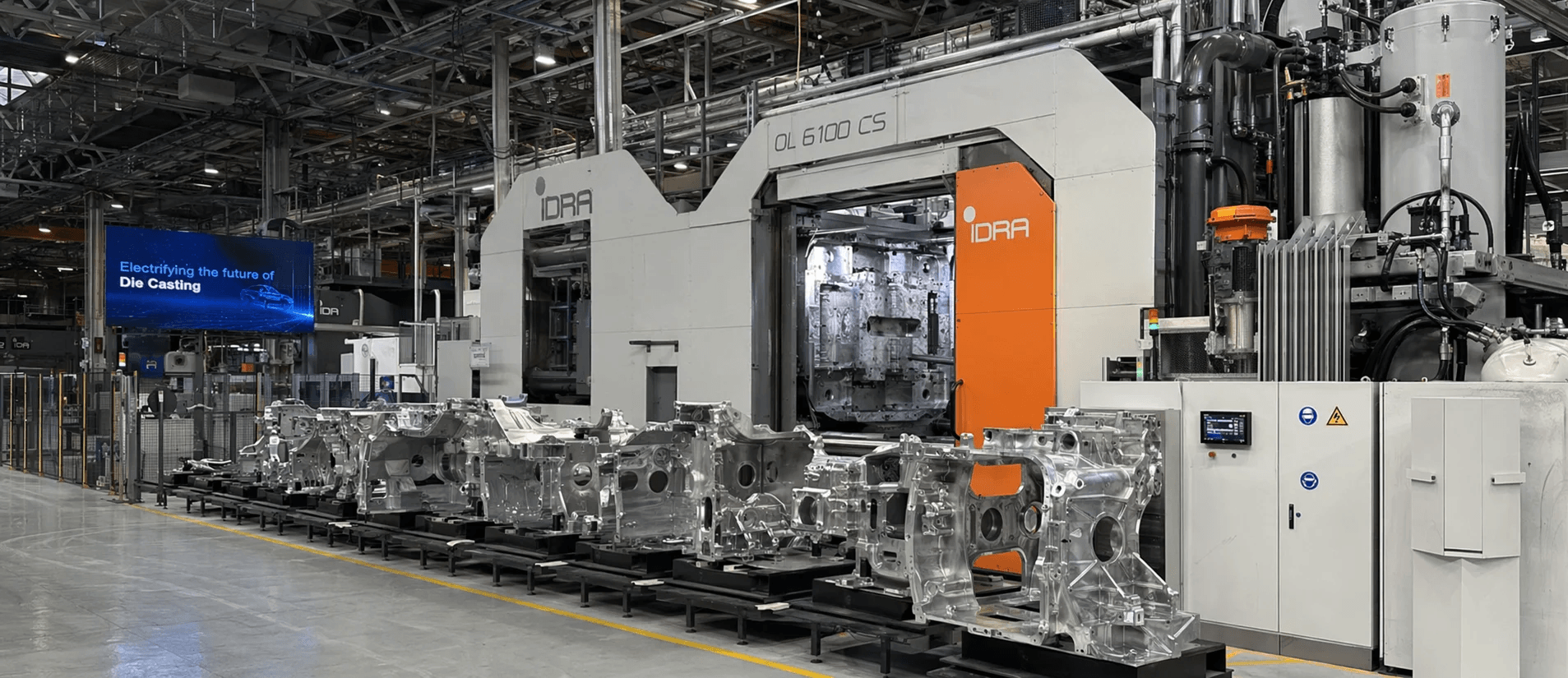
Tesla fired the starting gun at the end of 2020, commissioning an Idra OL 6100 CS — the world’s first operational “gigapress” — to produce the Model Y rear underbody as a single 6,000-tonne shot. The part consolidated roughly 70 stampings and weldments into one aluminium casting, eliminating hundreds of assembly steps, metres of structural adhesive, and an entire body-shop sub-line. What followed was a tonnage escalation that few outside the equipment supply base predicted: 6,000 → 9,000 → 12,000 → 16,000 tonnes, with credible signals that 20,000-tonne machines are in development. Every major OEM — BYD, Geely, Toyota, the German luxury manufacturers — now has a gigacasting programme at some stage of planning, pilot, or series production.
The metallurgical bottleneck. The scale of these castings creates a problem that conventional thermal processing was never designed to solve. A traditional aluminium structural casting destined for suspension or body-in-white use undergoes solution heat treatment followed by quenching and artificial ageing — the T6 or T7 temper — to develop its full mechanical properties. But when you take a thin-walled structure spanning two metres and plunge it from roughly 500°C into a water or polymer quench, differential thermal contraction distorts it beyond recovery. The part emerges from quench looking less like an engineering component and more like a potato crisp.
This is why gigacasting’s real innovation is not the press — impressive as a 16,000-tonne clamping unit is — but the alloy. “Heat-treatment-free” or “as-cast” aluminium formulations must deliver sufficient yield strength, elongation, and crash-energy absorption straight from the die, without the thermal processing that conventional structural castings depend on. Tesla, BYD, Xiaomi, NIO, and others have each invested in proprietary alloy development programmes, treating their formulations as strategic intellectual property. These alloys typically rely on carefully tuned micro-alloying — combinations of silicon, magnesium, manganese, strontium, titanium, and other elements at precise ratios and thermal histories — to precipitate strengthening phases during the controlled cooling that occurs within the die itself, not in a downstream furnace.
The economics are unforgiving. A single 9,000-tonne die-casting cell — press, die set, peripheral equipment, and commissioning — carries a price tag in the tens of millions of euros, creating a capital barrier that small and mid-sized Tier 1 suppliers cannot cross. This is not an accidental consequence; it is a structural force accelerating the consolidation of the supply base around a smaller number of well-capitalised players. Furthermore, the “all or nothing” nature of a gigacasting means that a single defect — porosity at a critical bolt boss, a cold-shut across a load path — often requires scrapping the entire part. There is no rework path, no local repair, no welding salvage. Process capability must be demonstrated at CpK levels that were aspirational in conventional die casting and are now the minimum entry ticket. Finally, some as-cast alloy grades, in their pursuit of die-released usability, trade off elongation and crash-energy absorption relative to their heat-treated conventional counterparts — a compromise that remains an active area of materials research.
For the die caster evaluating entry into this segment, the question is not whether the technology functions — it demonstrably does, and the parts are on the road. The question is whether the programme volumes, part pricing, scrap-rate assumptions, and internal process discipline collectively support the economics over a multi-year production run. A 9,000-tonne press that runs at 45% OEE is not a strategic asset; it is a financial liability with a very large foundation.
4. Air Tightness and Dimensional Precision: High-Voltage Electronics, One Cast Wall Away
The electrical heart of an EV generates substantial heat — and must be cooled actively, continuously, and without compromise. This places the coolant circuit in intimate proximity to high-voltage electronics, often separated by nothing more than the die-cast aluminium wall of the housing itself. A cast-in water jacket in a motor housing runs coolant at 2–3 bar through galleries that may be as little as a millimetre or two away from copper windings carrying 400A. A battery tray contains coolant channels running beneath cells storing tens of kilowatt-hours. The requirement is not “low leakage.” It is zero leakage, verified at a resolution the human eye cannot approach.
Helium as the inspector. The industry’s response has been to make high-vacuum die casting the baseline process for any part incorporating an integrated cooling gallery, and to elevate helium leak testing from a periodic audit check to a 100% in-line requirement. Helium, as the second-smallest molecule, penetrates leak paths that water or compressed air might never reveal — and a leak that passes a water-immersion test today can open under months of thermal cycling in service. Typical acceptance criteria for EV powertrain housings specify helium leak rates in the range of 10⁻⁴ to 10⁻⁶ mbar·L/s, depending on the part geometry and the OEM’s internal standards. These are numbers that demand the vacuum system on the die-casting machine, the degassing of the melt, the venting design of the tool, and the shot-profile parameters to operate as a single integrated system — not as independently adjusted variables.
The production implication is significant: a helium leak-test station is not a small addition to the end of a machining line. It requires a sealed test chamber, a mass spectrometer, a helium supply and recovery system, and a cycle time compatible with the line’s throughput. For parts that fail, the root-cause investigation must trace back through the casting process — was it a transient vacuum decay? A melt gas level excursion? A die-temperature drift that altered solidification? This demands data infrastructure that connects the leak-test result to process parameters from the shot itself, usually through the part serial number and a manufacturing execution system. Few shops have this infrastructure on day one of an EV programme.
Thin walls, tight tolerances. Weight reduction — the primary driver of electrification in the first place — pushes wall thicknesses to their practical floor. Structural sections of EV die castings routinely specify 2 to 3mm wall thickness, thin enough that filling behaviour, solidification shrinkage, and ejection forces all become critical simultaneously. At these thicknesses, maintaining dimensional accuracy across a part that may be a metre or more in length requires thermal management of the die that borders on active process control: dozens of independently regulated heating and cooling circuits, real-time temperature monitoring at multiple die points, and closed-loop adjustments to hold the entire die within a narrow thermal window across the full cycle.
The CNC finishing operations that follow casting must deliver micron-level precision on datum surfaces and bore positions, because the motor, gear train, and shaft seals that mount to these housings have cumulative tolerance stacks that do not forgive. Die steel selection, cutting-tool strategy, and workholding that were adequate for a transmission case may not be adequate for an EV drive-unit housing — a lesson that has been learned the hard way on more than one programme ramp-up, usually at the cost of several months’ delay and a strained customer relationship.
5. Magnesium: The Lightweighting Frontier Where Chemistry Still Pushes Back
Aluminium has been the default structural metal for automotive die casting for decades, but electrification’s relentless demand for range — every kilogram saved translates to battery mass that does not need to be carried — has revived serious interest in an old contender.
The physics are unambiguous. Magnesium’s density of 1.74 g/cm³ compares with aluminium’s 2.7 g/cm³, yielding approximately 36% weight savings for an equivalent-volume component. In a world where OEMs will spend hundreds of euros to save a single kilogram through battery chemistry or structural optimisation, a magnesium inverter cover or motor end-cap that saves several kilograms at a marginal material-cost difference is an economically compelling proposition. The mathematics of the business case are not in dispute.
Experience exists, but at small scale. The automotive industry is not starting from zero with magnesium. Steering wheel armatures, instrument panel supports, and other interior structural brackets have been die-cast in magnesium alloys for years, with established production volumes, alloy specifications, and process parameters — these are mature applications. The extension to large-dimension powertrain housings — inverter covers, motor end-caps, potentially even structural body components — represents the logical next step, but one that remains in the transition from low-volume validation to series production. Stable mass-production volumes have not yet materialised at the scale that would make magnesium a genuine substitute for aluminium across the broad supply base, and the gap between a successful pilot run and a reliable 500,000-unit-per-year process is where the industry currently operates.
Three problems that will not resolve themselves. First, magnesium is pyrophoric. Fine chips and dust from machining operations ignite readily, and a magnesium fire cannot be extinguished with water — it burns hot enough to dissociate H₂O into hydrogen and oxygen, fuelling its own combustion. Machining lines require specialised extraction, inert-atmosphere chip handling, and Class D fire suppression, all of which add capital cost and operational complexity relative to equivalent aluminium lines. Second, magnesium’s corrosion behaviour in the presence of dissimilar metals and glycol-based coolant fluids demands robust coating and surface treatment strategies — conversion coatings, e-coat, or specialised paints — that add process steps and cost. Third, magnesium’s narrow solidification range and high reactivity in the molten state make die-casting process control more demanding than aluminium: hot-tearing, oxidation, and die soldering are persistent challenges that require tight thermal management, protective cover gases, and specialised die coatings that aluminium foundries may not have experience with.
The Chinese market as proving ground. China’s position as the world’s largest producer and consumer of EVs — combined with product development cycles that move faster than in Europe or North America — has made it the primary testing ground for magnesium powertrain components at production-adjacent scale. European and North American OEMs and Tier 1 suppliers are watching these developments closely; Mercedes-Benz and BMW have each deployed magnesium components in production models, and the knowledge base exists. But the volume ramp and the total-cost equation remain works in progress. The supplier that solves magnesium’s process-reliability challenges at production scale will own a structural cost advantage in a market where every gram counts — but that is a research-and-engineering programme measured in years of sustained investment, not a single development project with a fixed endpoint.
The electrification of the automobile is conventionally discussed in terms of batteries, motors, and software architecture. For the die-casting supply base, it means something more prosaic but equally transformative: the rules of the game have been rewritten by a set of components that look superficially like the castings the industry has always produced, but demand a fundamentally different quality infrastructure. The investment required — in cleanliness laboratories, vacuum-capable die-casting cells, automated deburring lines, helium leak-detection systems, and metallurgical research — is substantial and ongoing. It favours organisations that can amortise these costs across multiple programmes and customer relationships, and it punishes those that attempt to meet the new requirements with the old toolkit. The consolidation that gigacasting has accelerated at the top of the market is, at a different scale, playing out across every tier of the supply chain. The shops that treat electrification as a process-quality problem to be solved will find themselves with more work than they can handle. The ones that treat it as a specification to be negotiated downward will not be in the conversation long enough to notice it has moved on.