
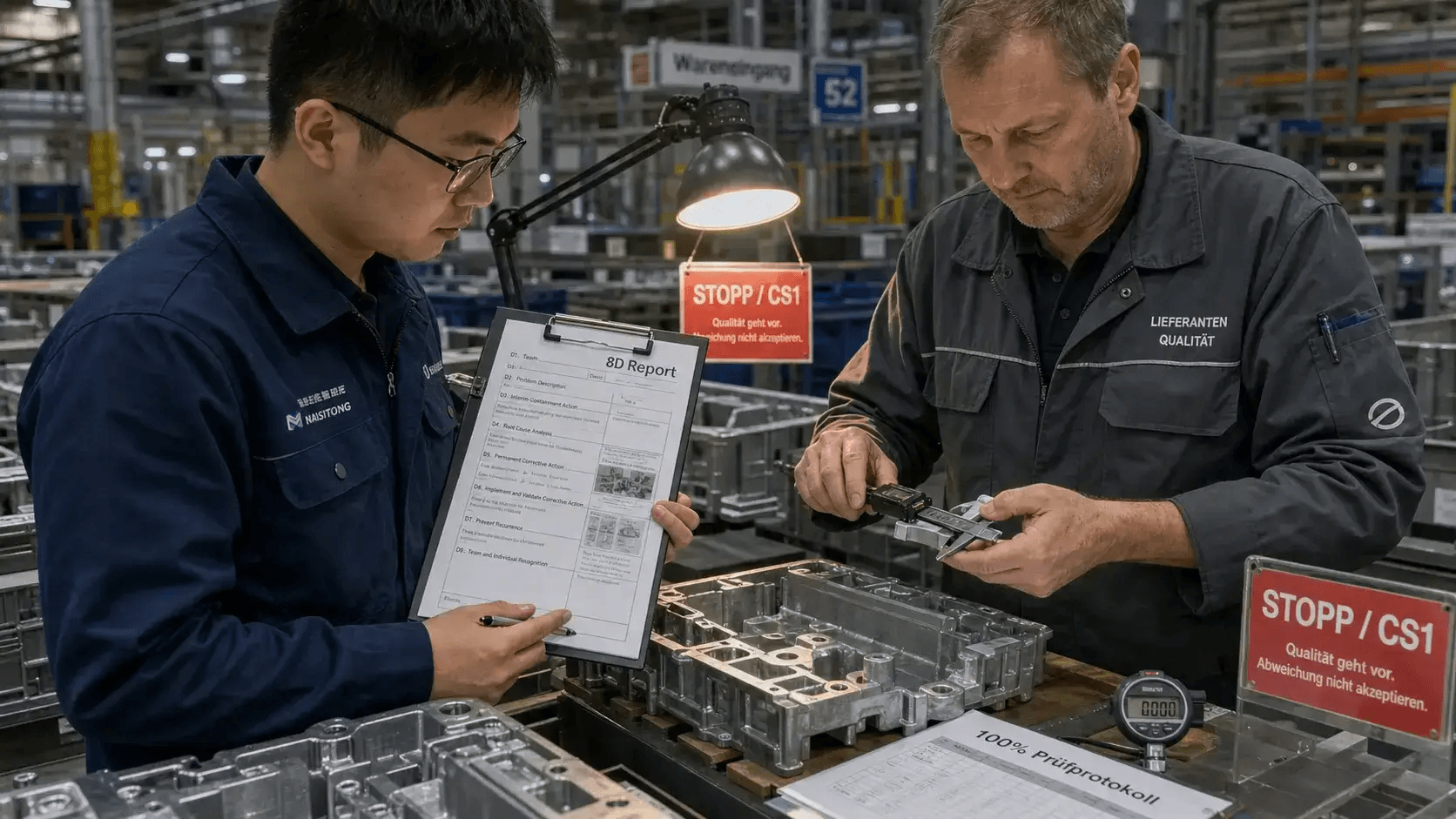
Controlled shipping is the European automotive industry’s emergency brake when a supplier’s parts are causing quality problems downstream. For a Chinese die-casting plant exporting to a German Tier-1, the first containment notice often arrives suddenly and reads like opaque bureaucracy. This article explains the mechanism, your obligations, and how to plan a path out.
What CS1 and CS2 require
CS1 (also CS Level 1 or Q1) requires parallel inspection. Parts continue on the normal logistics path, but you must add a second inspection step before release — typically 100% visual or gauged inspection against specification. You pay for it. Documented sort records travel with every shipment.
CS2 (also CS Level 2 or Q2) adds the same parallel inspection plus a redundant inspection at the customer’s site — again at your cost. From this point, your parts are not trusted in the customer’s incoming process. Each delivery must be re-validated by a third-party quality provider before it enters the line.
The levels are sequential: CS1 first. If defective parts continue to escape, the customer escalates to CS2.
Why negotiation is not an option at this stage
IATF 16949 gives customers the right to invoke controlled shipping unilaterally. Your supplier agreement almost certainly states that you shall implement controlled shipping at the customer’s request, at your cost, until exit criteria are met. There is no room for commercial negotiation here — only execution.
Calling the customer’s supplier quality manager to ask whether containment costs can be shared rarely goes anywhere. The objective is not price. It is rebuilding trust.
Your only real lever is speed: how fast a credible 8D is submitted, how fast sorting data proves effective, how fast exit criteria are met.
Why CS1/CS2 is especially hard from China
Three factors make controlled shipping particularly painful for overseas suppliers:
First, the sorter must be local to the customer. Flying your own engineer over for a four-week containment rarely adds up: visa, hotel, weekend downtime, one person who cannot cover both plant and customer at once. You need a partner who can be at the customer’s gate within 24–48 hours.
Second, the 8D runs on European working hours. Customers typically expect D2 (problem description) within 24 hours, D3 (interim containment) within 48 hours, and a full 8D within ten working days. Time zones shrink your effective response window further.
Third, exit criteria are objective. The usual requirement is zero defects over N consecutive shipments — often 20 or 50. One escape resets the counter. Sloppy sorting extends containment by weeks.
What a local partner can do
A field engineer who speaks German and Chinese and understands die-casting defect taxonomy can:
- Be on site within one business day to set up sorting, align acceptance criteria, and start photo and gauge documentation from day one
- Translate customer findings back to your plant in technical Chinese, not corporate English that shop-floor staff misread
- Run the 8D in two languages: German to the customer, Chinese to plant management — same data, updated in sync
Without that bridge, escalation from CS1 to CS2 is significantly more likely. CS2 costs roughly three times CS1 — and makes new programs with that customer unlikely for the following twelve months.
When to bring in support
Do not wait for the formal CS1 letter. The moment a customer raises a quality alert, spike form, or RGA number on your parts, the clock is running. Pre-emptive sorting at the customer’s incoming area — before CS1 is formally invoked — often prevents entry into the controlled-shipping register and protects your supplier rating.
If you are in a CS1 or CS2 situation and need on-site support in Germany or neighbouring European countries, get in touch.