
An email from your European customer lands in your inbox. It reads: “Incoming inspection detected porosity exceeding spec. Entire batch blocked.”
You might be at your factory, or at home with your family. Time zones and holidays make a phone call impossible, and your customer’s production line in Germany is waiting for those parts. The quality manager’s language is peppered with “Containment” and “8D” — you know this is serious.
In the many cross-border complaints NaiSiTong has handled, the root of most problems isn’t technical insolubility. It’s the process, the communication, and the response speed that become the bottleneck. What should you confirm with the customer first? When to send someone on-site? How to negotiate lower defect rates through on-site discussion? How to convince the customer to grant a concession or allow rework?
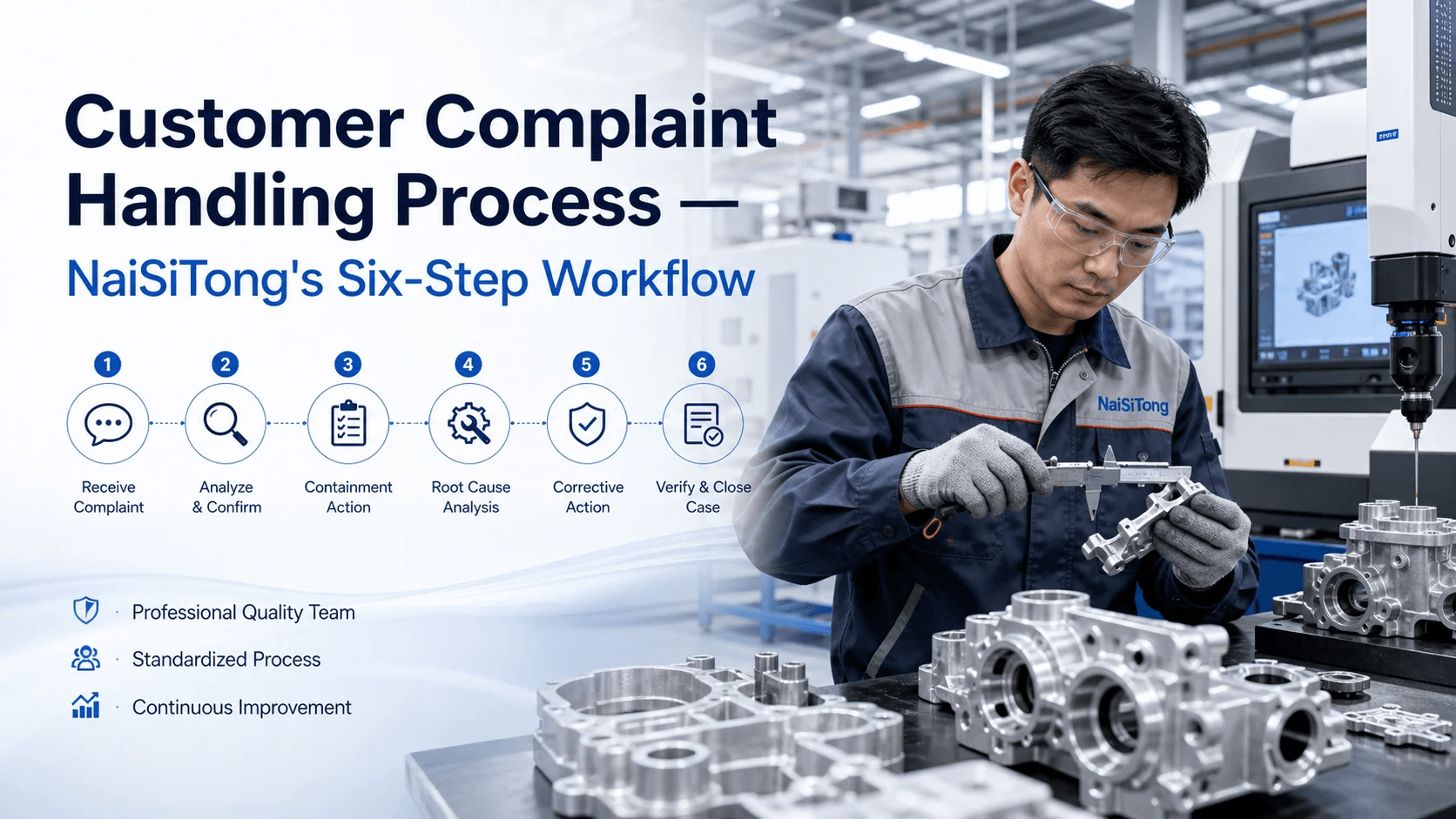
We’ve broken down the entire crisis-management process into a standard six-step methodology. Every step has a clear objective, deliverables, and anti-pitfall guidance. Here is the full breakdown.
📌 Step 1: Project Launch — Reconstruct the Scene Before You Diagnose
Core mission: Don’t jump to internal conclusions. Reconstruct the actual scene on the ground first.
The moment a complaint notification arrives, most factories react with internal investigation: pull inspection records, call a production meeting, have the tooling engineer look at samples. That’s not wrong — but it’s the wrong sequence.
The customer’s “porosity exceeding spec” and your “porosity exceeding spec” may be two entirely different things. They used X-ray inspection; you may have only done visual sampling at outgoing. Their “entire batch rejected” might in reality mean 3 defects found among 10 samples. Doing an internal post-mortem without first-hand information from the field is diagnosing blindfolded.
At this step, NaiSiTong engineers conduct a structured project briefing with you to quickly clarify three things:
- Technical details of the complaint: What standard did the customer reference? Where are the defect photos? What are the batch numbers, part numbers, and shipping dates? — The more precise, the better.
- The customer’s real demand: Do they just want an 8D report, or are they demanding immediate on-site sorting? Has Containment already been initiated? Is there a Line Stop risk? What is the daily production line shortage?
- Your factory’s known information: What inspections were done on this batch before shipping? Are retained samples still available? Has this part had similar complaints before? What might have caused this?
💡 Delivery timeline: This step is typically completed within 1 business day. Once the information is aligned, you can accurately assess the severity level and know exactly where to go next.
📌 Step 2: Contact the Customer — Professional Alignment, Not Message-Passing
Core mission: Transform communication from “relaying messages” into “technical peer-to-peer negotiation” — and build professional trust.
A common mistake at this stage is having sales or trade coordinators handle communication with the European customer. Salespeople rarely understand the technical details of die casting, and the customer’s quality manager has no patience for explaining standards. The conversation quickly devolves into mutual deflection.
The key is this: build professional trust. In a crisis, the customer needs to hear from someone who can discuss defect types, inspection standards, and solutions — not someone who keeps repeating “we’re looking into it.”
NaiSiTong engineers interface directly with your customer’s quality team, using the language they’re comfortable with (German or English) and the technical vocabulary they expect, to confirm:
- The specific defect classification (porosity, shrinkage, cold shut, or dimensional deviation)
- The batch proportion and severity level of the defects
- The customer’s expected response timeline, and whether on-site sorting needs to begin immediately
💡 Critical pitfall: Managing customer expectations is essential. Many customers make unrealistic demands at the start of a complaint (e.g., return the entire batch plus 100% inspection within 48 hours). NaiSiTong engineers use facts and data to help the customer understand what a reasonable response cycle looks like — without making it seem like you’re stalling, and without letting unreasonable demands crush you.
📌 Step 3: Customer Visit — Set Standards Face-to-Face, Contain the Loss at the Shop Floor
Core mission: Confirm the defect boundary, calibrate inspection standards, and minimize the supplier’s loss as much as possible.
No amount of remote communication can replace being there in person. Defect judgment is always finalized at the customer’s plant — not in a messaging group.
NaiSiTong engineers arrive at any European customer site within 24 to 48 hours of notification (24 hours within Germany, 48 hours for the rest of the EU and Schengen area). The visit has three layers of purpose:
- Layer 1: Confirm the defect boundary. What the customer calls “porosity exceeding spec” might turn out to be minor surface-visible pores on-site — or it might be extensive internal shrinkage under X-ray. Final defect determination must be done using the customer’s gauges and the customer’s standards, at the customer’s facility.
- Layer 2: Calibrate inspection standards (the most frequently overlooked critical point). The European incoming inspector has their own judgment habits; your outgoing inspector back home has a different set of standards. If you don’t align “what’s acceptable vs. what’s not” face-to-face with sample parts, even after you sort, the customer will still reject later. NaiSiTong engineers create borderline samples on the spot to unify the judgment criteria on both sides.
- Layer 3: Minimize the loss — as much as possible. On-site assessment often reveals that only 30% of the batch actually needs rework, 60% can be used as-is, and 10% is truly scrap. Without a professional on-site to separate these three categories, the customer’s safest move is “return the entire batch.” The cost of a round-trip air freight plus tariffs plus line-down penalties can pay for two years of a resident engineer in Europe. Our engineers can downgrade “return” to “sorting,” and “100% inspection” to “concession” or “batch-selective sorting.”
📌 Step 4: Action Plan — Data Speaks, and Speed Is the Professional Signal
Core mission: Within 1 business day after the site visit, deliver a clear sorting and rework action plan.
After the site visit is complete (often confirmed directly with the customer while still on-site), NaiSiTong produces a targeted execution plan at the earliest opportunity. This is not a formality — it’s the foundation for all subsequent decisions, and typically includes:
- Defect classification statistics: Quantified by defect type, severity, and batch distribution.
- Sorting plan recommendation: 100% inspection or sampling, detailed unified inspection criteria, Sorting Station setup.
- Rework feasibility assessment: Which defects can be reworked, whether reworked parts can meet specification, rework cost vs. scrap cost comparison.
- Workload estimate: Man-hours required, number of days to complete, what auxiliary equipment is needed.
💡 Critical pitfall: The worst thing you can do here is deliver the report slowly. The customer is waiting for a plan; their production line is facing a stoppage. Every day of delay costs enormous money. Speed isn’t just speed — it’s a signal of professionalism.
📌 Step 5: Sorting & Rework — Execution Is the Hard Currency, Plus Dynamic Optimization
Core mission: Execute strictly according to standards and work instructions — while dynamically optimizing criteria and holding the quality line.
The first four steps can be done beautifully, but if on-site execution falls short, everything resets to zero. NaiSiTong follows four iron rules during the execution phase:
- Work instructions first: Before sorting begins, the engineer confirms the Sorting Work Instruction with the supplier, detailing inspection sequence, judgment criteria, and recording format.
- Full team training: Every person involved in sorting must read through the work instruction and pass a test using standard sample parts before they touch a single real part.
- Engineer on-site supervision: Boundary judgments are handled clearly. When situations arise that the work instruction doesn’t cover, they’re recorded and escalated on the spot — no stopping, no waiting.
- Complete data recording: Every defective part — its location, defect type, photo, and judgment result — has a clear record. Data is the flesh and blood of the closure report.
🔥 NaiSiTong’s distinctive advantage — Dynamic Reassessment: The sorting station is where information density is highest. After the customer’s production line resumes, our engineers reassess defect types, severity levels, and defect proportions in real time.
Without compromising product function, we proactively and vigorously negotiate with the European customer (SQE / Quality Manager) to relax sorting criteria and explore rework possibilities. Examples: minor scratches or dents on non-cosmetic surfaces, tiny burrs on parts where cleanliness requirements are low. Through technical negotiation on the ground, we help suppliers reduce their defect rate as much as possible — reducing your loss while simultaneously improving the customer’s satisfaction with your factory.
📌 Step 6: Complaint Closure — Closure Is Not the End; It’s the Beginning of On-the-Ground Intelligence
Core mission: Conduct multi-party closure communication and bring back “core intelligence” from the European front line.
Sorting is done, the report is filed, and many people consider the complaint closed. But what truly separates suppliers who win in export markets is this final step. NaiSiTong engineers hold an in-depth closure meeting with you and your customer:
📊 1. Deliver Standard Closure Data
- How many parts were sorted in total? What are the precise quantities of each defect type?
- How many were successfully reworked? What is the final count of OK parts released?
🔍 2. Data-Driven Technical Review
- Root cause analysis based on field sorting data (are defects randomly distributed or concentrated in a specific die cavity number?) — providing real causal analysis to help adjust factory processes and inspection workflows with precision.
- Timeline summary: What was the initial chaos like? How did we actively manage and escalate step by step? What outcome did we ultimately achieve?
🤝 3. Exclusive Value: European Front-Line “Business Intelligence”
Beyond the technical report, we share candidly with the supplier:
- Customer engineer communications: the customer’s real attitude and feedback during this incident.
- Team dynamics and personalities: Who is the strict, principle-driven person? Who is the flexible, relationship-oriented one?
- The customer’s future focus points: What inspection metric will they be watching most closely when the next shipment arrives?
💡 Critical pitfall: Many suppliers invest enormous effort in sorting, but because the closure communication is sloppy, doubt lingers in the customer’s mind — and if another similar issue occurs in the next batch, CS1 (Controlled Shipping Level 1) arrives. The core value of closure is convincing the European customer that you have the self-correcting ability not to make the same mistake twice.
NaiSiTong’s six-step process is a complete closed-loop chain, not a collection of disconnected point services. From receiving the notification to final closure, information accumulates at every step, and every decision paves the way for the next round of commercial negotiation.
The next time you’re standing at the edge of a European customer’s production line, watching a NaiSiTong engineer sort parts and negotiate technically, what you’re seeing isn’t just someone doing the work for you — it’s a standard operating procedure (SOP) forged through countless tough complaint cases. It turns overseas chaos back into something you can control.