
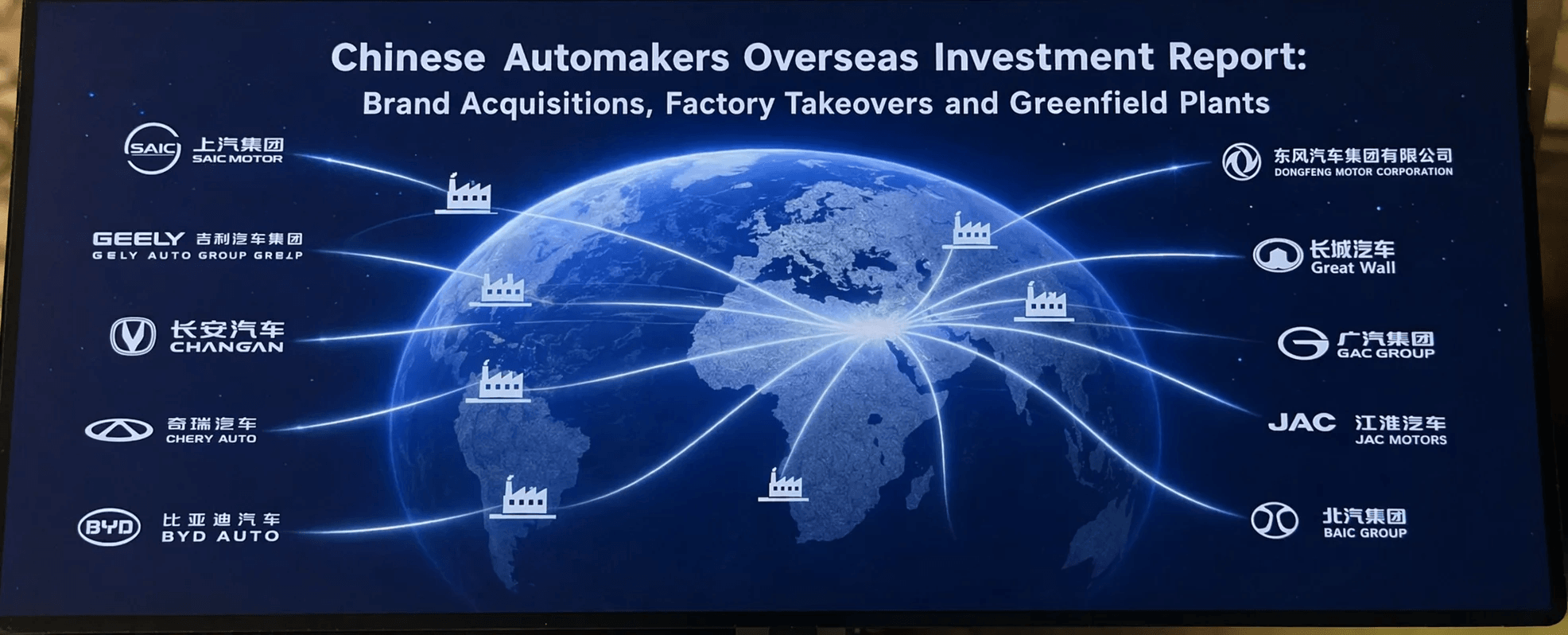
In 2010, when Geely bought Volvo from Ford, the deal was framed as a curiosity — a private Chinese company snapping up a Swedish icon. Fast-forward sixteen years, and the curiosity has become a blueprint. Chinese automakers are no longer just exporting cars. They are buying factories, resurrecting dormant brands, and pouring concrete in places no Chinese OEM would have considered a decade ago: a Ford plant in Brazil, a Nissan factory in South Africa, a Mercedes site in São Paulo state.
What has changed is not merely ambition. It is the convergence of three forces — domestic overcapacity pushing manufacturers outward, tariff walls making pure export uneconomic, and a generation of Chinese EV and hybrid technology that European and Southeast Asian markets actually want.
This article maps the full landscape: who bought what, who built where, and which bets look most consequential. It also covers the risks that the investment headlines tend to skip.
Brand Acquisitions and Equity Stakes
The most headline-grabbing moves sit in the brand portfolio. Geely is in a league of its own.
Geely Holding Group has assembled a collection that would make any legacy automaker envious. It owns 78.7% of Volvo Cars, controls roughly 66% of Polestar (through Volvo and direct holdings), and holds 51% of Lotus Cars — the British sports-car maker now pivoting to luxury EVs. Its 2013 acquisition of Manganese Bronze Holdings, later renamed LEVC (London Electric Vehicle Company), gave it the iconic black cab. In Malaysia, a 49.9% stake in Proton provides a right-hand-drive manufacturing bridge into Southeast Asia. A 50:50 joint venture with Mercedes-Benz operates the Smart brand globally as an EV-only marque.
Li Shufu, Geely’s founder, has also been building a financial portfolio: a 9.7% stake in Mercedes-Benz Group (making him the second-largest shareholder behind BAIC at 9.98%), a 34.02% slice of Renault Korea, and approximately 17% of Aston Martin Lagonda, where Geely is the third-largest shareholder.
SAIC Motor took a different path, acquiring nameplates rather than going concerns. Its purchase of Nanjing Automobile in 2007 delivered the MG marque — a British brand founded in Oxford in 1924 that now sells more units in overseas markets than in China. The 2010 acquisition of LDV Group became Maxus, SAIC’s commercial-vehicle export brand. Roewe, SAIC’s domestic premium line, was built on IP purchased from the collapsed MG Rover Group in 2006. SAIC also participated in GM’s acquisition of Daewoo Motor in 2002 with a 10% stake and once controlled SsangYong (2004–2010, since divested).
BAIC Group acquired core technology assets from Saab in 2009 to underpin its Senova brand, and today holds 9.98% of Mercedes-Benz Group — the single largest shareholder.
Dongfeng Motor took a 14% stake in PSA Peugeot Citroën in 2014, which converted into a smaller position when PSA merged with FCA to form Stellantis in 2021. Dongfeng has since reduced its holding and pivoted to a new strategic cooperation agreement with Stellantis, signed in May 2026, covering EV production and European market entry for its Voyah brand.
Chery made a notable move in 2024, partnering with Spain’s EV Motors in a joint venture that revived the dormant Spanish brand EBRO — a template of “Chinese technology, local badge” that is becoming a recurring pattern.
The Factory Map: Who Is Building Where
BYD — The Most Aggressive Builder
No Chinese automaker has committed to overseas manufacturing at BYD’s scale and speed.
- Thailand (Rayong): A greenfield passenger-vehicle plant, operational since 2024, with annual capacity of 150,000 units. Thailand is BYD’s ASEAN hub.
- Brazil (Camaçari, Bahia): BYD acquired Ford’s former manufacturing complex and converted it to EV production — covering passenger vehicles, bus chassis, and battery processing. The site is operational, though construction-phase labour practices drew scrutiny from Brazilian authorities, a reminder that overseas projects carry compliance risks unfamiliar at home.
- Hungary (Szeged): Under construction — the first full-vehicle manufacturing plant by a Chinese automaker inside the European Union.
- Turkey: A $1 billion investment agreement signed in July 2024 for a 150,000-unit plant, leveraging Turkey’s customs union with the EU. Subsequent status should be checked against the most recent official disclosure.
- Indonesia (Subang, West Java): A $1.3 billion investment for a 150,000-unit NEV plant, slated to begin production in 2026.
- Uzbekistan (Jizzakh): A joint venture with UzAuto, already operational, assembling PHEV models via CKD/SKD.
- Other sites: A joint venture in Pakistan (Karachi’s Port Qasim, targeting H1 2026), SKD assembly in India, an electric bus plant in Lancaster, California (operational since 2013), and an announced assembly facility in Malaysia.
Geely / Volvo Ecosystem
Geely’s manufacturing footprint combines inherited Volvo plants with opportunistic acquisitions.
- Brazil: Geely took a minority stake in Renault do Brasil, gaining access to Renault’s local production lines for NEV assembly.
- Europe and the US: Volvo Cars operates plants in Torslanda (Sweden), Ghent (Belgium), and Ridgeville, South Carolina (US). LEVC builds electric taxis at Ansty Park near Coventry, UK. Lotus produces sports cars at Hethel, Norfolk.
- Southeast and Central Asia: Proton’s facilities in Malaysia handle CKD assembly; a localisation partnership operates in Uzbekistan.
Chery — Resurrecting Idle Assets
Chery has developed a pattern of taking over plants that global automakers have walked away from, then pairing them with local brands.
- Spain (Barcelona): A 2024 joint venture with EV Motors took over Nissan’s former Zona Franca plant to revive the EBRO brand.
- South Africa (Rosslyn): In early 2026, Chery reached an agreement to acquire Nissan’s Rosslyn vehicle and stamping plant — a facility with nearly sixty years of operational history — with handover expected mid-2026.
- Brazil (Jacareí): Chery built its own plant in 2014, then brought in Brazilian partner Caoa Group as a joint-venture partner in 2017.
- Other regions: Joint ventures or CKD operations in Vietnam, Egypt, Uzbekistan, Russia, Indonesia, and Pakistan.
SAIC Motor — MG as the Right-Hand-Drive Spearhead
- Southeast and South Asia: SAIC operates an MG plant in Thailand through a joint venture with Charoen Pokphand Group. Its Indian subsidiary was restructured into JSW MG Motor India in 2024, bringing in Indian conglomerate JSW Group as a partner. MG assembly bases also exist in Indonesia and Pakistan.
- Europe: SAIC has announced plans for its first European passenger-vehicle plant; specific location and timeline should be referenced against official announcements. The Longbridge plant in the UK was fully shut down in 2016.
Great Wall Motor and Changan
- GWM: Operates a full-process plant in Tula Oblast, Russia; acquired GM’s former Rayong plant in Thailand in 2020; acquired Mercedes-Benz’s former Iracemápolis plant in Brazil in 2021 (now operational). Local assembly partnerships are active in Indonesia and Uzbekistan.
- Changan: Through its “Haina Baichuan” (A Hundred Rivers to the Sea) internationalisation programme, Changan is building a NEV production base in Thailand and partnering with local players in Brazil to retool existing facilities for extended-range pickup production. CKD operations exist in Vietnam and Pakistan.
The Startup Cohort
- Leapmotor: The most advanced of China’s EV startups in overseas manufacturing. Through its joint venture with Stellantis (which holds a 20% stake), Leapmotor is using Stellantis production lines in Europe — including the Figueruelas plant in Zaragoza, Spain — for localised manufacturing, a kind of reverse contract manufacturing.
- XPeng: In July 2025, XPeng launched its first overseas KD assembly line in Purwakarta, West Java, Indonesia, operated by local partner Handal Indonesia Motor, assembling the X9 model. Further overseas manufacturing moves should be tracked against official disclosures.
- GAC Aion: Localised NEV plants in Thailand and Indonesia have entered production, ramp-up, or commissioning phases.
- Dongfeng Voyah: In May 2026, Stellantis and Dongfeng signed a 51/49 joint venture framework for Voyah-branded vehicle sales and distribution in designated European markets, with plans to explore localised production at Stellantis facilities.
- NIO and Li Auto: Neither operates any overseas vehicle manufacturing. NIO’s only overseas physical asset is a battery-swap station assembly facility in Hungary — not a vehicle plant.
Three Structural Trends
1. From Asset-Light Export to Asset-Heavy Localisation
The 2010s were about brand acquisitions — Geely buying Volvo, SAIC acquiring MG. The 2020s are about bricks and mortar. Tariff walls — the EU’s countervailing duties on Chinese EVs, the US Connected Car Rules effectively banning Chinese-connected vehicles, India’s investment screening — have made pure export economically brittle. The response has been to build inside the walls: BYD in Hungary, Chery in Spain, Leapmotor through Stellantis.
2. Technology Export, Badge Agnosticism
A growing share of Chinese overseas capacity does not carry a Chinese brand nameplate. Chery’s Barcelona plant produces EBRO-badged vehicles. Leapmotor’s Stellantis-produced cars wear Leapmotor badges but emerge from a European factory floor. The strategic logic is clear: technology travels under a local logo, sidestepping the brand-acceptance friction that Chinese marques still face in some markets.
3. Startups Breaking the Zero-Footprint Pattern
For years, the narrative was that China’s EV startups — NIO, XPeng, Li Auto — were pure exporters with no overseas manufacturing ambition. That is changing. Leapmotor has production running in Europe. XPeng has KD assembly in Indonesia. The pattern is still nascent, but the direction of travel is unmistakable.
What the Investment Headlines Leave Out
No mapping of overseas investment is complete without acknowledging the risks that don’t fit neatly into a factory-count table.
Geopolitical and regulatory risk. The United States has effectively closed its market to Chinese-connected vehicles. The EU’s anti-subsidy investigation has already resulted in additional tariffs. India screens Chinese investment on national-security grounds. Any of these frameworks can shift with a change of government, leaving multi-year factory projects exposed.
Labour and compliance exposure. BYD’s Camaçari site in Brazil was temporarily suspended by Brazilian authorities over construction-phase labour conditions — a sharp reminder that the labour and compliance environment in overseas markets bears little resemblance to domestic Chinese norms. Unionised workforces, works councils, and local labour law introduce a layer of operational complexity that no amount of manufacturing expertise can bypass.
Currency and financial risk. Large-scale overseas investment is denominated in foreign currency. RMB depreciation or appreciation can materially alter the return profile on multi-billion-dollar commitments. This is not a theoretical concern — it is a structural feature of any cross-border capital deployment at this scale.
Tariff whiplash and rules of origin. Localised production does not eliminate tariff exposure. If the EU tightens rules of origin — requiring a higher share of locally sourced components to qualify for preferential treatment — supply chains that still depend on Chinese-made subassemblies could face cost shocks.
Brand perception and time-to-trust. The gap between “made by a Chinese automaker” and “a brand I trust” remains non-trivial in several key markets. Building a factory takes two to three years. Building a brand takes longer — and the payback clock on investment does not pause while trust accumulates.
The shift from “made in China, sold worldwide” to “made worldwide, sold worldwide” is a structural leap, not an incremental one. Getting the factory count right matters. Getting the risk assessment right matters more.