
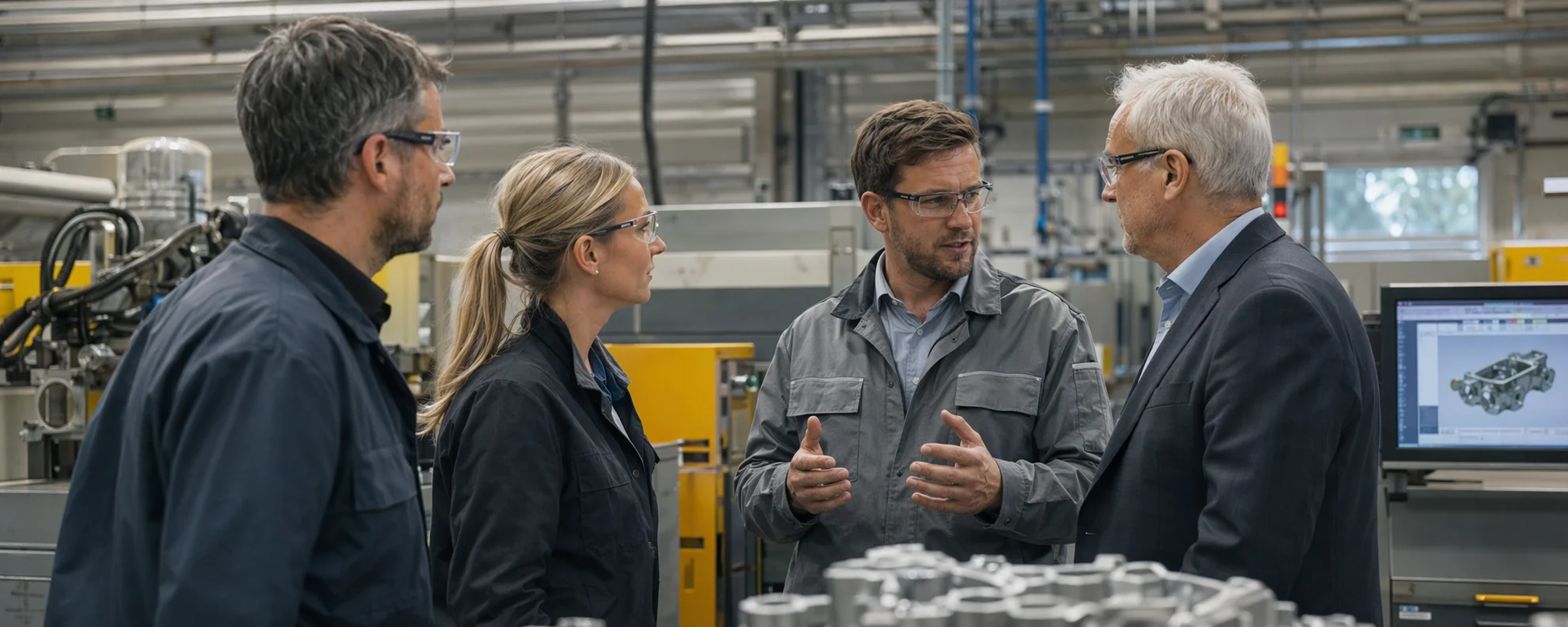
Ask any die-casting supplier what it takes to enter the European market, and the answer is predictable: technical capability, consistent quality, competitive pricing. Every foundry chasing European contracts has built its pitch around these three pillars. And for winning the first order, those pillars still hold.
The problem is that they stop holding the moment the relationship moves from procurement evaluation to live production. Once parts are flowing, once tooling is running, once production schedules are interdependent, the customer’s definition of reliability starts shifting — quietly, and for many suppliers, unexpectedly.
What European procurement, quality, and project managers actually judge after the first six months is not whether you can cast a good part. They already know you can. They are judging whether you can be a partner — and that judgment turns on communication in ways that most suppliers underestimate.
Why communication is becoming a core dimension of supplier reliability
The traditional supplier evaluation framework is technical at its heart. Can the foundry hold dimensional tolerance across a production run? Are the mechanical properties within specification? Does the part pass leak testing and X-ray inspection? These questions determine whether a supplier qualifies for the shortlist, and for many foundries, they are the only questions that get serious investment — better machines, tighter process control, more inspection stations.
None of that investment is wasted. But it addresses a problem that, in long-term European supply relationships, is rarely the one that ends the relationship.
The question European clients are actually asking has changed
When a partnership moves past the first few purchase orders, the customer’s internal conversation about a supplier quietly shifts from “does this part meet the drawing?” to a broader set of questions:
- When a project milestone slips, does the supplier tell us before we have to ask?
- When a quality deviation emerges mid-batch, does the supplier surface it immediately or wait until the full investigation is complete?
- When an engineering change request lands, does the supplier understand what we are actually trying to solve?
These are not technical questions. They are communication questions. And they matter because a European Tier-1 or OEM procurement team is managing a network of suppliers, not just inspecting individual shipments. Their job is not to verify that every casting meets specification — that is the quality department’s role. Their job is to ensure that the production plan holds together across dozens of suppliers, each of whom is a potential point of failure.
A supplier who delivers perfect parts but communicates poorly is, from this perspective, a supplier whose failure mode is invisible until it is catastrophic. A supplier who ships an occasional defect but communicates with transparency is a supplier whose failure mode is visible, manageable, and ultimately tolerable.
That asymmetry — invisible risk versus manageable risk — is driving a structural shift in how European die-casting clients evaluate their suppliers. Communication is no longer a soft skill. It is a risk management capability.
The European die-casting supply chain is under structural pressure
This shift is not happening in a vacuum. The European die-casting industry is undergoing a transformation that makes communication more critical than it was a decade ago. The electrification of vehicle platforms is driving demand for large structural castings — gigacastings, shock towers, battery trays — that are technically demanding, tooling-intensive, and unforgiving of supply disruptions. Product complexity is rising. Lead times are compressing. The margin for error in the supply chain is shrinking.
For a procurement manager at a German or Italian automotive Tier-1, a typical day involves coordinating supplier deliveries, managing internal production schedules, monitoring quality risks across multiple part numbers, and meeting customer project milestones. They are operating with less slack than they had five years ago, and they need suppliers to reduce uncertainty, not add to it.
What they need from a supplier, more than anything, is reliable information:
- What happened?
- Where is the risk right now?
- What measures have already been taken?
- What is the next step, and when will we know more?
Without this information, the customer cannot decide whether to adjust a production schedule, reallocate internal resources, or escalate a risk to their own client. The worst-case scenario for a European buyer is not that a defect occurs. It is that a defect is brewing, and nobody has told them. The risk they fear most is not the known problem — it is the unknown one.
Supplier reliability, in this environment, is not defined solely by whether the part is good. It is defined by whether the supplier shares the burden of managing risk when things go wrong.
Quality problems are inevitable. How you communicate about them is not.
No manufacturing operation ships defect-free forever. In die casting, the process variables are too numerous and too interdependent for anyone to promise otherwise. Tool wear shifts dimensional characteristics. Melt temperature drifts over a production shift. Vacuum system performance degrades between maintenance intervals. A casting that passed leak test this morning may fail this afternoon for reasons that took weeks to accumulate.
The difference between suppliers is not whether they encounter these problems. It is what they do in the hours and days after they find them.
Consider a real pattern Naisitong has observed repeatedly: a European customer discovers that a batch of die-cast housings is failing air-tightness testing. The customer’s immediate concerns are not abstract. They want to know:
- Does this affect the current production batch that is already on the line?
- Do we need to quarantine existing stock?
- Is sorting or rework required?
- When can we expect conforming parts to resume delivery?
A supplier with mature communication practices responds to these questions before they are asked. They confirm receipt of the issue within hours. They report what is known and what is still under investigation. They propose a containment plan tied to the customer’s production schedule. They commit to a next update with a specific time, not a vague promise.
A supplier without those practices waits until the internal investigation is complete, produces a technically sound 8D report two weeks later, and is genuinely confused when the customer’s trust has eroded. The 8D was thorough. The root cause was identified. The corrective action was implemented. But in the two weeks of silence, the customer’s production team had to manage the uncertainty without any input. That experience — being left to manage a risk blind — is what the customer remembers. The quality of the eventual report is almost irrelevant by then.
The same defect, handled differently, produces a completely different evaluation of supplier reliability. This is why communication capability is not a soft complement to technical capability. It is an independent axis of supplier assessment, and in many long-term relationships, it becomes the more important one.
Cross-border communication gaps amplify risk
For Asian die-casting foundries entering the European market, technical capability is rarely the primary obstacle. Many Chinese and other Asian foundries operate at world-class levels of process control, have invested heavily in advanced equipment, and hold the certifications European customers require.
The friction emerges in the communication layer.
Time zone differences stretch response cycles. A quality issue that surfaces at a German plant at 10:00 AM local time lands in a Chinese foundry’s inbox at 4:00 PM — at the end of the working day. By the time the relevant engineer reads it the next morning, 18 hours have passed. If the response requires internal investigation before any reply, another 24 to 48 hours disappear. To the European customer, the supplier has been silent for three days. To the supplier, they have been working on the problem continuously.
Language differences create their own distortions. A supplier may believe they have adequately responded because they sent an email stating that the issue is under investigation. The European customer, reading that same email, sees no information about risk boundaries, no containment plan, no indication of when they will know more. The supplier thought they communicated. The customer thinks they received nothing actionable. Both are correct within their own framework.
Commercial culture adds a third layer. In many European procurement cultures, surfacing a problem early — before all the data is in — is seen as professional and responsible. In other business cultures, surfacing incomplete information can feel unprofessional, as though the supplier is admitting incompetence before they have had a chance to fix the problem. The result is that the supplier waits to communicate until they have a complete answer, and in the waiting, they create the very impression of unreliability they were trying to avoid.
This is why European clients increasingly value suppliers who can bridge these gaps — not through better translation, but through a fundamentally different approach to communication that aligns with how European supply chain risk is managed. Local communication capability, whether through in-region staff or a trusted on-the-ground partner, is becoming a structural requirement rather than a nice-to-have.
Five communication patterns that erode trust with European clients
In Naisitong’s work supporting European clients and die-casting suppliers across Germany, Italy, Poland, Spain, and beyond, we have seen relationships deteriorate not because of manufacturing capability gaps, but because of communication patterns that fail to meet the risk management needs of European procurement and quality teams.
Here are the five patterns that do the most damage.
1. Radio silence, or responses that arrive too late
When a client raises a concern about a batch of castings — a porosity signal in X-ray, a leak test failure, a dimensional drift — they are not just asking for a root cause analysis. They are asking for a signal that the supplier has registered the problem and is taking ownership.
Some suppliers default to waiting until an internal investigation produces findings before replying. To them, replying without answers feels unprofessional — why tell the customer something they already know? But to the European customer, the silence creates a vacuum that their own internal stakeholders are pressing them to fill. The production manager wants to know if the line needs to slow down. The quality manager wants to know whether to expand the inspection scope. The project manager wants to know whether the delivery milestone is at risk.
The most damaging thing a supplier can do is not to give bad news. It is to give no news at all. A five-line email confirming that the issue has been received, that containment actions are already in motion, and that a detailed update will follow within 24 hours — this alone separates suppliers who retain trust from those who lose it.
2. The perfect-report trap: waiting until everything is resolved
Some suppliers operate on the principle that a complete investigation deserves a complete response. They gather data, run simulations, consult the tooling engineer, verify corrective actions, and only then present the full 8D report to the customer.
The logic is understandable. The result is an information blackout that can last a week or more.
During that week, the European customer is not sitting idle. They are fielding questions from their own production, quality, and planning teams — questions they cannot answer because they have no information from the supplier. They are making contingency decisions based on worst-case assumptions because nobody has given them better ones.
The suppliers who earn the strongest trust communicate in stages:
- First contact: “We have confirmed receipt, we have identified the likely affected batches, containment is underway.”
- Second contact: “Preliminary investigation suggests the root cause is in the vacuum system. We have adjusted parameters on the current run and are monitoring. Full analysis by Thursday.”
- Third contact: “Root cause confirmed, corrective action validated, documentation follows.”
This staged approach gives the customer what they need at each moment: not a perfect answer, but enough information to manage internal risk. European quality managers consistently rate staged communication higher than delayed comprehensive reports, because it allows them to do their job.
3. Guessing instead of reporting what you actually know
Under pressure to respond quickly, some suppliers reach for plausible explanations before the data supports them. “It’s probably a material issue.” “Transport damage, most likely.” “Operator error on that shift.”
To a European quality engineer, a guess dressed as a finding is worse than an honest “we do not yet know.” It signals either a lack of analytical discipline — if the supplier jumps to conclusions without data, what else do they jump to conclusions about? — or a lack of transparency, if the supplier is trying to close the issue quickly rather than solve it correctly.
The professional alternative is straightforward: “Based on the data we have so far, our preliminary assessment points toward [X]. We expect to confirm or revise this hypothesis by [specific date].” This tells the customer that the supplier is thinking systematically, not defensively.
4. Explaining the problem without addressing the impact
When a quality deviation occurs, the supplier’s natural focus is on the technical cause: why did the casting fail? What parameter shifted? What needs to change in the process?
But the European customer’s first priority — before they care about root cause — is impact containment. They need to know:
- Is the risk contained, or is it still spreading to current production?
- Does existing stock need to be sorted, quarantined, or reworked?
- Are downstream deliveries affected?
- Do we need on-site support at our facility?
Suppliers who dive straight into root cause analysis without first establishing the risk boundary are answering a question the customer has not yet asked. Answer the operational question first — “your line is safe, here is how we are making sure” — and then the technical conversation can proceed with the urgency it deserves, not the urgency of a crisis.
5. Hiding bad news until you are forced to share it
This pattern is the most corrosive, and it usually starts with good intentions. A supplier discovers a problem — an out-of-spec batch, a delayed shipment, a tooling issue that will push back a project milestone — and decides to try to fix it before telling the customer. The reasoning is that if the problem can be resolved, the customer never needs to know there was a risk.
The reasoning fails because, in practice, the problem is rarely resolved silently. The customer discovers it, either through their own inspection or because the delay becomes undeniable. And at that point, the conversation is not just about the original problem. It is about the fact that the supplier knew, could have told them, and chose not to.
A bad piece of news delivered proactively — “we have identified a risk in batch X, here is our containment plan, here is when we will update you” — does not destroy trust. It builds it, because it demonstrates that the supplier is willing to share risk rather than conceal it. European procurement teams are pragmatic. They understand that manufacturing involves variability. What they do not forgive is being kept in the dark by a partner who had the information and withheld it.
The supplier who hides bad news is making a calculation: short-term avoidance of an uncomfortable conversation in exchange for long-term erosion of the relationship. It is a trade that never pays off.
What European clients actually want from supplier communication
Communication in a European supply relationship is not about sending more emails. It is about building a mechanism that continuously reduces uncertainty for the customer. The goal is not volume of information but velocity of risk reduction.
Combine phone calls with documented follow-up
In European business practice, phone calls and written communication serve different functions, and the most effective suppliers use both.
A phone call — or increasingly, a video call — is for rapid alignment. When a quality issue surfaces, a 15-minute call can resolve ambiguities that would take three email exchanges to clarify. It allows the customer to hear tone, ask clarifying questions in real time, and develop confidence that the supplier understands the seriousness of the situation. It is the fastest way to converge on a shared understanding of the problem and the next steps.
The written follow-up — an email, a formal report entry — then serves as the record. It confirms what was discussed, locks in commitments and timelines, and creates a paper trail that both sides can reference. Written documentation matters because in a supply chain where multiple people on both sides need to act on decisions, verbal agreements are fragile.
The sequence matters: call first to align, then document to commit. Suppliers who skip the call and rely entirely on written exchanges often find that misunderstandings compound. Suppliers who call but never document find that commitments drift. The combination — rapid verbal alignment followed by written confirmation — is what European project and quality managers consistently describe as professional communication.
Show up at the moments that matter
For complex, high-stakes situations, remote communication has limits. No email chain can fully replace the alignment that happens when people sit across a table, look at the same parts, and work through a problem together.
The moments where in-person presence has disproportionate value include:
- Customer audits, where the supplier’s ability to walk the plant floor and discuss processes in real time signals a level of openness that audit documents alone cannot convey.
- New project kickoffs, where face-to-face discussion of specifications, timelines, and risk points reduces the likelihood of misaligned expectations.
- Quality crises, where on-site presence at the customer’s facility — or the customer’s presence at the foundry — builds trust at precisely the moment it is most at risk.
- PPAP and engineering change confirmation, where physical review of parts against requirements often surfaces nuances that digital communication misses.
European clients evaluate suppliers on whether they can be present when presence matters. A supplier who can put an engineer on a plane when a production line is at risk communicates something that no email can communicate: that the customer’s problem is the supplier’s problem, and that the supplier is willing to invest real resources to solve it.
Go beyond translation to real understanding
Many of the communication breakdowns Naisitong observes between European clients and Asian foundries are not language problems. They are understanding problems.
A European quality manager and a Chinese process engineer can both speak acceptable English and still talk past each other. The European is thinking about supply continuity risk, production schedule impact, and the need to brief internal stakeholders. The Chinese engineer is thinking about injection parameters, die temperature curves, and whether the tooling modification will affect cycle time. Both are competent professionals. They are simply operating in different frames of reference.
Effective local communication — whether through bilingual in-region staff or a partner with feet on the ground in both environments — does more than translate words. It translates contexts:
- Helping the European client understand what the supplier is actually capable of, not just what the supplier claims in English.
- Helping the supplier understand what the European client is actually worried about, not just what appears in the specification document.
- Reducing the supply chain friction that arises not from technical failures but from mismatched expectations about how and when communication should happen.
This is not translation work. It is the work of building shared understanding across the cultural, linguistic, and commercial gaps that define cross-border manufacturing relationships.
Naisitong Perspective
In our work with European die-casting clients across Germany, Italy, Poland, and Spain — and with the foundries that supply them — one trend has become unmistakable. The criteria European buyers use to evaluate suppliers are expanding. It is no longer enough to be able to make a good casting. You have to be able to be a good partner.
Supplier reliability, as European procurement teams now define it, has two dimensions. The first is the one every foundry understands: consistently delivering parts that meet the specification. The second is the one that determines whether the relationship survives the first quality deviation, the first project delay, the first engineering change: the ability to respond promptly, communicate transparently, and work with the customer to reduce supply chain risk rather than transfer it.
In a cross-border manufacturing environment, local communication and on-site support capability are becoming structural components of supplier reliability, not optional extras. A casting demonstrates what a foundry can make. Communication demonstrates what kind of partner the foundry will be.
Manufacturing capability gets a supplier through the door. Partnership capability determines how far they go.
This article is published by Naisitong. Naisitong helps die-casting enterprises build the local communication, customer support, and supply chain collaboration capabilities required to succeed in the European market. For more insights on the European die-casting industry, visit the Naisitong Insights column or contact us at Joseph@NaiSiTong.com.