
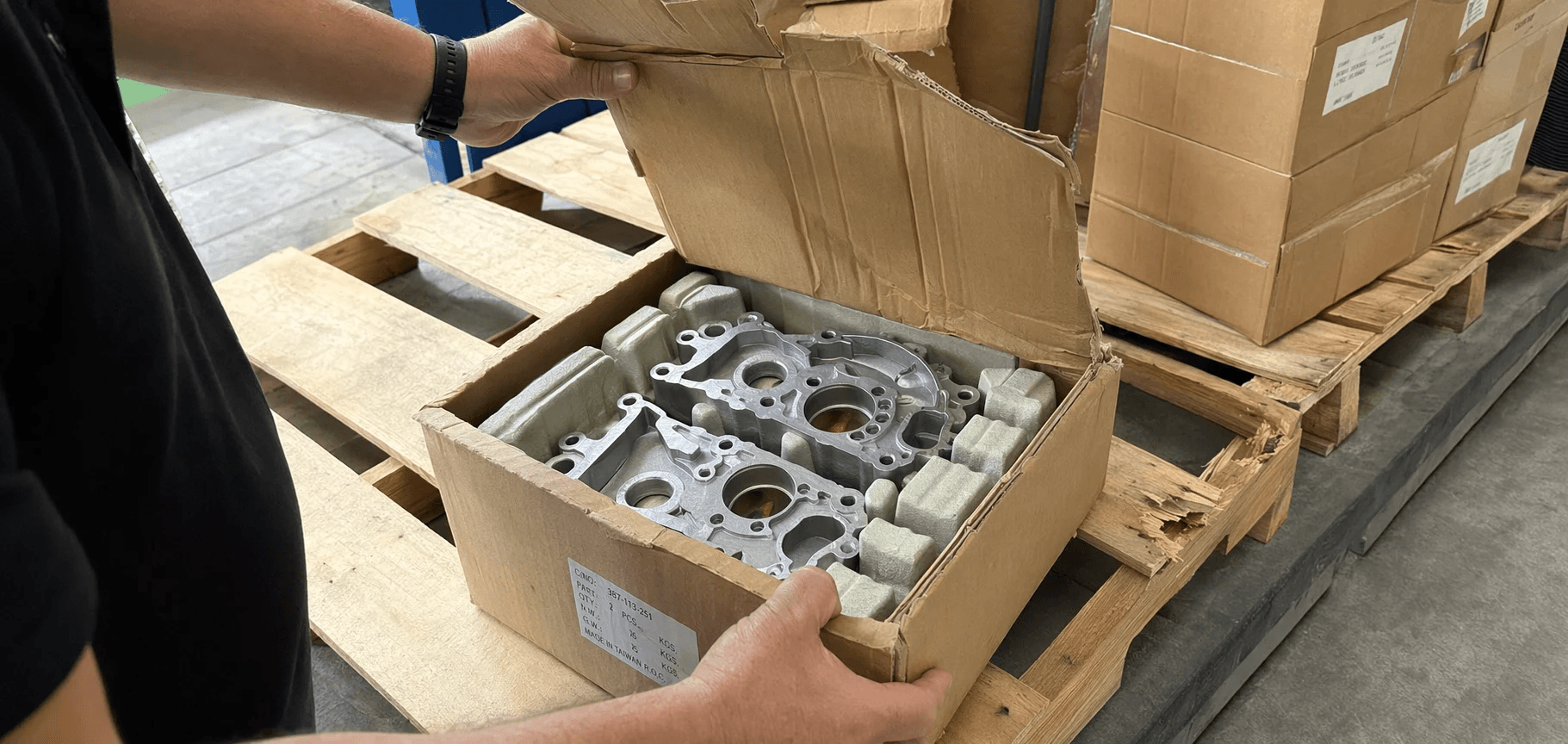
“All three pallets of die-cast parts are rejected. We need three new pallets — fully dimensionally inspected — by this Friday.”
The message landed in the quality manager’s inbox first thing Monday morning. It came from a European Tier-1 customer, and the tone left no room for negotiation.
The quality manager at the Chinese die-casting foundry felt his stomach drop. These weren’t ordinary production parts. Each and every piece across those three pallets had gone through a brutal selection process and full dimensional inspection — a regimen where every dimension on the drawing, sometimes numbering in the dozens or even hundreds per part, gets measured and verified. The foundry’s CMMs (coordinate measuring machines) had been running around the clock for two solid weeks to get this shipment out. Machines never stopped; operators rotated through shifts. The reason for the urgency? The OEM was scheduled to arrive at the Tier-1’s plant the following week to witness the completed assemblies and sign off on the automotive component.
And now, because the outer packaging had taken a beating somewhere along a cross-border logistics chain, three pallets of high-value, painstakingly inspected parts had been pushed to the edge of a cliff — full return, full rework, and possibly enormous compensation claims and a shattered commercial relationship if things went wrong.
The foundry’s gut reaction was entirely understandable. “First, the timeline is impossible — we’re in pilot production, there isn’t enough die-cast inventory lying around, the full inspection cycle time is what it is, and air freight still takes days. Second, every part passed dimensional and functional outgoing inspection at our facility. The problem’s the cartons, not the parts — can’t they just be used as-is?” But the customer’s quality engineer, sitting in Germany, was ice-cold and immovable: damaged packaging means the shipment endured unknown physical shocks during transit. The risk is unquantifiable. The OEM is coming next week for testing and audit. Usable parts must be on the assembly line this Friday. No exceptions.
The conversation had hit a brick wall. That’s when the call came through to NaiSiTong. Within hours of receiving the service request, our engineer was on the phone with the customer — not drafting another email, not waiting for a written reply. A direct call. A time locked in. A flight booked.
The Industry Paradox: Why a Fortune Spent on Full Dimensional Inspection Can’t Survive a Damaged Box
To understand the frustration the foundry felt at that moment, you need to grasp a fundamental tension in the automotive supply chain.
Full dimensional inspection isn’t your standard in-line spot check. It’s a grueling, exhaustive process where every dimension on the part drawing — anywhere from a few dozen to well over a hundred — gets measured individually. The investment in manpower, machine time, and quality engineering hours is enormous. The entire point of the exercise is to produce the hardest possible dimensional evidence: rock-solid data that proves every part conforms to spec.
And yet, all of that hard evidence got vetoed in a single stroke. By a dented cardboard box.
Here’s the thing: from the European Tier-1’s perspective, this logic isn’t nitpicking or obstructionism. When an incoming inspector sees a crushed carton, the questions racing through their mind go far beyond “are the dimensions still correct?” They’re asking: “Did the part inside suffer impact damage? Is there a micro-crack I can’t see with the naked eye? Could this fail in the field six months from now?” Nobody — not the inspector, not the quality engineer who signs the release, not the production manager who feeds the part into the assembly line — wants to carry the liability for that kind of unknown risk.
The gap between these two perspectives is precisely where quality crises are born. The foundry has data that proves the parts were good when they left the factory. The customer has physical evidence that something bad happened in between. Neither side is lying. Neither side is being unreasonable. But the burden of proof has shifted entirely onto the supplier.
At this point, there is only one way forward: you have to stand in front of the actual shipment, open the boxes, and turn “fuzzy risk” into concrete, itemized facts. There is no substitute for physical presence.
On-Site Inspection: Three Pallets, Three Radically Different Fates
By the afternoon of the same day the complaint landed, a NaiSiTong engineer was standing in the Tier-1 customer’s warehouse in Germany. The three pallets sat in the customs holding area, untouched. Our engineer went to work, performing a meticulous grading assessment of the damage on each pallet.
What emerged was not one problem but three entirely different ones:
-
Pallet One: Light corner scuffing. The wooden pallet frame was intact. Every carton was essentially pristine — only one carton showed a minor scuff mark on a corner edge, with zero deformation or compression anywhere. Our engineer compared this pallet side-by-side with other inventory already sitting in the customer’s warehouse. The packaging condition was no worse — in some cases, better — than stock that had already been accepted and put away. This pallet, on physical evidence alone, was clearly safe.
-
Pallet Two: Minor carton corner damage. The outer master carton showed slight crushing and deformation at one corner. Through the small opening, you could glimpse the inner PE bag — which appeared completely undisturbed. No tears, no punctures, no sign that anything had reached the parts inside. But the carton damage was real, and it was enough to raise legitimate questions that photos alone could never answer.
-
Pallet Three: Severe damage, re-packed by the logistics company without authorization. This was the worst pallet — and the most dangerous one. While our engineer was en route to the warehouse, the foundry had confirmed with the freight forwarder: this pallet had been accidentally struck during forklift handling at a transit hub, causing the original packaging to rupture. The logistics company, acting entirely on its own initiative and without informing anyone, had replaced the outer packaging. They’d taken the parts out of their crushed original cartons and stuffed them into new, unmarked boxes.
This third pallet was a black box. Nobody knew what sequence the parts had been in, what they’d hit during the accident, or who had handled them during the re-pack. The original damaged cartons — the ones that could have told the story — were gone.
The Core Negotiation: Tiered Disposition — Persuade with Facts, Not Pleas
Armed with first-hand physical evidence, our engineer didn’t rush to announce conclusions. Instead, they walked the Tier-1’s quality engineer (QE) through a structured, tiered disposition proposal — a negotiation framework that is the hallmark of professional automotive supply chain crisis management.
⚠️ Three Pallets with Transport Packaging Damage
│
┌─────────────┼─────────────┐
▼                           ▼                           ▼
[Pallet 3: Unauthorized       [Pallet 2: Outer Carton      [Pallet 1: Light
 Re-pack by Logistics]         Damage]                      Scuffing Only]
│                           │                           │
Proactive SCRAP              Customer Lab Sampling        On-the-Spot
Recommendation               & Validation                 Verification & Release
│                           │                           │
⚖️ Verdict: Traceability     ⚖️ Verdict: Release only     ⚖️ Verdict: Batch
 broken → eliminate risk      if all data passes           comparison passes → release
Pallet Three: Proactive Scrap Recommendation
This is the move that caught the customer off guard.
Our engineer was the one who brought up scrapping Pallet Three — before the customer had to ask, before anyone had to posture or negotiate. The reasoning was airtight: the logistics company’s unauthorized re-packaging had severed the traceability chain completely. The original damaged cartons had vanished. The parts had been pulled out of their proper sequence and stuffed into generic replacement boxes. Who did it? At which transit node? What did the parts experience between the forklift impact and the re-pack? All of those answers were gone — and they were never coming back.
In automotive quality, when traceability is broken, the part is dead. Any judgment of “it’s probably fine” is irresponsible. There is no “probably” in a supply chain where the end customer is an OEM signing off on safety-critical assemblies.
By proactively calling for scrap on this pallet, our engineer demonstrated something far more valuable than saving a few thousand euros’ worth of parts: an absolute, non-negotiable reverence for the automotive quality baseline. The message was unmistakable — NaiSiTong and the foundry behind it would rather eat the loss on a pallet than ask a customer to accept risk they couldn’t see.
Pallet Two: Bring in the Customer’s Own Lab — Let Their Equipment Be the Judge
The carton damage on Pallet Two was real but superficial — the inner PE bags were intact. Our engineer proposed a solution the customer couldn’t refuse because it placed them in complete control:
“Your lab technicians perform the inspection. One hundred percent inspection of parts from the area where the carton was damaged. For the rest of the pallet, random-sample three pieces from every layer. Run them through your own CMM and leak tester. If every single data point comes back within spec, the entire pallet is accepted.”
This proposal was surgically precise in neutralizing the customer’s psychological defenses. First, the data would come from the customer’s own equipment — there was zero “supplier trying to prove their own innocence” trust deficit. Second, layer-by-layer stratified sampling carries extremely high statistical confidence: if damage had propagated through the pallet during transit, a per-layer sample would catch it. If every layer tested clean, the probability that hidden damage lurked elsewhere was vanishingly small.
The customer’s QE agreed on the spot. The parts went to the lab. Every measurement passed. The pallet was released.
Pallet One: Comparative Verification, Signed Off Immediately
This pallet was the easiest call — but only because our engineer was physically present to make it.
The pallets already sitting in the customer’s warehouse as accepted inventory had packaging that looked similar, and in some cases worse, than Pallet One’s condition. Pallet Two, from the same shipment batch, had demonstrably worse packaging and yet its parts had just passed a full lab validation. The logic was inescapable: if Pallet Two’s parts — shipped in worse packaging — were fine, then Pallet One’s parts — shipped in nearly pristine packaging — were beyond question.
Our engineer opened a carton on the spot, pulled out a micrometer, and spot-checked critical dimensions right there in the warehouse. All readings fell comfortably within tolerance. The customer’s QE handled the parts himself, inspected the packaging corners himself, and nodded.
The release form was signed right there. No lab, no delay, no drama — just a straightforward technical judgment backed by evidence anyone could see with their own eyes.
The Outcome: Two Out of Three Pallets Saved
The case closed with a surgically precise disposition: one pallet scrapped, one pallet validated and released, one pallet released outright. Two-thirds of an irreplaceable, high-value air-freight shipment was saved.
For the Chinese foundry, the strategic value was enormous:
-
Losses cut by 66%. The foundry didn’t just save the cost of re-manufacturing those parts from scratch — which, given the full dimensional inspection requirement and pilot-phase constraints, would have been ruinously expensive. They also kept the customer’s assembly line fed with enough confirmed-good parts within the golden delivery window, averting what could have been a catastrophic line stoppage with the OEM auditor standing right there. The downstream financial exposure — line-down penalties, expedited re-manufacturing, emergency air freight for a second shipment — was measured in the hundreds of thousands of euros. Two pallets made all of that go away.
-
Trust went up, not down. The Tier-1 team saw something they don’t often see from overseas suppliers: a crisis-handling capability that was fast, technically rigorous, and utterly professional. No deflecting. No begging for concessions. No “trust me, it’s fine” emails. Just an engineer on the ground within 24 hours, a data-driven tiered disposition framework, and the integrity to proactively scrap a pallet when the evidence demanded it. That level of supply-chain emergency response maturity is rare, and it gets remembered.
Three Replicable Moves for Automotive Complaint Handling
Looking back at how this situation went from “lose everything” to “save two-thirds,” NaiSiTong got three things decisively right. Each one is replicable.
Move One: Make the First Contact a Phone Call, Not an Email Thread
When a customer issues a blanket rejection, firing off an email only forces them to double down on their defensive position in writing. Every paragraph they type becomes a commitment they now have to defend internally.
The purpose of that first phone call is not to debate. It’s to strip away the emotion, confirm the real basis for the customer’s judgment, and lock in an on-site visit time — that same afternoon if humanly possible. In a supply chain crisis, speed is the most professional signal you can send. A quality engineer who answers the phone and hears “I’m booking a flight — I’ll be at your warehouse this afternoon” is already in a different conversation than the one who receives yet another supplier email asking for photos and measurements.
Move Two: On Site, Decompose the “Monolithic Blur of Risk” into Independent Fact Units
“Scrap the whole batch” is the easiest decision an incoming inspection team can make. It carries zero personal liability. Nobody ever got fired for rejecting everything.
But when you walk into that warehouse with a disciplined tiered framework and stand in front of the actual goods — breaking “the shipment” down into three independent pallets, then into individual cartons, then into layers, then into single parts — the fuzzy, monolithic risk that justified a blanket rejection dissolves into granular, manageable fact units. Now you’re not arguing about “the shipment.” You’re looking at Pallet One, Pallet Two, and Pallet Three, each with its own story and its own evidence. Separating real risk from phantom risk — that’s the core value of showing up in person.
Move Three: Hand the Referee’s Whistle to the Customer’s Own Metrology Lab
In any cross-border quality dispute, any report generated by the supplier’s own facilities carries an inherent conflict of interest. It doesn’t matter how rigorous the testing was or how honest the data is — the optics are bad, and the trust deficit is baked in.
The smartest move in the playbook is to use the customer’s own equipment to validate your quality. When parts come off the customer’s CMM and the customer’s leak tester with green lights across the board, nobody needs to vouch for anyone. The data speaks for itself, and it speaks in a language the customer’s own quality system is built to trust.
The automotive supply chain isn’t a battleground of blind arguments. It’s a system of rules, data, and dynamic equilibrium. The supplier who understands that — and brings the data to prove it — wins.
The next time a shipment of your high-value, air-freighted die-cast parts lands in Europe with packaging damage and a Tier-1 customer demands a blanket return, don’t rush to accept the loss and don’t waste time pleading your case over email.
Book a flight. Or better yet, reach out to NaiSiTong.
Our technical team is permanently based in Germany. We can put an engineer at your pallets within 24 hours — someone who will separate real risk from phantom risk with clinical precision, defend the value your factory worked so hard to create, and earn your customer’s trust in your quality crisis management capability in the process.
Contact us at Joseph@NaiSiTong.com.