
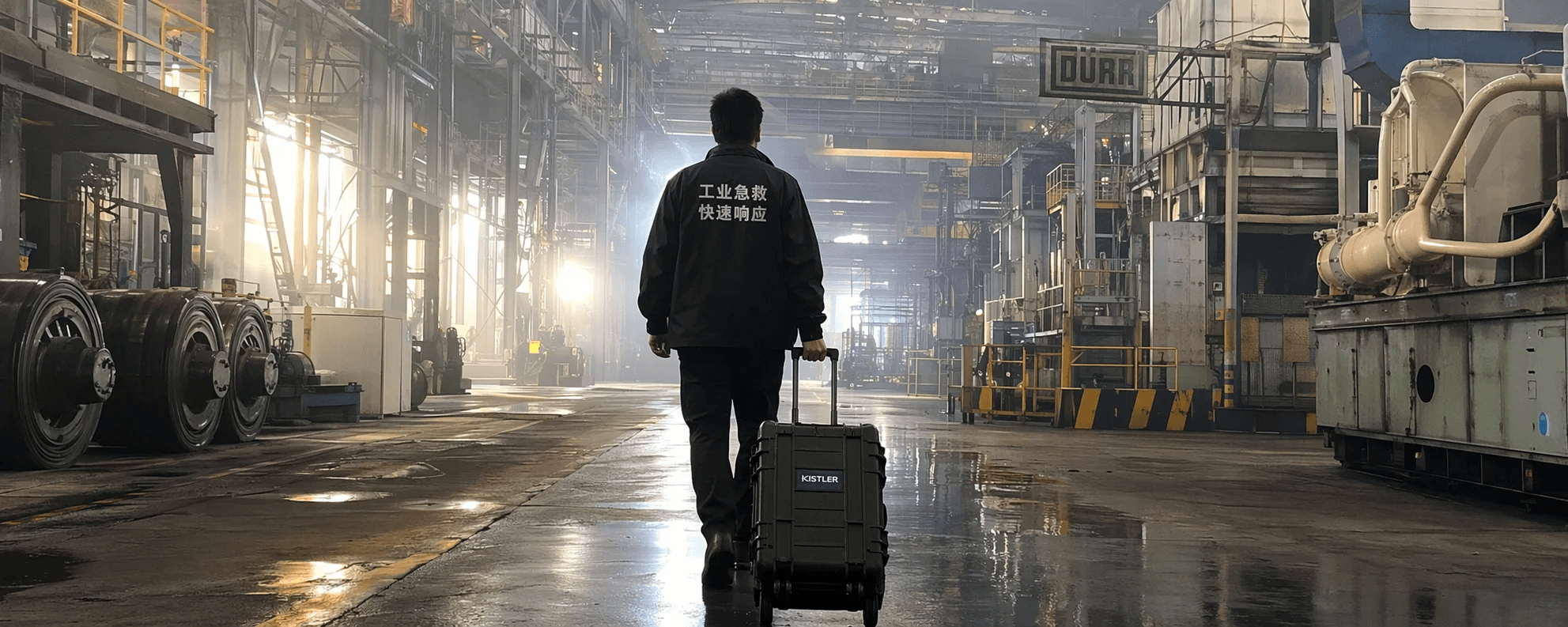
“We have incoming inspection piling up. Our assembly line is consuming 500 housings a day, and we’re running out of cleared stock. I need someone here — now.”
The caller was the quality manager of a German Tier-1 automotive supplier, and it was the spring of 2020. Borders were slamming shut across Europe. Factory floors were being reconfigured overnight to keep operators a meter and a half apart. And somewhere in southern Germany, a 24×7 assembly line was about to stall because nobody could inspect aluminum die-cast housings fast enough to feed it.
The part in question was a structural housing — aluminum, die-cast, with critical sealing surfaces, precision assembly reference faces, and cosmetic requirements that mattered to the OEM. Every housing had to be hand-inspected before it could touch the assembly line. The supplier had production capacity. What they didn’t have was inspection throughput.
The structural mismatch was brutal: the assembly line ran seven days a week, 24 hours a day, consuming roughly 500 parts daily — 3,500 per week, minimum. But the incoming inspection team operated on a standard five-day schedule. Five days of sorting had to cover seven days of consumption. Every weekend, the line burned through 1,000 parts with zero inspection output. By Monday morning, the buffers were empty and the line was running hand-to-mouth.
That math doesn’t work. The customer’s quality manager knew it. That’s why he called NaiSiTong.
📊 The Calculation: Space, Hours & Personnel Triple Deadlock
When our engineer arrived on-site, three constraints hit immediately — and none were negotiable.
The first was physical space. The customer’s incoming-inspection area could fit exactly nine workstations. Not ten. The layout was fixed — lighting rigs, inspection tables, calibrated gauges, parts racking, COVID-separated walkways. Adding a tenth station would require moving a wall, and nobody was doing construction during a pandemic. Nine people, maximum.
The second was working hours. This wasn’t just German labor law — the Arbeitszeitgesetz actually permits up to ten hours per day when averaged over six months. The constraint was tighter: a Betriebsvereinbarung, a works council agreement specific to that factory, capping all workers — including third-party contractors like NaiSiTong’s team — at eight hours a day, forty hours a week. No exceptions without formal approval, and approval meant going through the works council.
The third was personnel mobilization — the kind of logistical feat that doesn’t show up on a spreadsheet. In mid-2020, skilled sorting staff were dispersed across multiple cities and projects. Coordinating nine people to extract themselves from ongoing assignments, navigate the patchwork of COVID travel restrictions and quarantine rules, and physically converge on a single warehouse by 07:00 the next morning was a one-shot operation with zero margin for error. One person stuck at a checkpoint or held up by a quarantine order, and the full crew wouldn’t reach nine — which meant the 3,500 target was dead before a single part was inspected.
Now run the numbers. Our historical benchmark for this type of aluminum die-cast housing — checking sealing surface flatness, thread integrity, assembly reference dimensions, and cosmetic defects — was 80 inspected parts per person per day. That’s a real number, derived from years of sorting operations, not a theoretical maximum.
Nine people × 80 parts per day × 5 days = 3,600 parts per week.
Weekly consumption = 3,500 parts.
On paper, a surplus of 100. In reality? A deadlock waiting to happen. Here’s why.
🏃 Phase 1: Same-Day Response
The call came in the morning. By that afternoon, a NaiSiTong senior engineer was on a flight. This was mid-2020 — COVID tests at both ends, border paperwork, quarantine uncertainty. The engineer packed PPE, inspection tools, and a healthy supply of patience.
He walked onto the customer’s factory floor before the evening shift change.
Most crisis-response stories start with action. This one started with listening. The engineer spent the first day doing exactly three things: watching the existing inspection process end to end, talking to the quality engineer who’d been losing sleep over the backlog, and counting — parts in, parts out, dwell time at each workstation, defect categories, everything.
He made no promises on day one. No “we’ll fix this.” No “trust the process.” Just a clipboard, a stopwatch, and a willingness to understand the problem before prescribing a solution. The customer’s quality engineer later told us that was the moment he knew this wasn’t going to be a typical vendor relationship.
“When your guy showed up the same afternoon and didn’t try to sell me anything — just asked questions and wrote things down — I knew you were serious,” he said.
Behind the scenes, while the engineer was on site assessing the situation, another operation was unfolding: NaiSiTong’s dispatch team was working the phones into the night, pulling nine skilled inspectors off active projects across three different cities. Coordinating handovers, confirming cross-city travel eligibility under shifting COVID rules, and lining up accommodation — all before the last train left the station. By 07:00 the next morning, all nine were standing at their workstations. In the Germany of 2020, nine people showing up at the same place at the same time was a case study in its own right.
📝 Phase 2: Run One Day, Expose the Hidden Crisis
Day one data validated the 80-parts-per-person benchmark. But it also surfaced three problems that the clean spreadsheet math didn’t capture.
Problem one: first-day ramp-up. Nine people don’t walk onto a new production line and hit full speed by 09:00. Different defect catalog, unfamiliar part geometry, new go/no-go gauges, a quality standard you have to internalize. The first day produces closer to 60–65 parts per person, not 80. Every person brought in late needs their own ramp-up day too. That’s baked-in inefficiency the weekly math didn’t account for.
Problem two: the weekend consumption gap. The assembly line doesn’t stop on Saturday and Sunday. It burns through roughly 1,000 parts over the weekend. Sorting restarts Monday at 08:00, but the line needs parts at 06:00. Every Monday morning opened with a two-hour panic — line supervisors pulling partially-cleared stock, expediting individual parts, making phone calls. That’s not a supply chain. That’s gambling.
Problem three: COVID black swan risk. Nine people in the warehouse today. What happens when one tests positive tomorrow? Or two? Under 2020 protocols, that could mean the entire sorting team gets sent home. Seven people × 80 × 5 = 2,800 parts. Against 3,500 needed. The line stops. The German Tier-1 calls their OEM. The OEM calls everyone. This wasn’t a remote possibility — it was happening in factories across Europe.
Our engineer laid the data out for the customer’s quality engineer on a single sheet of paper. The conclusion was unambiguous: the nine-person, 40-hour baseline could barely keep pace under perfect conditions, and conditions were never going to be perfect. They needed overtime. Specifically: one extra hour on weekdays, a full eight-hour Saturday shift, for at least the first week — to build a safety stock buffer that would insulate the assembly line from the Monday-morning gap and absorb a COVID-induced personnel loss.
🤝 Phase 3: Leverage Data to Push Through Overtime Approval
This is where most external service providers stop. “You need overtime.” “Great, good luck with your works council.” They hand over the recommendation and wait.
NaiSiTong’s approach was different. Our engineer understood that getting overtime approved in a German factory with an active works council isn’t a one-step conversation. It’s a campaign. And campaigns need strategy, data, and the right messenger.
The strategy had three stages.
Stage one: convince the quality engineer. This was straightforward — he’d been living the problem for weeks. He saw the Monday-morning panic firsthand. The data confirmed what he already suspected. He was on board within the hour.
Stage two: convince the quality manager that no alternative exists. The quality manager was the gatekeeper. His question was obvious: “Can’t we just work faster? Train people better? Rotate shifts?” Our engineer had the numbers ready. Physical workstation cap. Ramp-up curve. Weekend consumption. COVID risk multiplier. Each objection had a data point waiting. The conversation shifted from “should we apply for overtime?” to “the data says overtime is the only viable path — here’s the evidence package you take to the works council.”
Stage three: the quality manager takes the case to the works council and factory management. This is the critical move. An external Chinese service provider walking into a German works council meeting to request overtime? That doesn’t work. It never works. The messenger has to be internal — someone the council trusts, someone who carries organizational credibility. The quality manager was that person. He walked into the meeting with NaiSiTong’s data in his hand and the authority of someone whose assembly line was at risk. The proposal: nine workers, one extra hour Monday through Friday (bringing the day to nine hours, well within the Arbeitszeitgesetz limit of ten), plus eight hours on Saturday — a temporary variance to the Betriebsvereinbarung, scoped to one week with a review point.
The works council approved it. They understood the situation, they saw the data, and they knew the quality manager wasn’t asking lightly.
That’s the leverage model: NaiSiTong provides the ammunition. The internal ally fires the shot.
⚙️ Phase 4: Execute Overtime Plan, Close the Gap in One Week
With approval in hand, execution moved fast.
The weekday schedule shifted to nine hours: 07:00 to 17:00 with a one-hour break. Saturday ran a full eight-hour shift — 07:00 to 16:00. That gave the team 53 working hours per person per week instead of 40.
Nine people × nine hours weekdays = roughly 10 parts per person-hour sustained × 9 hours × 5 days = 405 parts per person per week. Plus Saturday: 10 × 8 × 9 = 720 parts. Total weekly output under the overtime plan: approximately 4,365 parts, against a consumption of 3,500. That’s a surplus of 865 parts per week — safety stock accumulating daily.
But output targets mean nothing without execution rigor. Our engineer instituted three disciplines for the overtime period:
Hourly efficiency monitoring. A simple whiteboard at the sorting station, updated every 60 minutes: parts inspected by person, defect rate, accumulated total. Low performers got immediate coaching. High performers got rotated to buddy-train newer team members. No one waited until end-of-day to discover they were behind.
Standard alignment across all nine workstations. On day one, the engineer documented exactly how the best inspector worked — lighting angle, part orientation sequence, gauge order, defect marking convention. By day two, every workstation ran the same sequence. Variability between inspectors dropped sharply.
Daily handover to the quality engineer. A five-minute stand-up at 16:45 each day: output vs. target, new defect patterns spotted, any personnel issues, next-day adjustments. The customer’s quality engineer had full visibility without micromanaging.
COVID protocols ran in parallel: mask discipline, station spacing, surface sanitization between shifts, daily temperature checks. One positive case would trigger quarantine for the entire team — the very risk the overtime plan was designed to outrun. Protocol adherence wasn’t optional.
By the end of the first week, the team had built a buffer of over 800 cleared parts — enough to cover an entire weekend’s consumption with margin to spare. Monday morning arrived without panic. The assembly line ran uninterrupted. The quality manager called our engineer with two words: “It worked.”
💡 Core Takeaways
1. Know your real constraints — they’re not always the law.
Everyone assumed German labor law capped working hours at eight per day. It doesn’t. The Arbeitszeitgesetz allows ten. The real constraint was the Betriebsvereinbarung — the works council agreement at that specific factory. If our engineer had accepted “eight hours, it’s the law” as fact, the proposal would never have been written. Understanding the difference between statutory limits and contractual limits — and knowing which one you can negotiate — is the difference between solving the problem and being stopped by a phantom barrier.
2. Space can be a harder constraint than hours.
You can negotiate overtime. You can’t negotiate physics. Nine workstations meant nine workstations. Every productivity improvement had to come from within that footprint — process design, training, standard work, monitoring cadence. When you walk into a European factory, measure the physical space first. The floor plan might be your tightest bottleneck, and it’s the one you can’t talk your way around.
3. Find and empower your internal ally.
You cannot walk into a German factory as an external contractor and convince the works council of anything. You need someone inside — a quality manager, a plant director, a production lead — who can carry your data into the rooms you can’t enter. Your job is to make that person’s case unassailable. Give them the numbers, structure the argument, anticipate the objections. Then get out of the way and let them advocate. The quality manager in this case wasn’t just a customer — he was the lever that moved the entire organization.
4. Safety stock is insurance, not cost.
The overtime hours added direct labor cost. But the alternative — a stopped assembly line at a Tier-1 supplier feeding a major German OEM — would have cost orders of magnitude more in penalties, expedited freight, and reputational damage. The 800-part buffer wasn’t wasted inventory. It was the premium on a policy that paid out the following Monday morning. In just-in-time supply chains, a buffer is the difference between a crisis and a non-event.
Facing a sorting bottleneck at your European customer’s facility? NaiSiTong deploys engineers same-day, understands local labor agreements, and has the data discipline to make your internal advocates unbeatable. Contact us before Monday morning panic becomes a line stoppage.
#ChinaManufacturing #DieCastingSupplyChain #GermanWorksCouncil #OnSiteSorting #QualityCrisis #NaiSiTong