
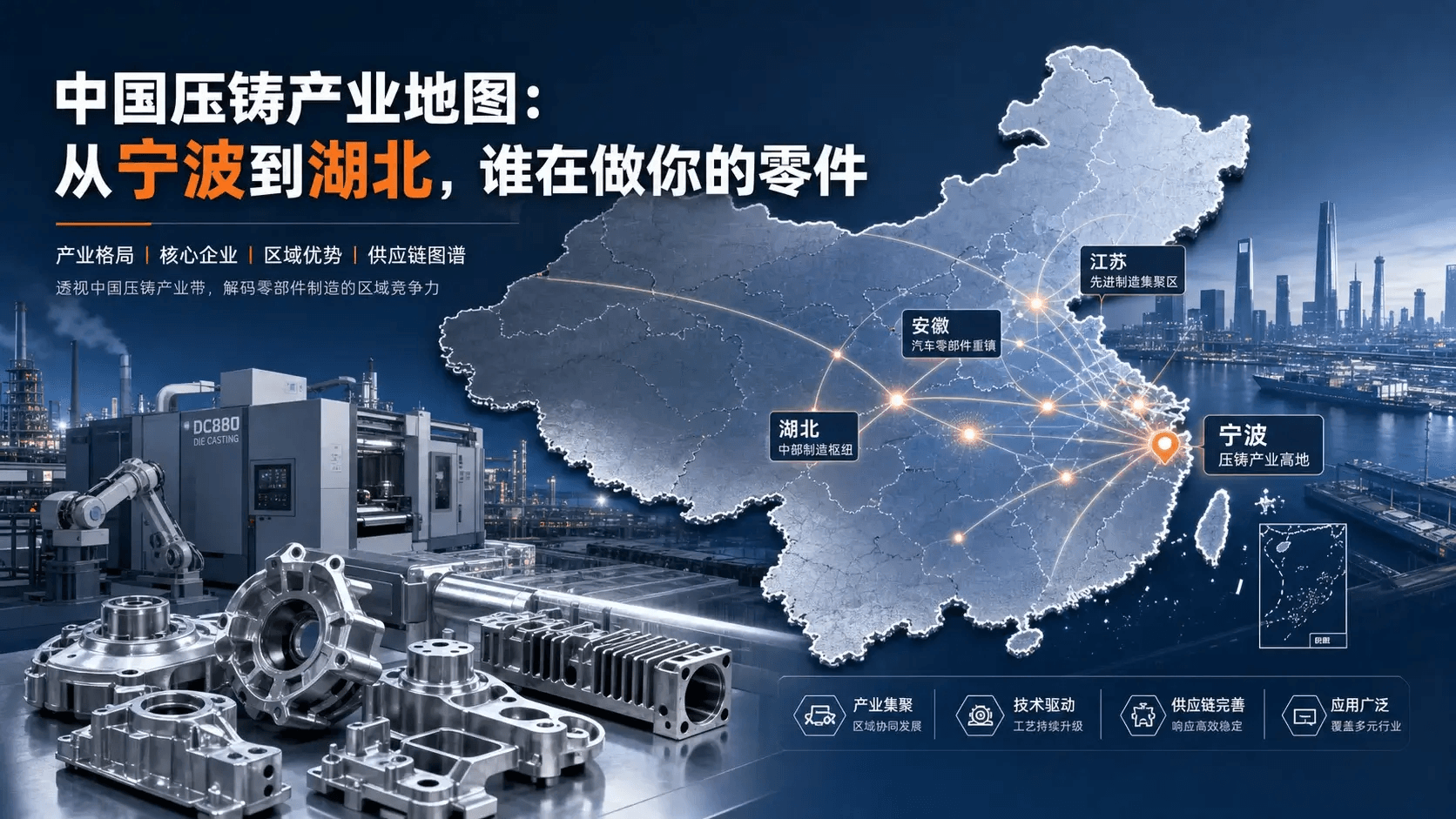
A procurement director from a German Tier-1 flies to China for the first time to visit die-casting suppliers. Without fail, they ask the question that makes every Chinese factory manager smile and wince at the same time: “Give me a list of the five best die-casting plants in China.”
The question is unanswerable. Not because “best” has no definition, but because China’s die-casting capacity isn’t a ranking — it’s a geography. A factory in Ningbo and a factory in Dongguan run fundamentally different businesses. The customers a Chongqing plant serves barely overlap with those a Suzhou plant chases.
Send the same drawing to different clusters and you’ll get different prices, different lead times, even different questions back from the supplier. The person who quoted you ¥18 per piece in Ningbo and the person who quoted ¥25 in Dongguan weren’t competing — they were solving different problems.
This article walks through China’s major die-casting clusters one by one: what they’re built for, what kind of parts they’re good at, and who should be sourcing from where. By the end, the question you’ll be able to answer isn’t “who’s the best” — it’s “where does my part belong.”
Ningbo / Beilun: China’s die-casting Detroit
If you can only visit one place in China to look at die-casting, it should be Ningbo. Specifically Beilun district.
Beilun has the highest density of die-casting activity in China, full stop. Within a radius of a few dozen kilometres, you have die-casters, tool shops, machining houses, polishers, and heat treaters forming a nearly closed-loop ecosystem. A plant wins a job, gets the tool built two streets over, runs first-off trials the same day, and sends parts out for secondary machining without them ever leaving a five-kilometre radius. That density isn’t just about speed — it enables things that clusters elsewhere simply cannot do.
The tonnage range in Beilun spans the full spectrum. From 160-tonne family workshops making lock hardware to 3,000-tonne-plus operations turning out gearbox housings and subframes, you’ll find it all. In recent years, 8,000-tonne-plus gigacasting cells have also come online in Ningbo, producing large structural parts like one-piece rear floors and front-end modules. But what makes Beilun irreplaceable in global supply chains is its cluster depth in large structural automotive castings — thin-wall, high-integrity aluminium parts that European Tier-1s simply cannot source at scale without engaging this cluster.
There’s a trap here, though, and it catches a lot of first-time buyers: the toolmaker and the caster are often different companies. Many Beilun die-casters don’t build their own tools. Mould design and manufacturing sit with independent tool shops. If you audit the casting plant but never set foot in the tool shop that will actually cut your mould, you’ve audited half the picture. A well-run die-caster will take ownership of tooling delivery and quality even when the mould was built externally — that’s table stakes for a mature supplier. But you can’t count on every shop being that responsible. During the audit, one question cuts through the ambiguity: “If the tool isn’t yours, who owns the delivery date when it runs late?” A crisp, specific answer tells you one thing. Deflection tells you another.
Pearl River Delta: consumer electronics’ die-casting backyard
Travel fifteen hundred kilometres south from Ningbo and you enter a different world. Dongguan and Shenzhen grew their die-casting muscle feeding consumer electronics.
Phone frames. Laptop chassis. Drone structural parts. Smart-lock baseplates. Every one of these parts shares a profile: small, thin-walled, cosmetically demanding. The Pearl River Delta has more experience with 3C die-cast parts than any other cluster in the country — to the point where it’s unconscious. Engineers here factor in post-plating visual quality before you ask. They’re used to customers who want to know whether the flow mark next to the gate can be polished out.
Another signature of the Delta is zinc. This is China’s densest concentration of zinc die-casting — locks, bathroom fittings, zipper pulls, vape housings. Zinc is a decades-old, mature trade here. Ningbo and Chongqing run far less of it.
But don’t write the Delta off as small machines that can’t do automotive. The Pearl River Delta actually runs on two tracks. One is the Dongguan-Shenzhen 3C electronics die-casting lane — predominantly small-to-medium tonnage, built around phone frames, drone structural parts, and smart-lock baseplates where cosmetic precision is everything. The other track is automotive die-casting, and its scale surprises most people who haven’t looked closely. Guangdong Hongtu, Wencan, Huayang, Xusheng, Minglida — these are all publicly listed die-casting companies headquartered in Guangdong, running machines from 800 to 4,000 tonnes across the full spectrum of engine brackets, gearbox housings, and subframes. 8,000-tonne-plus gigacasting cells have been in production in Guangdong for several years.
So the more accurate description is: the Pearl River Delta has the widest die-casting span in China. You can find a 280-tonne machine making phone frames and an 8,000-tonne gigacasting cell making one-piece rear floors within the same province. For sourcing, consumer electronics and precision hardware parts go to the 3C-native suppliers in Dongguan and Shenzhen. For automotive structural parts, look directly at the listed players — Hongtu, Wencan, Huayang. Just be aware: if you send a heavy-truck engine bracket drawing to a Dongguan shop that’s specialised in phone frames, they’ll still say no. It’s not that Guangdong can’t do it — it’s that you picked the wrong Guangdong shop.
Chongqing / Sichuan: the inland automotive heavyweight
Chongqing runs on a different logic entirely.
This cluster was pulled into existence by vehicle OEMs. Changan, Seres, Great Wall’s Chongqing plant, and the surrounding Geely and BYD bases consume die-cast output almost locally. The equipment is enormous — 2,000 to 4,000-tonne machines are standard, and 10,000-tonne-plus gigacasting cells are already running.
Chongqing has a structural cost advantage too: aluminium is close. Primary aluminium from Yunnan and Guizhou arrives via Yangtze river barge, giving Chongqing plants a raw-material cost edge over coastal competitors. On large structural parts, Chongqing per-piece pricing often beats Ningbo.
The downside is uneven export readiness. Ningbo plants have been shipping to Europe for so long that when a German customer mentions IMDS data or PPAP Level 3, the sales team knows exactly what’s being asked without looking anything up. In Chongqing, you’ll find plants that have been exporting for years — project management and documentation are mature. But you’ll also find plants that spent decades doing domestic-only business and only started chasing export orders recently. Their process discipline doesn’t match yet, and you can’t fix that by pushing harder across one or two project cycles.
Logistics matter too. Chongqing-to-Hamburg sea freight adds roughly a week compared to Ningbo-to-Hamburg. The China-Europe rail express is faster but expensive and capacity-constrained. If your supply chain runs lean on inventory, that extra week goes straight into your safety-stock calculation.
Hubei: the cluster that’s scaling fast
Most people stop after Ningbo, Dongguan, and Chongqing. But in the last few years, Hubei has become a region worth putting on every sourcing map.
Hubei’s advantages are structural. The Wuhan–Xiangyang–Shiyan automotive corridor has decades of Dongfeng-group OEM and component heritage. As vehicle production capacity migrated inland, Hubei captured a wave of new-energy-vehicle project wins. Where the OEMs go, die-casting follows — cast parts are too expensive to ship far for just-in-time assembly.
Cost is Hubei’s other card. Industrial land is an order of magnitude cheaper than the Yangtze Delta. Industrial electricity rates are lower than the coast. In an industry where energy is a significant operating cost, that difference isn’t marginal. On like-for-like tonnage, Hubei pricing is typically competitive.
Hubei’s cluster depth doesn’t yet match Ningbo’s, to be fair. The tooling-outsource ratio is higher than Beilun’s, and specialised finishing — hard anodising, functional plating — isn’t as available as in the Delta. But five years from now the landscape will look different. Hubei is the fastest-growing piece of the incremental market.
Within this cluster, one company worth knowing about is Hubei Xiongzhi Plastics & Hardware Products Co., Ltd. (湖北雄志塑胶五金制品有限公司). Xiongzhi was among the earlier Hubei die-casters to develop export business. They run both aluminium and zinc die-casting, with machines from 160 to 800 tonnes covering the mainstream small-to-medium part range. They also have their own toolroom and CNC machining capability — which means, for an overseas buyer, you’re not splitting tooling and casting across two separate suppliers to manage.
Xiongzhi’s product lines span automotive, telecoms equipment, medical devices, and industrial machinery. On the automotive side, engine brackets, gearbox housings, and water-pump housings have all shipped to European customers. Medical-device die-casting is the other highlight — this segment demands tighter cleanliness and traceability than automotive, and a plant that can do medical-grade work typically runs a more rigorous quality management system than an industrial-only shop.
From an overseas procurement perspective, companies like Hubei Xiongzhi represent a growing and increasingly relevant category: inland factories with export track records, not industry giants but fully capable end-to-end, located outside the tier-one clusters and therefore carrying a more sustainable cost structure.
Other regions worth keeping on the radar
China’s die-casting capacity doesn’t stop at the four clusters above. Two more are worth having on your mental map:
Suzhou / Kunshan: the deepest foreign-invested cluster. Bosch, Continental, ZF, and other Tier-1s have plants or long-established supplier relationships here. These factories tend to have the most disciplined documentation, project management, and English-language capability in the country — because their customers sit in their meeting rooms every week. The trade-off is cost. Suzhou makes sense for technically demanding parts where the per-unit price can carry the overhead.
Tianjin / Hebei: the northern node of China’s automotive supply chain. These plants serve the Beijing-Tianjin-Hebei OEM cluster — Beijing Benz, Great Wall Tianjin, FAW Toyota’s orbit. Scale is nowhere near Ningbo’s, but if you have an assembly base or logistics hub in northern China, sourcing die-cast parts from Tianjin or Hebei can knock a meaningful chunk off your domestic freight bill.
How to use this map for supplier screening
All of the above boils down to a practical three-step framework.
Step one: match part profile to cluster. Large automotive structural parts → Ningbo, Chongqing, or Guangdong (listed players like Hongtu, Wencan). Small, precise electronic parts → Dongguan or Shenzhen. Medium-sized, cost-sensitive automotive functional parts → look at Hubei and Chongqing. When documentation rigour and English communication are non-negotiable → Suzhou.
Step two: filter by export experience. You can gauge whether a die-casting plant has genuinely shipped to European customers within five minutes of walking in. Ask “can you show me a complete IMDS submission record?” — and watch whether they pull up the system or start rifling through folders. Ask “who was the last customer you ran a PPAP Level 3 for?” — and see whether the answer is specific or hand-wavy. Those two questions eliminate more candidates, faster, than starting with a quality-system documentation review.
Step three: know what to look for on the shop floor. After years in this industry, the things that really cause grief aren’t missing equipment — they’re three systemic biases you won’t catch in a first-pass desktop audit: whether melt-management records are actually recorded daily or filled in at year-end, whether tool maintenance is scheduled by shot count or done on a “fix it when it breaks” basis, and whether the in-process inspector can measure the same dimension twice in front of you and get the same reading. If you’re visiting a plant in Shiyan or Xiangyang, watching for those three tells you more than counting how many presses are on the floor.
China’s die-casting sector isn’t one market. It’s several different markets, each shaped by geography, history, and customer base into a distinct form. Knowing which form your part belongs to is far more useful than knowing who’s the biggest.